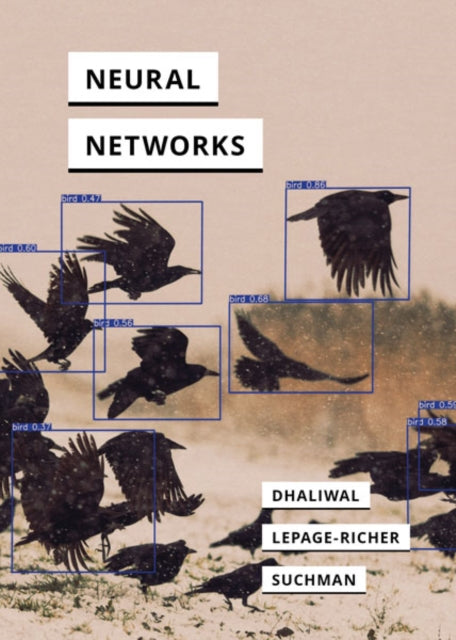
Ranjodh Singh Dhaliwal,Theo LePage-Richer,Lucy Suchman
Neural Networks
Neural Networks
💎 Earn 61 Points (£0.61) on this item.
YOU SAVE £1.61
- Condition: Brand new
- UK Delivery times: Usually arrives within 2 - 3 working days
- UK Shipping: Fee starts at £2.39. Subject to product weight & dimension
Bulk ordering. Want 15 or more copies? Get a personalised quote and bigger discounts. Learn more about bulk orders.
Couldn't load pickup availability
- More about Neural Networks
Neural Networks examines the figure of the neural network as it mediates neuroscientific and computational discourses and technical practices, highlighting the technologization of neurophysiology and the construction of cognition as essentially computational. It explores how countermovements provide resources for thinking otherwise.
Format: Paperback / softback
Length: 110 pages
Publication date: 09 April 2024
Publisher: University of Minnesota Press
Neural Networks: A Critical Examination of the Figure in Neuroscientific and Computational Discourses and Technical Practices
Neural Networks: A Critical Examination of the Figure in Neuroscientific and Computational Discourses and Technical Practices
Neural Networks proposes to reconstruct situated practices, social histories, mediating techniques, and ontological assumptions that inform the computational project of the same name. If so-called machine learning comprises a statistical approach to pattern extraction, then neural networks can be defined as a biologically inspired model that relies on probabilistically weighted neuron-like units to identify such patterns. Far from signaling the ultimate convergence of human and machine intelligence, however, neural networks highlight the technologization of neurophysiology that characterizes virtually all strands of neuroscientific and AI research of the past century. Taking this traffic as its starting point, this volume explores how cognition came to be constructed as essentially computational in nature, to the point of underwriting a technologized view of human biology, psychology, and sociability, and how countermovements provide resources for thinking otherwise.
Neural networks are a biologically inspired model that relies on probabilistically weighted neuron-like units to identify patterns. They have been used in various fields, including machine learning, computer vision, and natural language processing. However, their use has also raised concerns about the technologization of neurophysiology and the potential for human intelligence to be surpassed by machines.
One of the key challenges facing neural networks is the problem of overfitting. Overfitting occurs when a neural network is trained on a limited dataset and performs well on that dataset but fails to generalize to new data. This can lead to poor performance in real-world applications, such as autonomous vehicles or medical diagnosis.
To address overfitting, neural networks have been developed with various techniques, such as regularization, dropout, and batch normalization. Regularization involves adding a penalty term to the loss function to prevent the network from overfitting. Dropout involves randomly dropping out neurons during training to prevent them from becoming too dependent on each other. Batch normalization involves normalizing the input data to a specific distribution before training the network.
Another challenge facing neural networks is the problem of bias. Bias can occur when a neural network is trained on a dataset that is biased in some way. This can lead to the network making incorrect predictions or decisions. To address bias, neural networks have been developed with various techniques, such as data augmentation, adversarial training, and fairness testing.
Data augmentation involves creating new training data by modifying existing data. Adversarial training involves training a neural network to defend against attacks from other networks. Fairness testing involves evaluating the performance of a neural network on different groups of people.
Despite these challenges, neural networks have made significant progress in recent years. They have been used to achieve state-of-the-art performance in various tasks, such as image classification, object detection, and natural language processing. They have also been used to develop new technologies, such as autonomous vehicles and medical diagnosis.
However, the use of neural networks has also raised concerns about the ethical implications of AI. For example, neural networks can be used to automate decision-making processes, which can have negative consequences for individuals. They can also be used to track and monitor individuals without their consent.
To address these ethical concerns, there have been calls for more regulation of AI. For example, the European Union has proposed a set of regulations that would require AI systems to be transparent, accountable, and ethical.
In conclusion, neural networks are a biologically inspired model that relies on probabilistically weighted neuron-like units to identify patterns. They have been used in various fields, but their use has also raised concerns about the technologization of neurophysiology and the potential for human intelligence to be surpassed by machines. To address these challenges, neural networks have been developed with various techniques, such as regularization, dropout, and batch normalization. Despite these challenges, neural networks have made significant progress in recent years and have been used to achieve state-of-the-art performance in various tasks. However, the use of neural networks has also raised concerns about the ethical implications of AI, and there have been calls for more regulation of AI.
Weight: 132g
Dimension: 127 x 180 x 9 (mm)
ISBN-13: 9781517916695
UK and International shipping information
UK and International shipping information
UK Delivery and returns information:
- Delivery within 2 - 3 days when ordering in the UK.
- Shipping fee for UK customers from £2.39. Fully tracked shipping service available.
- Returns policy: Return within 30 days of receipt for full refund.
International deliveries:
Shulph Ink now ships to Australia, Belgium, Canada, France, Germany, Ireland, Italy, India, Luxembourg Saudi Arabia, Singapore, Spain, Netherlands, New Zealand, United Arab Emirates, United States of America.
- Delivery times: within 5 - 10 days for international orders.
- Shipping fee: charges vary for overseas orders. Only tracked services are available for most international orders. Some countries have untracked shipping options.
- Customs charges: If ordering to addresses outside the United Kingdom, you may or may not incur additional customs and duties fees during local delivery.