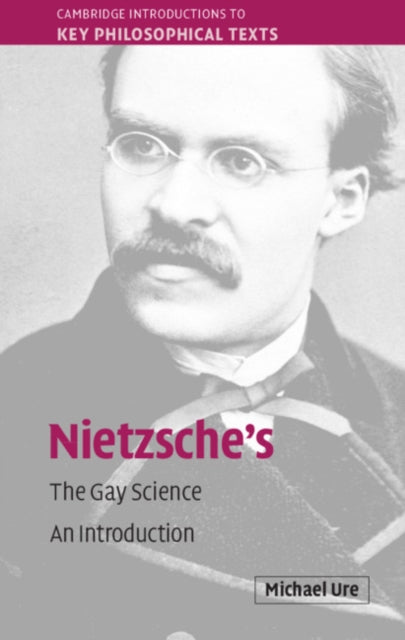
MichaelUre
Nietzsche's The Gay Science: An Introduction
Nietzsche's The Gay Science: An Introduction
💎 Earn 127 Points (£1.27) on this item.
YOU SAVE £1.51
- Condition: Brand new
- UK Delivery times: Usually arrives within 2 - 3 working days
- UK Shipping: Fee starts at £2.39. Subject to product weight & dimension
Bulk ordering. Want 15 or more copies? Get a personalised quote and bigger discounts. Learn more about bulk orders.
Couldn't load pickup availability
- More about Nietzsche's The Gay Science: An Introduction
Nietzsche's The Gay Science is a philosophical autobiography that communicates his experience of overcoming pessimism and recovering the capacity to affirm joyfully the tragedy of life. It articulates his famous philosophical concepts and images, such as the death of God, the exercise of eternal recurrence, and the ideal of self-fashioning. It explains the ancient and modern philosophical contexts that shape Nietzsche's central concern with the affirmation of life and shows how he revives an ancient conception of philosophy as a way of life and the philosopher as physician.
\n Format: Paperback / softback
\n Length: 282 pages
\n Publication date: 23 May 2019
\n Publisher: Cambridge University Press
\n
Nietzsche's The Gay Science (1882/1887) is a profoundly personal and significant work of philosophy. Nietzsche sees it as a philosophical autobiography, a record of his own self-transformation. Through concise and evocative aphorisms, he conveys his central realization of overcoming pessimism and rediscovering the ability to celebrate life's tragedies with joy. Drawing from his own experiences of living, Nietzsche articulates his renowned philosophical concepts and images, including the death of God, the concept of eternal recurrence, and the ideal of self-fashioning. This book provides an in-depth exploration of the ancient and modern philosophical contexts that shape Nietzsche's central concern with affirming life. It surveys Nietzsche's entire philosophy, highlights the pivotal role of The Gay Science as the source of his ideal of tragic joy, and demonstrates how he revives an ancient conception of philosophy as a way of life and the philosopher as a physician.
Introduction:
Nietzsche's The Gay Science is a remarkable work that blends personal introspection with profound philosophical insights. It serves as both a philosophical autobiography and a philosophical exploration of life's tragedies. Through his concise and evocative aphorisms, Nietzsche communicates his central experience of overcoming pessimism and rediscovering the capacity for joy. This book provides an in-depth analysis of Nietzsche's philosophy, exploring the historical and cultural contexts that shaped his ideas. It examines the pivotal role of The Gay Science as the source of his ideal of tragic joy and demonstrates how he revives an ancient conception of philosophy as a way of life and the philosopher as a physician.
Philosophical Autobiography:
Nietzsche conceives The Gay Science as a philosophical autobiography, a record of his own self-transformation. He sees it as a journey of self-discovery and self-overcoming, where he confronts and challenges his own pessimism and despair. Through his philosophical experiments and observations of life, Nietzsche articulates his central experience of overcoming pessimism and recovering the capacity to affirm joyfully the tragedy of life. His aphorisms serve as powerful expressions of his philosophical insights, offering concise yet profound observations on the nature of existence, morality, and human suffering.
Overcoming Pessimism:
Nietzsche's central achievement in The Gay Science is his rejection of pessimism. He argues that traditional philosophical perspectives, which view life as a meaningless struggle or a mere illusion, are inadequate and ultimately harmful. Instead, Nietzsche advocates for a positive and affirmative view of life, one that recognizes the inherent value and significance of human existence. He encourages individuals to embrace life's tragedies as opportunities for growth and self-discovery, rather than viewing them as sources of despair or nihilism.
Recovering the Capacity for Joy:
Nietzsche's ability to recover the capacity for joy is a testament to his profound understanding of human nature. He recognizes that life's tragedies can be sources of profound pain and suffering, but he also believes that they can be transformed into sources of strength and resilience. Through his philosophical experiments and observations of life, Nietzsche articulates his vision of a tragic joy, a profound appreciation for the complexities and contradictions of human existence. He encourages individuals to embrace life's tragedies as opportunities for personal growth and self-transformation, rather than allowing them to consume them.
Philosophical Concepts and Images:
Nietzsche's The Gay Science is rich in philosophical concepts and images that have had a lasting impact on the field of philosophy. Among his most famous concepts are the death of God, the exercise of eternal recurrence, and the ideal of self-fashioning. These concepts and images are deeply interconnected and serve as the foundation for Nietzsche's vision of a new philosophical and ethical framework.
Death of God:
The death of God is a central theme in Nietzsche's philosophy. He argues that the traditional belief in a transcendent God is a false and harmful illusion. Instead, Nietzsche proposes that individuals should reject the idea of a higher power and embrace a more nihilistic and humanistic perspective. He believes that the death of God frees individuals from the constraints of religious and moral norms, allowing them to create their own values and beliefs based on their own experiences and desires.
Exercise of Eternal Recurrence:
The exercise of eternal recurrence is another key concept in Nietzsche's philosophy. He argues that the universe is governed by a fundamental principle of recurrence, where everything that has happened, is happening, and will happen again. This concept challenges the traditional notion of linear time and suggests that the past, present, and future are interconnected in a cyclical and repetitive manner. Nietzsche sees this as a source of hope and resilience, as it implies that individuals have the power to shape their own destiny and create their own meaning in life.
Ideal of Self-Fashioning:
The ideal of self-fashioning is another important concept in Nietzsche's philosophy. He argues that individuals should reject the notion of predetermined life as a predetermined path or fate and instead embrace the power to create their own identity and values. Nietzsche encourages individuals to be true to themselves and their desires, rather than conforming to societal norms or expectations. He believes that the ideal of self-fashioning is a way of overcoming the limitations of traditional morality and finding meaning and purpose in life.
Conclusion:
Nietzsche's The Gay Science is a profound and influential work of philosophy that offers a unique perspective on life's tragedies and the human condition. Through his personal introspection and philosophical exploration, Nietzsche articulates his central experience of overcoming pessimism and rediscovering the capacity for joy. His philosophical concepts and images, including the death of God, the exercise of eternal recurrence, and the ideal of self-fashioning, have had a lasting impact on the field of philosophy. This book provides an in-depth analysis of Nietzsche's philosophy, exploring the historical and cultural contexts that shaped his ideas. It highlights the pivotal role of The Gay Science as the source of his ideal of tragic joy and demonstrates how he revives an ancient conception of philosophy as a way of life and the philosopher as a physician. By reading and studying Nietzsche's The Gay Science, individuals can gain a deeper understanding of themselves, their place in the world, and the significance of life's tragedies.
\n Weight: 354g\n
Dimension: 138 x 215 x 15 (mm)\n
ISBN-13: 9780521144834\n \n
UK and International shipping information
UK and International shipping information
UK Delivery and returns information:
- Delivery within 2 - 3 days when ordering in the UK.
- Shipping fee for UK customers from £2.39. Fully tracked shipping service available.
- Returns policy: Return within 30 days of receipt for full refund.
International deliveries:
Shulph Ink now ships to Australia, Belgium, Canada, France, Germany, Ireland, Italy, India, Luxembourg Saudi Arabia, Singapore, Spain, Netherlands, New Zealand, United Arab Emirates, United States of America.
- Delivery times: within 5 - 10 days for international orders.
- Shipping fee: charges vary for overseas orders. Only tracked services are available for most international orders. Some countries have untracked shipping options.
- Customs charges: If ordering to addresses outside the United Kingdom, you may or may not incur additional customs and duties fees during local delivery.