Massimo Recalcati
Night in Gethsemane: On Solitude and Betrayal
Night in Gethsemane: On Solitude and Betrayal
💎 Earn 38 Points (£0.38) on this item.
YOU SAVE £3.21
- Condition: Brand new
- UK Delivery times: Usually arrives within 2 - 3 working days
- UK Shipping: Fee starts at £3.89. Subject to product weight & dimension
Bulk ordering. Want 15 or more copies? Get a personalised quote and bigger discounts. Learn more about bulk orders.
Couldn't load pickup availability
- More about Night in Gethsemane: On Solitude and Betrayal
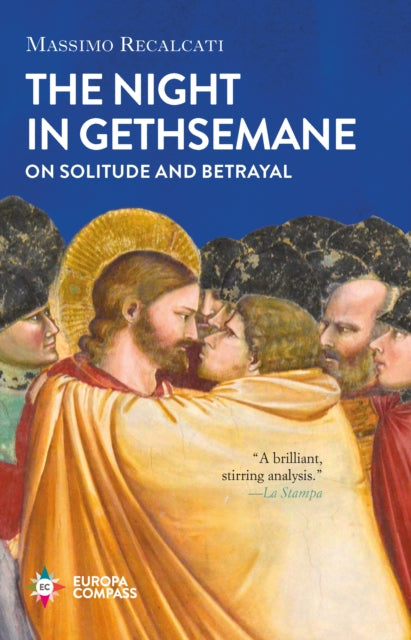
During the Last Supper, Judas kisses Jesus, symbolizing betrayal and abandonment. In "The Night in Gethsemane," Massimo Recalcati explores the relationship between biblical text and psychoanalytical theory, revealing the fragility and agony of human life.
Format: Hardback
Length: 80 pages
Publication date: 05 November 2020
Publisher: Europa Editions (UK) Ltd
After the Last Supper, Jesus retreated to a small field called Gethsemane, located just outside the city of Jerusalem. There, he engaged in intense prayer, but his solitude was interrupted when Judas arrived with a group of armed men. Judas, betraying Jesus, kissed him on the cheek, a symbolic act that marked the beginning of Jesus' crucifixion. This kiss, intended to identify Jesus to the guards, has become a powerful symbol of betrayal and abandonment. Despite being betrayed by his disciples, including Peter, who was considered the most faithful, Jesus was forsaken by God. The reason for this was his sin, which brought God closer to humanity.
In his book "The Night in Gethsemane," renowned psychoanalyst Massimo Recalcati delves into the intricate relationship between biblical text and psychoanalytical theory. Through his exploration, Recalcati sheds light on the fragility and agony of human life. He demonstrates how the Gospel narratives, particularly the account of Jesus' night in Gethsemane, resonate with psychoanalytical concepts such as the unconscious, guilt, and the search for meaning.
Recalcati begins by examining the historical context of the Gospel narratives and the societal and political conditions of the time. He notes that the Gospel writers were influenced by the prevailing ideologies of their era, which emphasized the divide between the religious and the secular. This divide played a significant role in shaping the portrayal of Jesus and his followers in the Gospels.
In Gethsemane, Jesus faced a moment of profound anguish and self-doubt. He prayed intensely, seeking guidance from God. However, his prayers were interrupted by Judas, who betrayed him with a kiss. This act symbolized Jesus' separation from God and his impending crucifixion.
Recalcati argues that the kiss between Judas and Jesus can be interpreted as a manifestation of the unconscious. According to psychoanalytical theory, the unconscious is a reservoir of primal emotions, desires, and memories that are often inaccessible to conscious awareness. In this case, Judas' kiss was a subconscious act driven by his own desires and motivations, which were in conflict with Jesus' teachings and the moral values of his followers.
The betrayal of Jesus by Judas also evokes feelings of guilt and shame. Psychoanalysts believe that guilt is a result of the violation of one's own moral values or the expectations of others. Judas felt guilty for betraying Jesus, as he had been taught to love and respect him. This guilt led to his emotional turmoil and eventual suicide.
Recalcati further explores the concept of abandonment in the context of Jesus' night in Gethsemane. He argues that Jesus was abandoned by both God and his followers. God, in Recalcati's interpretation, withdrew his support and protection from Jesus, leaving him to face the consequences of his sin alone. Jesus' disciples, who had been with him throughout his ministry, also abandoned him, fleeing in fear and disbelief.
Recalcati suggests that the abandonment experienced by Jesus in Gethsemane can be linked to the trauma of separation and loss. According to psychoanalytical theory, trauma can arise from experiences of extreme stress, violence, or loss. In the case of Jesus, the trauma of betrayal and abandonment was compounded by the fact that he was also experiencing the physical pain and suffering of crucifixion.
In conclusion, "The Night in Gethsemane" by Massimo Recalcati offers a profound exploration of the relationship between biblical text and psychoanalytical theory. Through his analysis, Recalcati sheds light on the fragility and agony of human life, highlighting the themes of betrayal, abandonment, guilt, and trauma. He demonstrates how the Gospel narratives, particularly the account of Jesus' night in Gethsemane, resonate with psychoanalytical concepts and provide insights into the human condition. This book is a valuable resource for anyone interested in exploring the intersection of religion, psychology, and human experience.
Weight: 208g
Dimension: 143 x 218 x 15 (mm)
ISBN-13: 9781787702592
UK and International shipping information
UK and International shipping information
We deliver throughout the United Kingdom and to 128 countries and territories worldwide, including the United States, Australia, Canada, Germany, Spain and France.