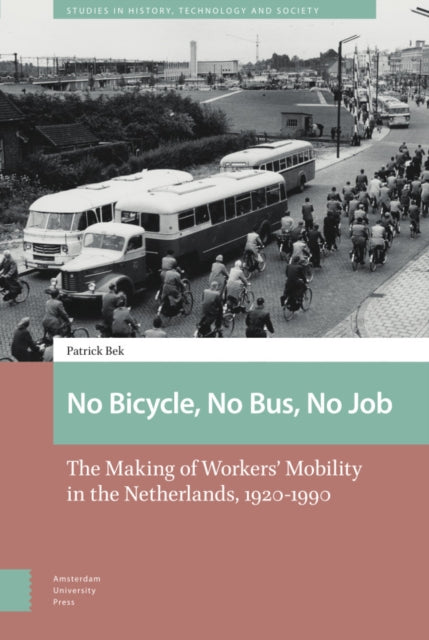
Patrick Bek
No Bicycle, No Bus, No Job: The Making of Workers' Mobility in the Netherlands, 1920-1990
No Bicycle, No Bus, No Job: The Making of Workers' Mobility in the Netherlands, 1920-1990
💎 Earn 689 Points (£6.89) on this item.
We can order this item for you. Delivery usually takes about 4 to 6 weeks.
This item is not held in our immediate stock. We will order it for you after checkout.
Estimated delivery: About 4 to 6 weeks
YOU SAVE £8.18
- Condition: Brand new
- UK Delivery times: Usually arrives within 2 - 3 working days
- UK Shipping: Fee starts at £2.39. Subject to product weight & dimension
Bulk ordering. Want 15 or more copies? Get a personalised quote and bigger discounts. Learn more about bulk orders.
Couldn't load pickup availability
- More about No Bicycle, No Bus, No Job: The Making of Workers' Mobility in the Netherlands, 1920-1990
The cost of getting to work is a significant aspect of daily life for working people, especially in the twentieth century when people's opportunity to travel increased. However, this did not apply to everyone due to the absence of affordable housing near job locations and the lack of safe, efficient, and affordable mobility options. No Bicycle, No Bus, No Job explores how power relations have historically enabled or restricted workers mobility in the Netherlands, with blue-collar workers, industrial employers, and the state shaping workers' everyday commute in a changing playing field of uneven power relations.
Format: Hardback
Length: 212 pages
Publication date: 05 May 2022
Publisher: Amsterdam University Press
For working people, the cost of getting to work, in terms of time and expense, is a crucial aspect of daily life. In the twentieth century, people's opportunity to travel increased. This did not, however, apply to everyone. The absence of affordable housing near job locations combined with the lack of safe, efficient, and affordable mobility options aggravated social exclusion for some.
No Bicycle, No Bus, No Job explores how power relations have historically enabled or restricted workers' mobility in twentieth-century Netherlands. Blue-collar workers, industrial employers, and the state shaped workers' everyday commute in a changing playing field of uneven power relations that shifted from paternalism to neo-liberalism.
Access to transportation is essential for workers to reach their workplaces, and it has a significant impact on their quality of life and economic opportunities. In the past, workers relied on bicycles, buses, and other modes of public transportation to get to work. However, the availability and affordability of these options varied greatly depending on the location and income level of the workers.
For example, in the Netherlands, blue-collar workers who lived in the suburbs or rural areas often had limited access to public transportation, which made it difficult for them to get to work. They were often forced to rely on their own vehicles or walk to work, which could be time-consuming and expensive. On the other hand, industrial employers in urban areas often provided their employees with transportation options, such as company buses or subsidized public transportation, which made it easier for them to get to work.
The lack of affordable housing near job locations was another factor that aggravated social exclusion for some workers. In the past, workers were often able to afford to live near their workplaces, which made it easier for them to get to work on time and avoid long commutes. However, as housing prices have increased in many cities, workers who live in the suburbs or rural areas may be unable to afford to live near their workplaces, which can lead to longer commutes and increased transportation costs.
The lack of safe, efficient, and affordable mobility options was also a significant issue for workers. In the past, bicycles and buses were the primary modes of transportation for workers, and they were generally safe and efficient. However, as traffic volumes have increased and the number of vehicles on the road has grown, the safety of these modes of transportation has become a concern. Additionally, the cost of owning and operating a vehicle has become increasingly expensive, which can make it difficult for workers to afford to get to work.
To address these issues, the Dutch government has implemented a number of policies and programs aimed at improving workers' mobility. For example, the government has invested in public transportation infrastructure, such as new bus lines and bike lanes, to make it easier for workers to get to work. The government has also implemented policies to promote affordable housing, such as rent control and housing subsidies, to make it easier for workers to afford to live near their workplaces.
In addition, the Dutch government has implemented policies to promote safe and efficient mobility options, such as carpooling and ride-sharing programs. These programs have been successful in reducing traffic volumes and improving the safety of workers' commutes.
Despite these efforts, there are still challenges that workers face in terms of mobility. For example, some workers may still have limited access to public transportation, particularly in rural areas or low-income neighborhoods. Additionally, some workers may face discrimination or harassment on public transportation, which can make it difficult for them to get to work safely and comfortably.
In conclusion, the cost of getting to work, in terms of time and expense, is a crucial aspect of daily life for working people. In the twentieth century, people's opportunity to travel increased, but this did not apply to everyone. The absence of affordable housing near job locations combined with the lack of safe, efficient, and affordable mobility options aggravated social exclusion for some workers. No Bicycle, No Bus, No Job explores how power relations have historically enabled or restricted workers' mobility in twentieth-century Netherlands. The Dutch government has implemented a number of policies and programs aimed at improving workers' mobility, but there are still challenges that workers face in terms of access to transportation and safety. It is important for policymakers and other stakeholders to continue to work towards improving workers' mobility and ensuring that all workers have access to safe, efficient, and affordable transportation options.
Dimension: 234 x 156 (mm)
ISBN-13: 9789463723183
UK and International shipping information
UK and International shipping information
UK Delivery and returns information:
- Delivery within 2 - 3 days when ordering in the UK.
- Shipping fee for UK customers from £2.39. Fully tracked shipping service available.
- Returns policy: Return within 30 days of receipt for full refund.
International deliveries:
Shulph Ink now ships to Australia, Belgium, Canada, France, Germany, Ireland, Italy, India, Luxembourg Saudi Arabia, Singapore, Spain, Netherlands, New Zealand, United Arab Emirates, United States of America.
- Delivery times: within 5 - 10 days for international orders.
- Shipping fee: charges vary for overseas orders. Only tracked services are available for most international orders. Some countries have untracked shipping options.
- Customs charges: If ordering to addresses outside the United Kingdom, you may or may not incur additional customs and duties fees during local delivery.