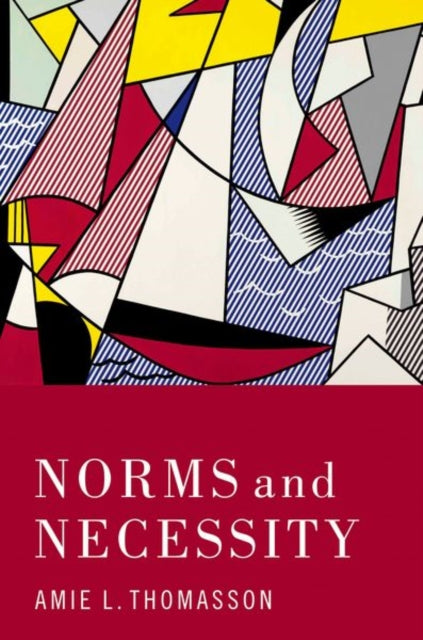
AmieThomasson
Norms and Necessity
Norms and Necessity
- Condition: Brand new
- UK Delivery times: Usually arrives within 2 - 3 working days
- UK Shipping: Fee starts at £3.89. Subject to product weight & dimension
Bulk ordering. Want 15 or more copies? Get a personalised quote and bigger discounts. Learn more about bulk orders.
Couldn't load pickup availability
- More about Norms and Necessity
Claims about metaphysical necessity and possibility have long been a central topic in philosophy, but the traditional assumption that they aim to describe modal features or possible worlds has led to difficult ontological, epistemological, and methodological puzzles. Norms and Necessity develops a new approach called Modal Normativism, which rejects the descriptivist assumption and argues that modal claims serve as useful ways of conveying, reasoning with, and renegotiating semantic rules and their consequences. This approach helps to unravel the ontological problems of modality and provides a clear and plausible story about how we can come to know what is metaphysically necessary or possible. It also reveals that resolving metaphysical modal questions does not require a special form of philosophical insight or intuition but rather empirical knowledge, conceptual mastery, and an ability to explicitly convey and renegotiate semantic rules.
Format: Paperback / softback
Length: 256 pages
Publication date: 19 December 2023
Publisher: Oxford University Press Inc
Claims about what is metaphysically necessary or possible have long played a central role in metaphysics and other areas of philosophy. These claims are traditionally thought of as aiming to describe a special kind of modal fact or property, or perhaps facts about other possible worlds. However, this assumption leads to difficult ontological, epistemological, and methodological puzzles. Should we accept that there are modal facts or properties, or other possible worlds? If so, what could these things be? How could we come to know what the modal facts or properties are? How can we resolve philosophical debates about what is metaphysically necessary or possible?
Norms and Necessity develops a new approach to understanding our claims about metaphysical possibility and necessity: Modal Normativism. The Normativist rejects the assumption that modal claims aim to describe modal features or possible worlds, arguing instead that they serve as useful ways of conveying, reasoning with, and renegotiating semantic rules and their consequences. By dropping the descriptivist assumption, the Normativist is able to unravel the notorious ontological problems of modality and provide a clear and plausible story about how we can come to know what is metaphysically necessary or possible.
Most importantly, this approach helps demystify philosophical methodology. It reveals that resolving metaphysical modal questions does not require a special form of philosophical insight or intuition. Instead, it requires nothing more mysterious than empirical knowledge, conceptual mastery, and an ability to explicitly convey and renegotiate semantic rules.
The Normativist approach to understanding metaphysical possibility and necessity is based on the idea that modal claims are not descriptions of modal features or possible worlds. Instead, they are useful tools for conveying, reasoning with, and renegotiating semantic rules and their consequences. The Normativist argues that modal claims are not meant to be taken literally, but rather as a way of expressing and exploring the implications of semantic rules.
One of the key insights of the Normativist approach is that modal claims can be used to clarify and refine semantic rules. By identifying the modal implications of a rule, we can better understand how it applies in different situations. This can help us resolve philosophical debates about the scope and limits of semantic rules, as well as the relationships between different rules.
For example, consider the rule "All bachelors are unmarried men." This rule is true in all possible worlds, but it does not necessarily imply that all unmarried men are bachelors. The Normativist approach can be used to clarify this rule by identifying the modal implications of the word "bachelor." We can then see that the rule is true in all possible worlds in which there is a single unmarried man, but it is not true in all possible worlds in which there are multiple unmarried men.
Another example of the Normativist approach is its use in resolving philosophical debates about the possibility of miracles. Many philosophers argue that miracles are impossible, but the Normativist approach can be used to explore the modal implications of this claim. By identifying the modal implications of the word "miracle," we can see that the claim is not necessarily true in all possible worlds. For example, it may be possible for a miracle to occur in a world in which natural laws are suspended or altered in some way.
The Normativist approach also provides a clear and plausible story about how we can come to know what is metaphysically necessary or possible. The Normativist argues that we can come to know what is metaphysically necessary or possible through empirical knowledge, conceptual mastery, and the ability to explicitly convey and renegotiate semantic rules. Empirical knowledge allows us to observe the natural world and gather data about the laws and principles that govern it. Conceptual mastery allows us to understand and apply semantic rules to different situations. Finally, the ability to explicitly convey and renegotiate semantic rules allows us to communicate our ideas and beliefs to others and engage in philosophical debates.
In conclusion, the Normativist approach to understanding metaphysical possibility and necessity provides a new and innovative way of thinking about these topics. By rejecting the assumption that modal claims aim to describe modal features or possible worlds, the Normativist is able to unravel the notorious ontological problems of modality and provide a clear and plausible story about how we can come to know what is metaphysically necessary or possible. This approach also helps demystify philosophical methodology, revealing that resolving metaphysical modal questions does not require a special form of philosophical insight or intuition. Instead, it requires nothing more mysterious than empirical knowledge, conceptual mastery, and an ability to explicitly convey and renegotiate semantic rules.
Weight: 290g
Dimension: 210 x 140 x 14 (mm)
ISBN-13: 9780197747162
UK and International shipping information
UK and International shipping information
We deliver throughout the United Kingdom and to 128 countries and territories worldwide, including the United States, Australia, Canada, Germany, Spain and France.