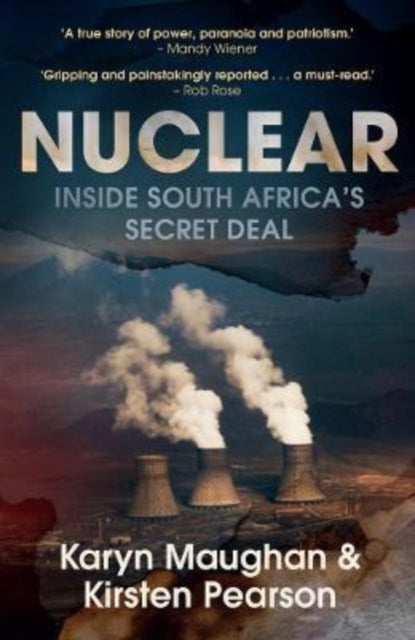
Karyn Maughan,Kirsten Pearson
Nuclear: Inside South Africa's Secret Deal
Nuclear: Inside South Africa's Secret Deal
💎 Earn 76 Points (£0.76) on this item.
YOU SAVE £4.66
- Condition: Brand new
- UK Delivery times: Usually arrives within 2 - 3 working days
- UK Shipping: Fee starts at £2.39. Subject to product weight & dimension
Bulk ordering. Want 15 or more copies? Get a personalised quote and bigger discounts. Learn more about bulk orders.
Couldn't load pickup availability
- More about Nuclear: Inside South Africa's Secret Deal
Karyn Maughan and Kirsten Pearson expose South Africa's nuclear deal with Russia in an investigative book.
Format: Paperback / softback
Length: 224 pages
Publication date: 22 April 2022
Publisher: Tafelberg Publishers Ltd
Karyn Maughan and Kirsten Pearson, two award-winning investigative journalists, have uncovered the inside story behind South Africa's controversial nuclear deal. Through exclusive interviews, audio recordings, and confidential minutes, they have pieced together the Zuma administration's secret dealings with Russia and the extraordinary lengths they went to to conclude the nuke before Zuma's time ran out.
The deal, which was signed in 2015, was intended to provide South Africa with a reliable source of energy and to help it meet its growing energy needs. However, it has been plagued by controversy and has been criticized for its cost, its environmental impact, and its potential to contribute to nuclear proliferation.
One of the key aspects of the deal was the construction of two nuclear power plants in South Africa. The first plant, the Medupi Power Station, was completed in 2017 and is currently the largest power station in Africa. The second plant, the Kusile Power Station, is expected to be completed in 2023.
However, the construction of these plants has been plagued by delays, cost overruns, and safety concerns. The Medupi Power Station, for example, has been plagued by numerous safety incidents, including a fire that killed two workers and a leak that caused a radioactive leak.
In addition to the construction of the power plants, the deal also included the transfer of technology and expertise from Russia to South Africa. This included the training of South African engineers and technicians in Russia and the provision of equipment and materials for the construction of the power plants.
However, there have been concerns that the transfer of technology and expertise could be used for military purposes. Russia has a history of using its nuclear technology for military purposes, and there have been allegations that the transfer of technology to South Africa could be used to develop nuclear weapons.
To address these concerns, the South African government has implemented a number of measures. These include the establishment of a nuclear regulatory authority, the implementation of international safeguards, and the signing of a nuclear non-proliferation treaty.
However, there have been criticisms of these measures, with some arguing that they are not sufficient to prevent nuclear proliferation. For example, the nuclear regulatory authority has been criticized for its lack of independence and its failure to enforce international safeguards.
In addition to the controversy surrounding the nuclear deal, there have been concerns about the impact of the deal on South Africa's economy. The deal has been estimated to cost South Africa billions of dollars, and there have been concerns that the money could be better spent on other infrastructure projects.
Despite these concerns, the South African government has continued to support the nuclear deal. President Jacob Zuma has argued that the deal is necessary for South Africa's economic growth and that it will help to reduce the country's dependence on foreign energy sources.
However, there have been calls for President Zuma to step down, with some arguing that he has been involved in corruption and that he has not been transparent about the deal.
In conclusion, the nuclear deal between South Africa and Russia has been plagued by controversy and has been criticized for its cost, its environmental impact, and its potential to contribute to nuclear proliferation. While the South African government has implemented a number of measures to address these concerns, there have been criticisms of these measures, and there have been calls for President Zuma to step down. It is important for South Africa to continue to monitor the deal and to ensure that it is implemented in a transparent and responsible manner.
Weight: 286g
Dimension: 153 x 233 x 18 (mm)
ISBN-13: 9780624087144
UK and International shipping information
UK and International shipping information
UK Delivery and returns information:
- Delivery within 2 - 3 days when ordering in the UK.
- Shipping fee for UK customers from £2.39. Fully tracked shipping service available.
- Returns policy: Return within 30 days of receipt for full refund.
International deliveries:
Shulph Ink now ships to Australia, Belgium, Canada, France, Germany, Ireland, Italy, India, Luxembourg Saudi Arabia, Singapore, Spain, Netherlands, New Zealand, United Arab Emirates, United States of America.
- Delivery times: within 5 - 10 days for international orders.
- Shipping fee: charges vary for overseas orders. Only tracked services are available for most international orders. Some countries have untracked shipping options.
- Customs charges: If ordering to addresses outside the United Kingdom, you may or may not incur additional customs and duties fees during local delivery.