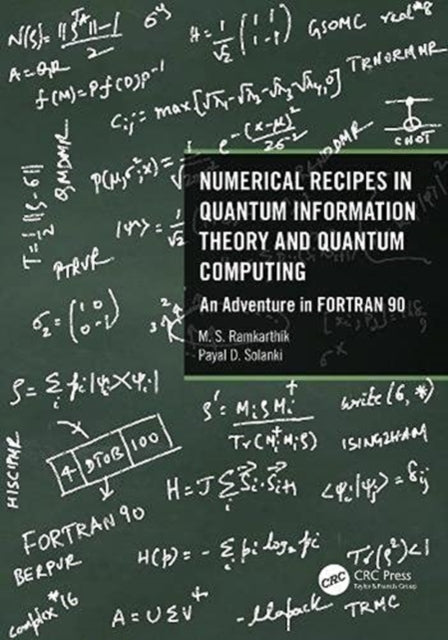
M.S.Ramkarthik,Payal D.Solanki
Numerical Recipes in Quantum Information Theory and Quantum Computing: An Adventure in FORTRAN 90
Numerical Recipes in Quantum Information Theory and Quantum Computing: An Adventure in FORTRAN 90
💎 Earn 589 Points (£5.89) on this item.
We can order this item for you. Delivery usually takes about 4 to 6 weeks.
This item is not held in our immediate stock. We will order it for you after checkout.
Estimated delivery: About 4 to 6 weeks
YOU SAVE £7.00
- Condition: Brand new
- UK Delivery times: Usually arrives within 2 - 3 working days
- UK Shipping: Fee starts at £2.39. Subject to product weight & dimension
Bulk ordering. Want 15 or more copies? Get a personalised quote and bigger discounts. Learn more about bulk orders.
Couldn't load pickup availability
- More about Numerical Recipes in Quantum Information Theory and Quantum Computing: An Adventure in FORTRAN 90
Suitable for beginner and advanced readers alike, students and researchers will find this textbook to be a helpful guide and a compendium.
This textbook offers Fortran 90 computational tools for quantum information, quantum computing, linear algebra, and one-dimensional spin-half condensed matter systems. It includes 160 subroutines with detailed flowcharts, suitable for beginner and advanced readers.
Format: Hardback
Length: 400 pages
Publication date: 13 September 2021
Publisher: Taylor & Francis Ltd
The book is written in a simple and easy to understand language.
This groundbreaking textbook offers a comprehensive collection of computational tools in Fortran 90, serving as a vital resource for advancing knowledge in quantum information, quantum computing, linear algebra, and one-dimensional spin-half condensed matter systems. With an extensive array of over 160 subroutines, this text provides a wealth of numerical recipes accompanied by detailed flowcharts, making it suitable for both beginner and advanced readers alike. Whether you're a student or a researcher, this textbook serves as a valuable guide and a comprehensive compendium, offering valuable insights and practical applications in these fields.
Chapter 1: Introduction to Fortran 90
In this introductory chapter, we provide a comprehensive overview of Fortran 90, highlighting its features and benefits. We discuss the language's syntax, data types, and control structures, as well as its suitability for various scientific and engineering applications. We also introduce the book's structure and organization, which will guide you through the various computational tools and techniques covered in subsequent chapters.
Chapter 2: Quantum Information
In this chapter, we delve into the realm of quantum information, exploring the fundamental principles and applications of quantum computing. We introduce the concept of quantum bits (qubits) and their properties, such as superposition and entanglement. We discuss the various algorithms and protocols used in quantum computing, including quantum algorithms for solving complex problems and quantum cryptography for secure communication. We also introduce the use of quantum simulators, such as quantum computers and quantum annealers, for studying the behavior of quantum systems.
Chapter 3: Quantum Computing
In this chapter, we explore the practical aspects of quantum computing, including the development of quantum algorithms and the implementation of quantum computers. We discuss the various hardware architectures and programming languages used in quantum computing, such as quantum circuit simulators and quantum programming languages. We also introduce the use of quantum error correction techniques, such as quantum error correction codes, for mitigating the effects of quantum decoherence.
Chapter 4: Linear Algebra
In this chapter, we delve into the world of linear algebra, exploring its fundamental concepts and applications. We discuss the matrix representation of linear equations and the properties of matrices, such as determinant, inversion, and eigenvalues. We introduce the concept of linear transformations and their applications in solving differential equations and optimization problems. We also discuss the use of linear algebra in quantum computing, such as quantum linear algebra algorithms and quantum linear optics.
Chapter 5: One-Dimensional Spin-Half Condensed Matter Systems
In this chapter, we explore the behavior of one-dimensional spin-half condensed matter systems, such as magnetic materials and quantum dots. We discuss the theoretical models and computational methods used to study these systems, including the use of density functional theory and Monte Carlo simulations. We also introduce the use of linear algebra in studying the properties of one-dimensional spin-half condensed matter systems, such as spin-orbit coupling and magnetic frustration.
Chapter 6: Subroutines and Recipes
In this chapter, we introduce the various subroutines and recipes provided in the book. We discuss the purpose and functionality of each subroutine, as well as its input and output parameters. We also provide detailed examples of how to use each subroutine and recipe, along with their corresponding output. A comprehensive dependency chart is provided for every recipe, allowing you to understand the relationships between different subroutines and recipes.
Chapter 7: Conclusion
In this concluding chapter, we summarize the key concepts and applications covered in the book. We discuss the importance of computational tools in advancing knowledge in quantum information, quantum computing, linear algebra, and one-dimensional spin-half condensed matter systems. We also highlight the potential applications of these tools in various fields, such as materials science, chemistry, and physics. We encourage readers to explore further the topics covered in this book and to apply their knowledge to real-world problems.
In conclusion, this groundbreaking textbook offers a comprehensive collection of computational tools in Fortran 90, providing a valuable resource for advancing knowledge in quantum information, quantum computing, linear algebra, and one-dimensional spin-half condensed matter systems. With an extensive array of over 160 subroutines, this text offers a wealth of numerical recipes accompanied by detailed flowcharts, making it suitable for both beginner and advanced readers alike. Whether you're a student or a researcher, this textbook serves as a valuable guide and a comprehensive compendium, offering valuable insights and practical applications in these fields.
Weight: 962g
Dimension: 183 x 261 x 32 (mm)
ISBN-13: 9780367759285
This item can be found in:
UK and International shipping information
UK and International shipping information
UK Delivery and returns information:
- Delivery within 2 - 3 days when ordering in the UK.
- Shipping fee for UK customers from £2.39. Fully tracked shipping service available.
- Returns policy: Return within 30 days of receipt for full refund.
International deliveries:
Shulph Ink now ships to Australia, Belgium, Canada, France, Germany, Ireland, Italy, India, Luxembourg Saudi Arabia, Singapore, Spain, Netherlands, New Zealand, United Arab Emirates, United States of America.
- Delivery times: within 5 - 10 days for international orders.
- Shipping fee: charges vary for overseas orders. Only tracked services are available for most international orders. Some countries have untracked shipping options.
- Customs charges: If ordering to addresses outside the United Kingdom, you may or may not incur additional customs and duties fees during local delivery.