Shulph Ink
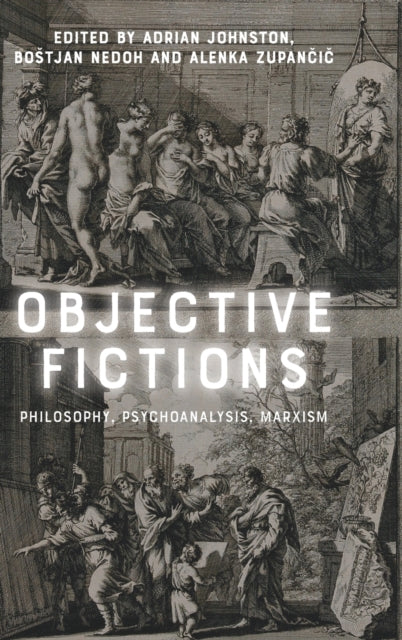
Objective Fictions: Philosophy, Psychoanalysis, Marxism
Objective Fictions: Philosophy, Psychoanalysis, Marxism
We can order this item for you. Delivery usually takes about 4 to 6 weeks.
This item is not held in our immediate stock. We will order it for you after checkout.
Estimated delivery: About 4 to 6 weeks
YOU SAVE £25.90
- Condition: Brand new
- UK Delivery times: Usually arrives within 2 - 3 working days
- UK Shipping: Fee starts at £3.89. Subject to product weight & dimension
Bulk ordering. Want 15 or more copies? Get a personalised quote and bigger discounts. Learn more about bulk orders.
Couldn't load pickup availability
- More about Objective Fictions: Philosophy, Psychoanalysis, Marxism
The debate between nominalism and realism in current philosophical debates revolves around the notion of truth and objective reality. This collection explores the relationship between objectivity and fiction through engaging with objective fictions such as fetishes,semblances,lies,rumours,sophistry,fantasies, and conspiracy theories. It challenges the neat separation between the spheres of subjectivity and objectivity and between fiction and truth, suggesting that both approaches share a fundamental presupposition of a separation between these spheres.
Format: Hardback
Length: 272 pages
Publication date: 31 January 2022
Publisher: Edinburgh University Press
When it comes to the question of objectivity in current philosophical debates, there is a growing prominence of two opposite approaches: nominalism and realism. By absolutizing intersubjectivity, the nominalist approach is moving towards the abandonment of the very notion of truth and objective reality. For its part, the realist approach insists on the category of the object-in-itself as irreducible to any kind of subjective mediation. Despite their seeming mutual exclusiveness, both approaches share a fundamental presupposition, namely, that of a neat separation between the spheres of subjectivity and objectivity as well as between fiction and truth.
This collection offers a rethinking of the relationship between objectivity and fiction through engaging with a series of objective fictions, including such topics as fetishes,semblances, lies, rumours, sophistry, fantasies, and conspiracy theories. It does so through engagement with modern and contemporary philosophical traditions and psychoanalytic theory, with all of these orientations being irreducible to either nominalist or realist approaches.
The nominalist approach, which emphasizes intersubjectivity, posits that truth and objective reality are relative and subjective. It rejects the idea of an absolute, universal truth and instead emphasizes the diversity of perspectives and interpretations. Nominalists argue that objects and events are not independent of our perception and interpretation, and that our understanding of them is shaped by our cultural, social, and historical context. This approach emphasizes the importance of language and meaning in our understanding of the world, and it suggests that there is no objective reality beyond our subjective experiences.
On the other hand, the realist approach, which emphasizes the object-in-itself, posits that there is an objective reality that exists independently of our perception and interpretation. Realists argue that objects and events have an existence beyond our subjective experiences and that they can be observed and measured objectively. They believe that there are fundamental properties and structures that exist independently of our minds and that these properties and structures can be discovered through scientific inquiry.
Despite their apparent differences, both approaches share a fundamental presupposition, namely, that of a neat separation between the spheres of subjectivity and objectivity as well as between fiction and truth. This presupposition is challenged by a number of contemporary philosophical and psychoanalytic thinkers, who argue that these spheres are interconnected and that our understanding of the world is shaped by a complex interplay of subjective and objective factors.
One of the most influential thinkers in this regard is Jacques Lacan, a French psychoanalyst who developed a theory of the unconscious that emphasizes the role of the subject in shaping their own reality. Lacan argued that the unconscious is a reservoir of primal desires, impulses, and fantasies that are beyond the conscious mind's control. He also argued that the unconscious is structured in a way that is similar to the structure of language, and that our understanding of the world is shaped by the way in which we interpret and communicate our unconscious desires and impulses.
Another important thinker in this regard is Ludwig Wittgenstein, a German philosopher who developed a theory of language that emphasizes the role of language in shaping our understanding of the world. Wittgenstein argued that language is not a tool for describing the world but rather a part of the world itself. He also argued that our understanding of the world is shaped by the way in which we use language to communicate with others and to interpret our experiences.
In addition to these philosophical and psychoanalytic perspectives, a number of contemporary writers and artists have also explored the relationship between objectivity and fiction. One of the most notable examples is the novelist David Mitchell, who has written a series of novels that explore the boundaries between reality and fiction. Mitchell's novels often feature characters who are struggling to navigate a world that is both familiar and strange, and who are forced to confront the limitations of their own perception and interpretation.
Another example is the filmmaker David Lynch, who has created a series of films that are characterized by their surreal and dreamlike quality. Lynch's films often feature characters who are trapped in a world that is both familiar and strange, and who are forced to confront the limitations of their own perception and interpretation.
In conclusion, the relationship between objectivity and fiction is a complex and multifaceted issue that is explored through a variety of contemporary philosophical and psychoanalytic perspectives. While the nominalist and realist approaches may seem mutually exclusive, both share a fundamental presupposition that of a neat separation between the spheres. However, contemporary thinkers argue that these spheres
spheres are interconnected and that our understanding of the world is shaped by a complex interplay of subjective and objective factors. Through engaging with a series of objective fictions, including such topics as fetishes,semblances, lies, rumours, sophistry, fantasies, and conspiracy theories, this collection offers a rethinking of the relationship between objectivity and fiction and highlights the importance of exploring the boundaries between these two spheres in order to gain a deeper understanding of the world around us.
Weight: 596g
Dimension: 244 x 164 x 23 (mm)
ISBN-13: 9781474489324
UK and International shipping information
UK and International shipping information
We deliver throughout the United Kingdom and to 128 countries and territories worldwide, including the United States, Australia, Canada, Germany, Spain and France.