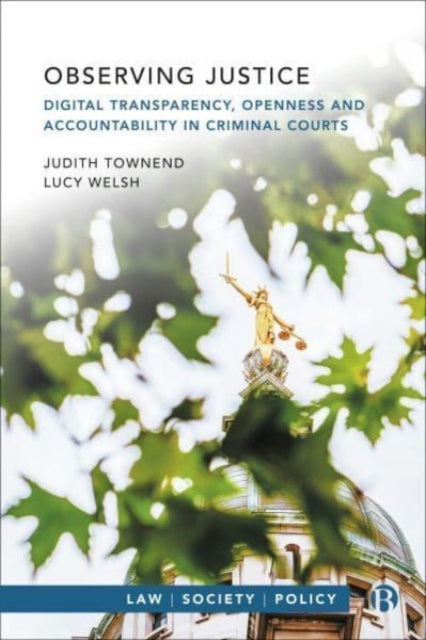
JudithTownend,LucyWelsh
Observing Justice: Digital Transparency, Openness and Accountability in Criminal Courts
Observing Justice: Digital Transparency, Openness and Accountability in Criminal Courts
💎 Earn 185 Points (£1.85) on this item.
YOU SAVE £7.83
- Condition: Brand new
- UK Delivery times: Usually arrives within 2 - 3 working days
- UK Shipping: Fee starts at £2.39. Subject to product weight & dimension
Bulk ordering. Want 15 or more copies? Get a personalised quote and bigger discounts. Learn more about bulk orders.
Couldn't load pickup availability
- More about Observing Justice: Digital Transparency, Openness and Accountability in Criminal Courts
The book examines how legal, social, and technological developments affect the transparency and accountability of the criminal justice process, proposing a framework for open justice that prioritizes public legal education and justice system accountability.
Format: Hardback
Length: 176 pages
Publication date: 28 November 2023
Publisher: Bristol University Press
The criminal justice process is a complex and multifaceted system that involves a wide range of legal, social, and technological developments. While these developments have brought many benefits, they have also raised concerns about transparency and accountability. This book examines how these developments have affected the criminal justice process and proposes a framework for open justice that prioritizes public legal education and justice system accountability.
The book draws on empirical and evaluative studies, as well as the authors' own research experiences, to explore key legal policy issues such as equality of access, remote and virtual courts, justice system data management, and the roles of public and media observers. It highlights the implications of recent changes for access to justice, offender rehabilitation, and public access to information and proposes a framework for open justice that prioritizes public legal education and justice system accountability.
One of the key challenges facing the criminal justice process is ensuring that it is accessible to all individuals. This includes ensuring that individuals have access to legal representation, that court proceedings are conducted in a fair and transparent manner, and that justice system data is managed in a secure and efficient manner. The book explores how these challenges can be addressed and proposes a range of solutions, including the use of remote and virtual courts, the use of justice system data management systems, and the involvement of public and media observers.
Remote and virtual courts have the potential to increase access to justice by providing individuals with access to court proceedings from anywhere in the world. They can also reduce the cost of court proceedings and improve the efficiency of the justice system. However, there are also concerns about the impact of remote and virtual courts on the quality of justice and the rights of individuals. The book explores these concerns and proposes a range of solutions, including the use of video conferencing, the use of remote court reporters, and the use of virtual courtrooms.
Justice system data management is another key issue facing the criminal justice process. Data can be used to improve the efficiency of the justice system, to identify patterns of crime, and to improve the quality of justice. However, there are also concerns about the security of justice system data and the use of data for purposes other than justice. The book explores these concerns and proposes a range of solutions, including the use of secure data storage systems, the use of data encryption, and the use of data analytics.
Public and media observers play a critical role in the criminal justice process. They can provide feedback to the justice system and can help to ensure that justice is being served fairly and transparently. However, there are also concerns about the impact of public and media observers on the justice system and the rights of individuals. The book explores these concerns and proposes a range of solutions, including the use of training programs for public and media observers, the use of guidelines for public and media observers, and the use of transparency and accountability measures.
In conclusion, the criminal justice process is a complex and multifaceted system that involves a wide range of legal, social, and technological developments. While these developments have brought many benefits, they have also raised concerns about transparency and accountability. This book examines how these developments have affected the criminal justice process and proposes a framework for open justice that prioritizes public legal education and justice system accountability. By addressing these challenges, we can ensure that the criminal justice process is fair, transparent, and accountable to all individuals.
Dimension: 203 x 127 (mm)
ISBN-13: 9781529228670
UK and International shipping information
UK and International shipping information
UK Delivery and returns information:
- Delivery within 2 - 3 days when ordering in the UK.
- Shipping fee for UK customers from £2.39. Fully tracked shipping service available.
- Returns policy: Return within 30 days of receipt for full refund.
International deliveries:
Shulph Ink now ships to Australia, Belgium, Canada, France, Germany, Ireland, Italy, India, Luxembourg Saudi Arabia, Singapore, Spain, Netherlands, New Zealand, United Arab Emirates, United States of America.
- Delivery times: within 5 - 10 days for international orders.
- Shipping fee: charges vary for overseas orders. Only tracked services are available for most international orders. Some countries have untracked shipping options.
- Customs charges: If ordering to addresses outside the United Kingdom, you may or may not incur additional customs and duties fees during local delivery.