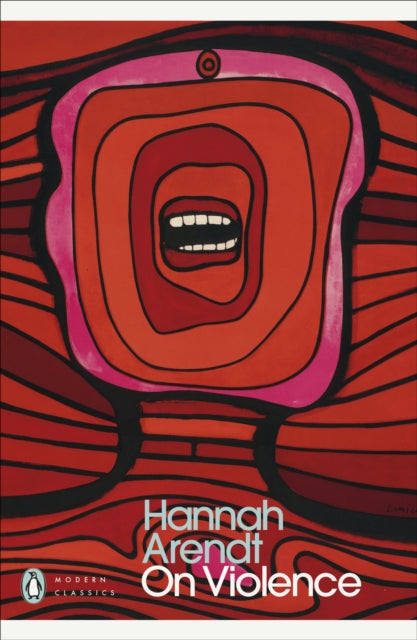
Hannah Arendt
On Violence
On Violence
💎 Earn 31 Points (£0.31) on this item.
YOU SAVE £2.63
- Condition: Brand new
- UK Delivery times: Usually arrives within 2 - 3 working days
- UK Shipping: Fee starts at £2.39. Subject to product weight & dimension
Bulk ordering. Want 15 or more copies? Get a personalised quote and bigger discounts. Learn more about bulk orders.
Couldn't load pickup availability
- More about On Violence
Hannah Arendt's essay "Violence" examines the relationship between violence, power, war, and politics, warning against the glamorization of violence by revolutionary causes and arguing that true, lasting power can never grow out of the barrel of a gun.
Format: Unspecified
Length: 80 pages
Publication date: 30 November 2023
Publisher: Penguin Books Ltd
From the renowned author of "The Origins of Totalitarianism," Hannah Arendt, comes her influential essay delving into the intricate relationship between violence, power, war, and politics. In this seminal work, written in 1970, Arendt examines the profound impact of violence on human history, drawing upon the haunting memories of the Holocaust, Hiroshima, the Vietnam War, and the tumultuous streets of Europe and America, where student protests erupted. Through her incisive analysis, Arendt sheds light on the nature and causes of violence in the twentieth century, exploring its connection to politics and war. She cautions against the romanticization of violence by revolutionary causes, emphasizing that true, lasting power cannot emerge from the barrel of a gun.
Written with clarity and grace, this essay serves as an ideal framework for understanding the turbulent times we live in. With an introduction by Arendt expert Lyndsey Stonebridge, Professor of Humanities and Human Rights at the University of Birmingham, this edition provides a deeper understanding of Arendt's thought-provoking ideas and their relevance to contemporary society.
Violence, as Arendt reveals, has the power to destroy power, rendering it utterly incapable of creating it. Throughout history, violence has played a significant role, shaping the course of events and influencing the trajectory of societies. Arendt delves into the various manifestations of violence, from political assassinations to genocides, wars, and acts of terrorism. She questions why violence has been so prevalent and explores the underlying factors that contribute to its occurrence.
One of Arendt's central arguments is that violence is often used as a means to gain and maintain power. She argues that those in power often resort to violence to suppress opposition, consolidate their grip on power, and project an image of strength and dominance. However, Arendt cautions that the use of violence can have unintended consequences, leading to further instability, loss of lives, and the erosion of democratic values.
Arendt also examines the relationship between violence and war. She argues that war is not merely a physical confrontation between nations but a complex social and political phenomenon. War is often driven by political agendas, economic interests, and territorial ambitions, and it has the potential to unleash devastating consequences on both the combatants and the civilian population. Arendt highlights the role of propaganda, misinformation, and the manipulation of public opinion in fueling wars and perpetuating cycles of violence.
In the modern age, violence has taken on new forms and dimensions. With the rise of globalization, the proliferation of weapons, and the ease of access to information, violence has become more decentralized and transnational. Cyberattacks, online harassment, and the use of social media platforms to spread hate and misinformation have become increasingly prevalent. Arendt warns against the dangers of these new forms of violence, emphasizing that they can have far-reaching consequences and undermine the foundations of democratic societies.
Arendt's essay is a powerful exploration of the complex relationship between violence, power, war, and politics. It provides a critical analysis of the historical and contemporary manifestations of violence, challenging our understanding of its nature and causes. Through her insightful and thought-provoking ideas, Arendt encourages us to reflect on the role of violence in our world and to work towards creating a more peaceful and just society.
In conclusion, Hannah Arendt's essay "Violence" is a seminal work that delves into the profound impact of violence on human history. Through her incisive analysis, Arendt sheds light on the nature and causes of violence, exploring its connection to politics and war. She cautions against the glamorization of violence by revolutionary causes and emphasizes that true, lasting power cannot emerge from the barrel of a gun. Written with clarity and grace, this essay serves as an ideal framework for understanding the turbulent times we live in. With an introduction by Arendt expert Lyndsey Stonebridge, this edition provides a deeper understanding of Arendt's thought-provoking ideas and their relevance to contemporary society. By reflecting on the lessons learned from Arendt's essay, we can work towards creating a more peaceful and just world.
Weight: 68g
Dimension: 129 x 197 x 7 (mm)
ISBN-13: 9780241631645
UK and International shipping information
UK and International shipping information
UK Delivery and returns information:
- Delivery within 2 - 3 days when ordering in the UK.
- Shipping fee for UK customers from £2.39. Fully tracked shipping service available.
- Returns policy: Return within 30 days of receipt for full refund.
International deliveries:
Shulph Ink now ships to Australia, Belgium, Canada, France, Germany, Ireland, Italy, India, Luxembourg Saudi Arabia, Singapore, Spain, Netherlands, New Zealand, United Arab Emirates, United States of America.
- Delivery times: within 5 - 10 days for international orders.
- Shipping fee: charges vary for overseas orders. Only tracked services are available for most international orders. Some countries have untracked shipping options.
- Customs charges: If ordering to addresses outside the United Kingdom, you may or may not incur additional customs and duties fees during local delivery.