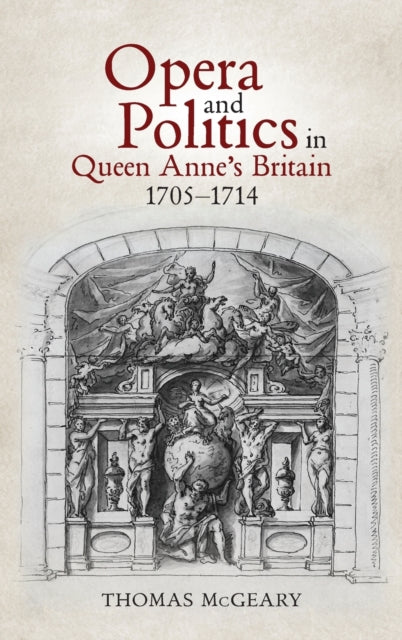
Thomas McGeary
Opera and Politics in Queen Anne's Britain, 1705-1714
Opera and Politics in Queen Anne's Britain, 1705-1714
💎 Earn 657 Points (£6.57) on this item.
- Condition: Brand new
- UK Delivery times: Usually arrives within 2 - 3 working days
- UK Shipping: Fee starts at £2.39. Subject to product weight & dimension
Bulk ordering. Want 15 or more copies? Get a personalised quote and bigger discounts. Learn more about bulk orders.
Couldn't load pickup availability
- More about Opera and Politics in Queen Anne's Britain, 1705-1714
Explores the political meanings that Italian opera - its composers, agents and institutions - had for audiences in eighteenth-century Britain.
Format: Hardback
Length: 444 pages
Publication date: 26 July 2022
Publisher: Boydell & Brewer Ltd
The political significance of Italian opera in eighteenth-century Britain is a fascinating subject that requires careful exploration. During the reign of Queen Anne (1702-1714), the political and cultural landscape of Britain underwent significant changes, and Italian opera played a significant role in shaping public opinion and influencing political discourse. In this study, Thomas McGeary aims to shed light on the intricate relationship between politics and opera during this period.
The introduction of Italian-style opera to Britain in the 1690s was not a foreign invasion but rather a native product that grew out of plans for a new theatre in the Haymarket. The associations that Italian singing and singers acquired by this time were heavily exploited by partisan Whig-Tory writings, which used them to promote their political agendas. The Whigs, in particular, saw opera as a tool to promote their cultural values and to undermine the popularity of the rival Tory party.
One of the most significant events in the history of opera in Britain was the arrival of Handel in London in 1710. Handel's operas, known for their musical complexity and emotional depth, quickly gained popularity among audiences in Britain. The support and patronage of major political figures, mostly Whigs, played a crucial role in the early promotion and sponsorship of opera. These figures included the Duke of Newcastle, who was a prominent Whig politician and a keen music lover, and the Earl of Shaftesbury, who was a prominent Whig philosopher and patron of the arts.
The criticism of opera by Whig writers such as Richard Steele and Joseph Addison is well known, but McGeary uncovers how the early promotion and sponsorship of opera was, in fact, largely a Whig enterprise and cultural program. The Whigs saw opera as a way to promote their cultural values and to undermine the popularity of the rival Tory party. They also used opera to promote their political agenda and to appeal to the educated and upper-class audiences who were increasingly interested in the arts.
Opera and Politics in Queen Anne's Britain is a valuable contribution to the field of opera scholarship and cultural and political history of eighteenth-century Britain. It provides a comprehensive analysis of the relationship between politics and opera during this period and sheds light on the complex ways in which the two worlds were intertwined. The book will be of interest to opera scholars, cultural historians, and those interested in the vibrant literature culture of the period.
In conclusion, the political significance of Italian opera in eighteenth-century Britain cannot be overstated. Italian opera played a significant role in shaping public opinion and influencing political discourse during this period. The introduction of Italian-style opera was a native product that grew out of plans for a new theatre in the Haymarket, and the support and patronage of major political figures, mostly Whigs, played a crucial role in the early promotion and sponsorship of opera. The criticism of opera by Whig writers such as Steele and Addison is well known, but McGeary uncovers how the early promotion and sponsorship of opera was, in fact, largely a Whig enterprise and cultural program. Opera and Politics in Queen Anne's Britain is a valuable contribution to the field of opera scholarship and cultural and political history of eighteenth-century Britain, and it will be of interest to scholars and enthusiasts alike.
Dimension: 234 x 156 (mm)
ISBN-13: 9781783277155
This item can be found in:
UK and International shipping information
UK and International shipping information
UK Delivery and returns information:
- Delivery within 2 - 3 days when ordering in the UK.
- Shipping fee for UK customers from £2.39. Fully tracked shipping service available.
- Returns policy: Return within 30 days of receipt for full refund.
International deliveries:
Shulph Ink now ships to Australia, Belgium, Canada, France, Germany, Ireland, Italy, India, Luxembourg Saudi Arabia, Singapore, Spain, Netherlands, New Zealand, United Arab Emirates, United States of America.
- Delivery times: within 5 - 10 days for international orders.
- Shipping fee: charges vary for overseas orders. Only tracked services are available for most international orders. Some countries have untracked shipping options.
- Customs charges: If ordering to addresses outside the United Kingdom, you may or may not incur additional customs and duties fees during local delivery.