Shulph Ink
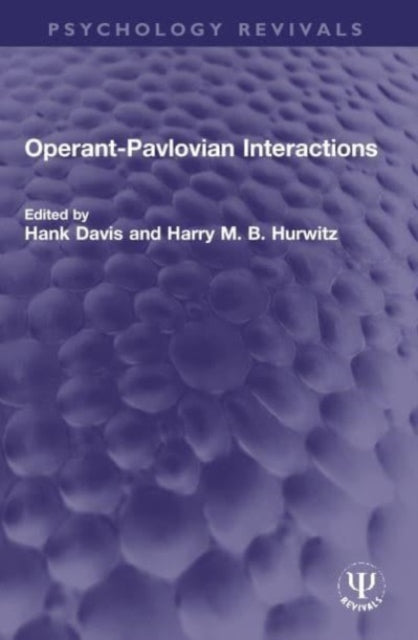
Operant-Pavlovian Interactions
Operant-Pavlovian Interactions
We can order this item for you. Delivery usually takes about 4 to 6 weeks.
This item is not held in our immediate stock. We will order it for you after checkout.
Estimated delivery: About 4 to 6 weeks
YOU SAVE £3.25
- Condition: Brand new
- UK Delivery times: Usually arrives within 2 - 3 working days
- UK Shipping: Fee starts at £3.89. Subject to product weight & dimension
Bulk ordering. Want 15 or more copies? Get a personalised quote and bigger discounts. Learn more about bulk orders.
Couldn't load pickup availability
- More about Operant-Pavlovian Interactions
Konorski and Miller's 1928 distinction between operant and Pavlovian conditioning, as well as Skinner's 1935 proposal, sparked a debate over two types of conditioned reflexes. This volume reassesses our basic learning paradigms and examines operant-Pavlovian interactions in various settings, including generating procedures and examining their contribution to conditioning paradigms.
Format: Paperback / softback
Length: 348 pages
Publication date: 30 June 2023
Publisher: Taylor & Francis Ltd
The first significant distinction between operant and Pavlovian conditioning was established in 1928 by Polish scientists Konorski and Miller. Unaware of their work, Skinner proposed a similar analysis in 1935 of the manner in which operant and Pavlovian conditioning might differ and interact. Konorski and Miller responded to Skinners statement, and by 1937, the now-classic debate over two types of conditioned reflexes was in high gear.
In the years before publication, the attention of many learning theorists had returned to the fundamental question of whether there are identifiably different forms of learning. The present volume, originally published in 1977, contains chapters that reassess our basic learning paradigms of the time. They deal with the definitional problems of isolating operant and Pavlovian conditioning, as well as the attempt to analyze the inevitable interactions that follow. These issues are examined in a variety of settings: some authors deal with operant-Pavlovian interactions directly by devising procedures to generate them; others examine operant-Pavlovian interactions by examining their possible contribution to established conditioning paradigms.
Operant conditioning, as defined by Skinner, is a type of learning in which behavior is shaped by its consequences, specifically by the rewards and punishments that follow it. In contrast, Pavlovian conditioning is a type of learning in which behavior is shaped by the association between a stimulus and a response, specifically by the occurrence of a stimulus that elicits a response that is conditioned to occur by a previous stimulus.
One of the key differences between operant and Pavlovian conditioning is that operant conditioning is based on the principles of reinforcement and punishment, while Pavlovian conditioning is based on the principles of association and conditioning. Reinforcement is the process by which a behavior is strengthened by the presentation of a reward after the behavior. For example, if a dog is trained to sit by receiving a treat every time it sits, the dog will learn to sit more frequently in order to receive the reward. Punishment is the process by which a behavior is weakened by the presentation of a punishment after the behavior. For example, if a dog is trained to sit by receiving a shock every time it sits, the dog will learn to sit less frequently in order to avoid the punishment.
In contrast, association is the process by which a stimulus is associated with a response. For example, if a bell is rang every time a dog is fed, the dog will come to associate the sound of the bell with the arrival of food. Conditioning is the process by which a response is learned to occur in response to a stimulus. For example, if a dog is trained to salivate in response to the sight of food by receiving a reward every time it salivates, the dog will learn to salivate in response to the sight of food.
Another key difference between operant and Pavlovian conditioning is that operant conditioning is more flexible than Pavlovian conditioning. Operant conditioning can be used to train a wide range of behaviors, including complex behaviors such as language learning and problem-solving. In contrast, Pavlovian conditioning is limited to training simple behaviors, such as salivation in response to the sight of food.
In addition to these differences, operant and Pavlovian conditioning have different effects on behavior. Operant conditioning can lead to long-term changes in behavior, while Pavlovian conditioning can lead to short-term changes in behavior. Operant conditioning can also lead to more complex behaviors than Pavlovian conditioning, such as the formation of associations between multiple stimuli and multiple responses.
In conclusion, operant and Pavlovian conditioning are two different types of learning that have different principles, different effects, and different applications. Operant conditioning is based on the principles of reinforcement and punishment, while Pavlovian conditioning is based on the principles of association and conditioning. Operant conditioning is more flexible than Pavlovian conditioning and can be used to train a wide range of behaviors, while Pavlovian conditioning is limited to training simple behaviors. Operant conditioning can lead to long-term changes in behavior, while Pavlovian conditioning can lead to short-term changes in behavior.
Weight: 640g
Dimension: 234 x 156 (mm)
ISBN-13: 9780367713485
UK and International shipping information
UK and International shipping information
We deliver throughout the United Kingdom and to 128 countries and territories worldwide, including the United States, Australia, Canada, Germany, Spain and France.