DanielGalbraith
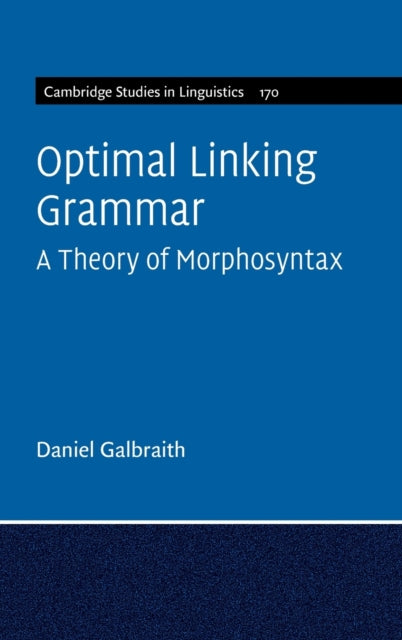
Optimal Linking Grammar: Volume 170: A Theory of Morphosyntax
Optimal Linking Grammar: Volume 170: A Theory of Morphosyntax
💎 Earn 490 Points (£4.90) on this item.
YOU SAVE £5.82
- Condition: Brand new
- UK Delivery times: Usually arrives within 2 - 3 working days
- UK Shipping: Fee starts at £3.89. Subject to product weight & dimension
Bulk ordering. Want 15 or more copies? Get a personalised quote and bigger discounts. Learn more about bulk orders.
Couldn't load pickup availability
- More about Optimal Linking Grammar: Volume 170: A Theory of Morphosyntax
This book presents a pioneering approach to syntactic analysis, Optimal Linking Grammar (OLG), which combines Linking Theory and Optimality Theory (OT). It provides a robust account of case-marking phenomena in Faroese and Icelandic and explains a wide range of sentence types, including passives, ditransitives, object shift, and word order variation. OLG can resolve numerous issues in competing theories of formal syntax and has the potential to be applied to other languages in future research. It is essential reading for researchers and students in syntax, morphology, sociolinguistics, and European languages.
Format: Hardback
Length: 300 pages
Publication date: 27 April 2023
Publisher: Cambridge University Press
This groundbreaking book presents a pioneering approach to syntactic analysis, Optimal Linking Grammar (OLG), which seamlessly integrates two existing models, Linking Theory and Optimality Theory (OT). While OT has primarily been associated with phonology, its application to syntax has gained significant traction in recent years. OLG offers a comprehensive account of case-marking phenomena in Faroese and Icelandic, as well as elucidating a diverse array of sentence types, including passives, ditransitives, object shift, and word order variation. By demonstrating how OLG can resolve numerous issues in competing theories of formal syntax and showcasing its potential for application in other languages, this book serves as a vital resource for researchers and students in syntax, morphology, sociolinguistics, and European languages.
The integration of Linking Theory and Optimality Theory (OT) in Optimal Linking Grammar (OLG) offers a novel and comprehensive framework for syntactic analysis. While OT has traditionally been central to phonology, its application to syntax has gained increasing prominence in recent years. OLG provides a robust account of case-marking phenomena in Faroese and Icelandic, showcasing its ability to handle complex linguistic structures. Moreover, the book extends the reach of OT to encompass a wide range of sentence types, including passives, ditransitives, object shift, and word order variation. By resolving numerous issues in competing theories of formal syntax and demonstrating its potential for application in other languages, this book emerges as a seminal resource for researchers and students in syntax, morphology, sociolinguistics, and European languages.
The fusion of Linking Theory and Optimality Theory (OT) in Optimal Linking Grammar (OLG) presents a groundbreaking approach to syntactic analysis. While OT has traditionally been associated with phonology, its application to syntax has gained significant traction in recent years. OLG offers a comprehensive account of case-marking phenomena in Faroese and Icelandic, demonstrating its ability to handle complex linguistic structures. Moreover, the book extends the reach of OT to encompass a wide range of sentence types, including passives, ditransitives, object shift, and word order variation. By resolving numerous issues in competing theories of formal syntax and showcasing its potential for application in other languages, this book emerges as a seminal resource for researchers and students in syntax, morphology, sociolinguistics, and European languages.
The integration of Linking Theory and Optimality Theory (OT) in Optimal Linking Grammar (OLG) presents a novel and comprehensive framework for syntactic analysis. While OT has traditionally been central to phonology, its application to syntax has gained significant traction in recent years. OLG provides a robust account of case-marking phenomena in Faroese and Icelandic, showcasing its ability to handle complex linguistic structures. Moreover, the book extends the reach of OT to encompass a wide range of sentence types, including passives, ditransitives, object shift, and word order variation. By resolving numerous issues in competing theories of formal syntax and demonstrating its potential for application in other languages, this book emerges as a seminal resource for researchers and students in syntax, morphology, sociolinguistics, and European languages.
Weight: 610g
Dimension: 236 x 160 x 27 (mm)
ISBN-13: 9781316516591
UK and International shipping information
UK and International shipping information
We deliver throughout the United Kingdom and to 128 countries and territories worldwide, including the United States, Australia, Canada, Germany, Spain and France.