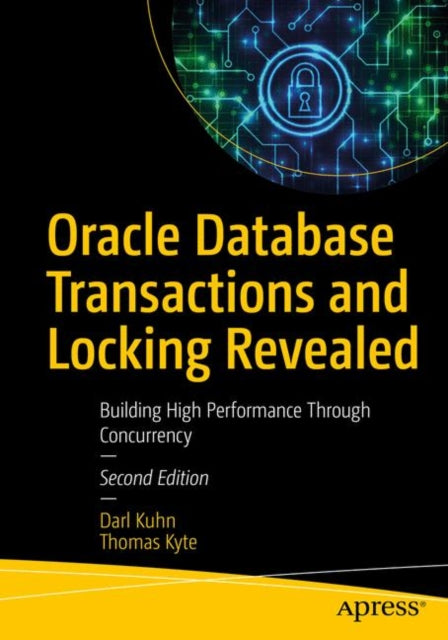
Darl Kuhn,Thomas Kyte
Oracle Database Transactions and Locking Revealed: Building High Performance Through Concurrency
Oracle Database Transactions and Locking Revealed: Building High Performance Through Concurrency
💎 Earn 227 Points (£2.27) on this item.
YOU SAVE £9.57
- Condition: Brand new
- UK Delivery times: Usually arrives within 2 - 3 working days
- UK Shipping: Fee starts at £2.39. Subject to product weight & dimension
Bulk ordering. Want 15 or more copies? Get a personalised quote and bigger discounts. Learn more about bulk orders.
Couldn't load pickup availability
- More about Oracle Database Transactions and Locking Revealed: Building High Performance Through Concurrency
This book provides a comprehensive explanation of how locking and concurrency are handled by Oracle Database, with a focus on transaction design and troubleshooting recipes. It is updated for Oracle Database 19 and includes a new chapter on resolving urgent locking problems that block production.
Format: Paperback / softback
Length: 265 pages
Publication date: 15 October 2020
Publisher: APress
This new edition of Oracle Database Transactions and Locking Revealed is updated to be current with Oracle Database 19. It includes a new chapter with troubleshooting recipes to help you quickly diagnose and resolve locking problems that are urgent and block production. Good transaction design is an important facet of highly-concurrent applications that are run by hundreds, even thousands, of users who are executing transactions at the same time. Transaction design, in turn, relies on a good understanding of how the database engine manages the locking of resources to prevent access conflicts and data loss that might otherwise result from concurrent access to data in the database. This book provides a solid and accurate explanation of how locking and concurrency are dealt with by Oracle Database. You will learn how the Oracle Database architecture accommodates user transactions, and how you can write code to mesh with the way in which Oracle Database is designed to operate. Oracle Database Transactions and Locking Revealed covers in detail the various lock types, and also different locking schemes such as pessimistic and optimistic locking. Then you will learn about transaction isolation and multi-version concurrency, and how the various lock types support Oracle Databases transactional features. You will learn tips for transaction design, as well as some bad practices and habits to avoid. Coverage is also given to redo and undo, and their role in concurrency. The book is loaded with insightful code examples that drive home each concept. This is an important book that anyone developing highly-concurrent applications will want to have handy on their shelf.
Oracle Database Transactions and Locking Revealed
This new edition of Oracle Database Transactions and Locking Revealed is updated to be current with Oracle Database 19. It includes a new chapter with troubleshooting recipes to help you quickly diagnose and resolve locking problems that are urgent and block production. Good transaction design is an important facet of highly-concurrent applications that are run by hundreds, even thousands, of users who are executing transactions at the same time. Transaction design, in turn, relies on a good understanding of how the database engine manages the locking of resources to prevent access conflicts and data loss that might otherwise result from concurrent access to data in the database. This book provides a solid and accurate explanation of how locking and concurrency are dealt with by Oracle Database. You will learn how the Oracle Database architecture accommodates user transactions, and how you can write code to mesh with the way
Transaction Design
Good transaction design is an important facet of highly-concurrent applications that are run by hundreds, even thousands, of users who are executing transactions at the same time. Transaction design, in turn, relies on a good understanding of how the database engine manages the locking of resources to prevent access conflicts and data loss that might otherwise result from concurrent access to data in the database. This book provides a solid and accurate explanation of how locking and concurrency are dealt with by Oracle Database. You will learn how the Oracle Database architecture accommodates user transactions, and how you can write code to mesh with the way in which Oracle Database is designed to operate.
Lock Types
Oracle Database Transactions and Locking Revealed covers in detail the various lock types, and also different locking schemes such as pessimistic and optimistic locking. Then you will learn about transaction isolation and multi-version concurrency, and how the various lock types support Oracle Databases transactional features. You will learn tips for transaction design, as well as some bad practices and habits to avoid. Coverage is also given to redo and undo, and their role in concurrency. The book is loaded with insightful code examples that drive home each concept. This is an important book that anyone developing highly-concurrent applications will want to have handy on their shelf.
Transaction Isolation
Transaction isolation and multi-version concurrency are two important concepts that are covered in this book. Transaction isolation ensures that concurrent transactions do not interfere with each other, while multi-version concurrency allows multiple users to access the same data at the same time. The various lock types support these features by allowing the database engine to lock resources in a way that prevents access conflicts and data loss. This book provides a solid and accurate explanation of how locking and concurrency are dealt with by Oracle Database. You will learn how the Oracle Database architecture accommodates user transactions, and how you can write code to mesh with the way in which Oracle Database is designed to operate.
Redo and Undo
Redo and undo are two important features that are used to manage concurrency in Oracle Database. Redo is used to undo changes that are made to data, while undo is used to undo changes that are made to the transaction log. These features are used to ensure that transactions are consistent and that data is not lost in the event of a system failure. This book provides a solid and accurate explanation of how locking and concurrency are dealt with by Oracle Database. You will learn how the Oracle Database architecture accommodates user transactions, and how you can write code to mesh with the way in which Oracle Database is designed to operate.
Conclusion
In conclusion, Oracle Database Transactions and Locking Revealed is an important book that anyone developing highly-concurrent applications will want to have handy on their shelf. It provides a solid and accurate explanation of how locking and concurrency are dealt with by Oracle Database, and it includes a new chapter with troubleshooting recipes to help you quickly diagnose and resolve locking problems that are urgent and block production. Good transaction design is an important facet of highly-concurrent applications that are run by hundreds, even thousands, of users who are executing transactions at the same time. Transaction design, in turn, relies on a good understanding of how the database engine manages the locking of resources to prevent access conflicts and data loss that might otherwise result from concurrent access to data in the database. This book provides a solid and accurate explanation of how locking and concurrency are dealt with by Oracle Database. You will learn how the Oracle Database architecture accommodates user transactions, and how you can write code to mesh with the way in which Oracle Database is designed to operate.
Weight: 586g
Dimension: 179 x 253 x 20 (mm)
ISBN-13: 9781484264249
Edition number: 2nd ed.
UK and International shipping information
UK and International shipping information
UK Delivery and returns information:
- Delivery within 2 - 3 days when ordering in the UK.
- Shipping fee for UK customers from £2.39. Fully tracked shipping service available.
- Returns policy: Return within 30 days of receipt for full refund.
International deliveries:
Shulph Ink now ships to Australia, Belgium, Canada, France, Germany, Ireland, Italy, India, Luxembourg Saudi Arabia, Singapore, Spain, Netherlands, New Zealand, United Arab Emirates, United States of America.
- Delivery times: within 5 - 10 days for international orders.
- Shipping fee: charges vary for overseas orders. Only tracked services are available for most international orders. Some countries have untracked shipping options.
- Customs charges: If ordering to addresses outside the United Kingdom, you may or may not incur additional customs and duties fees during local delivery.