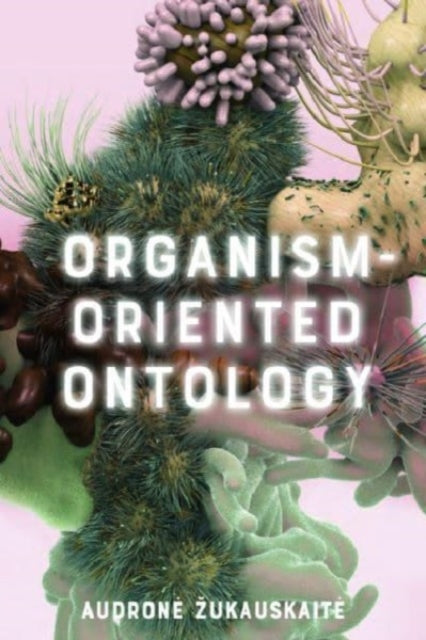
Audrone Zukauskaite
Organism-Oriented Ontology
Organism-Oriented Ontology
We can order this item for you. Delivery usually takes about 4 to 6 weeks.
This item is not held in our immediate stock. We will order it for you after checkout.
Estimated delivery: About 4 to 6 weeks
YOU SAVE £24.60
- Condition: Brand new
- UK Delivery times: Usually arrives within 2 - 3 working days
- UK Shipping: Fee starts at £3.89. Subject to product weight & dimension
Bulk ordering. Want 15 or more copies? Get a personalised quote and bigger discounts. Learn more about bulk orders.
Couldn't load pickup availability
- More about Organism-Oriented Ontology
Audron ukauskait argues that contemporary philosophy is increasingly interested in organism-oriented ontology, which focuses on processes, multiplicities, and potential for change, as an antidote to biopolitical power and control in the Anthropocene.
Format: Hardback
Length: 184 pages
Publication date: 31 August 2023
Publisher: Edinburgh University Press
Audron ukauskait explores the philosophy of Gilbert Simondon, Raymond Ruyer, Gilles Deleuze, and Flix Guattari, as well as contemporary thinkers such as Catherine Malabou, Bernard Stiegler, Bruno Latour, and Donna J. Haraway, to argue that all these threads can be seen as precursors to organism-oriented ontology. Instead of focusing on individuals and identities, contemporary philosophy is increasingly interested in processes, multiplicities, and potential for change, which define living beings. ukauskait contends that the capacity of living beings for self-organisation, creativity, and contingency can act as an antidote to biopolitical power and control in the times of the Anthropocene.
Simondon's philosophy emphasizes the importance of individuation and the emergence of new forms of life through processes of self-organisation. He argues that living beings are not just objects but also subjects with their own capacities for action and transformation. Ruyer's philosophy, on the other hand, focuses on the relationship between the individual and the world, and he argues that the world is not a static entity but a dynamic and evolving system. Deleuze and Guattari's philosophy, known as "rhizomatic ontology," emphasizes the interconnectedness of all things and the potential for new forms of life to emerge from the interconnections between different elements.
Malabou's philosophy, in contrast, emphasizes the role of memory and the capacity of living beings to create new meanings and narratives. She argues that the capacity of living beings to create meaning is essential for their survival and that the loss of meaning can lead to a sense of despair and disorientation. Stiegler's philosophy, meanwhile, focuses on the role of technology in shaping our understanding of the world and our place in it. He argues that technology has the potential to both liberate and enslave us and that we need to develop a new relationship with technology that is more ethical and sustainable.
Latour's philosophy, known as "actor-network theory," emphasizes the importance of networks and the role of non-human actors in shaping our world. He argues that the world is not a collection of objects but a network of relationships and that non-human actors, such as animals, plants, and machines, have their own agency and can influence our lives. Haraway's philosophy, finally, focuses on the intersection of science, technology, and feminism and argues that these fields can be used to create a more just and equitable world.
All of these thinkers share a common interest in the potential of living beings to create new forms of life and to resist biopolitical power and control. They argue that the capacity of living beings for self-organisation, creativity, and contingency can help us to navigate the challenges of the Anthropocene and to create a more sustainable and just world.
One of the key themes in contemporary philosophy is the idea of the "anthropocene," which refers to the current geological epoch in which human activity has had a significant impact on the Earth's environment. The Anthropocene has led to a range of environmental problems, including climate change, deforestation, and pollution, and has also had a significant impact on human societies.
In response to the Anthropocene, contemporary philosophy is increasingly interested in the idea of organism-oriented ontology. This approach emphasizes the importance of living beings as subjects with their own capacities for action and transformation. It argues that living beings are not just objects but also subjects with their own histories, cultures, and identities.
One of the key challenges of organism-oriented ontology is the question of how to understand the relationship between the individual and the world. Simondon argues that the individual is not a static entity but a dynamic and evolving system that is constantly interacting with the world. Ruyer, on the other hand, argues that the world is not a static entity but a dynamic and evolving system that is constantly changing and evolving.
Deleuze and Guattari's philosophy, known as "rhizomatic ontology," emphasizes the interconnectedness of all things and the potential for new forms of life to emerge from the interconnections between different elements. They argue that the world is not a collection of objects but a network of relationships and that new forms of life can emerge from the interconnections between different elements.
Malabou's philosophy, in contrast, emphasizes the role of memory and the capacity of living beings to create new meanings and narratives. She argues that the capacity of living beings to create meaning is essential for their survival and that the loss of meaning can lead to a sense of despair and disorientation.
Stiegler's philosophy, meanwhile, focuses on the role of technology in shaping our understanding of the world and our place in it. He argues that technology has the potential to both liberate and enslave us and that we need to develop a new relationship with technology that is more ethical and sustainable.
Latour's philosophy, known as "actor-network theory," emphasizes the importance of networks and the role of non-human actors in shaping our world. He argues that the world is not a collection of objects but a network of relationships and that non-human actors, such as animals, plants, and machines, have their own agency and can influence our lives.
Haraway's philosophy, finally, focuses on the intersection of science, technology, and feminism and argues that these fields can be used to create a more just and equitable world. She argues that the current system of power and control is based on a patriarchal and colonialist ideology and that we need to develop a new system that is more inclusive and democratic.
In conclusion, Audron ukauskait's argument that all these threads can be seen as precursors to organism-oriented ontology is a compelling one. Contemporary philosophy is increasingly interested in the potential of living beings to create new forms of life and to resist biopolitical power and control. By emphasizing the importance of self-organisation, creativity, and contingency, these thinkers can help us to navigate the challenges of the Anthropocene and to create a more sustainable and just world.
Weight: 363g
Dimension: 216 x 140 x 13 (mm)
ISBN-13: 9781399510547
UK and International shipping information
UK and International shipping information
We deliver throughout the United Kingdom and to 128 countries and territories worldwide, including the United States, Australia, Canada, Germany, Spain and France.