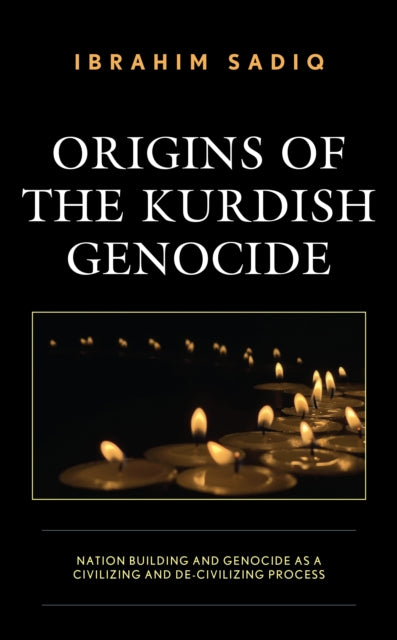
Ibrahim Sadiq
Origins of the Kurdish Genocide: Nation Building and Genocide as a Civilizing and De-Civilizing Process
Origins of the Kurdish Genocide: Nation Building and Genocide as a Civilizing and De-Civilizing Process
💎 Earn 169 Points (£1.69) on this item.
We can order this item for you. Delivery usually takes about 4 to 6 weeks.
This item is not held in our immediate stock. We will order it for you after checkout.
Estimated delivery: About 4 to 6 weeks
- Condition: Brand new
- UK Delivery times: Usually arrives within 2 - 3 working days
- UK Shipping: Fee starts at £2.39. Subject to product weight & dimension
Bulk ordering. Want 15 or more copies? Get a personalised quote and bigger discounts. Learn more about bulk orders.
Couldn't load pickup availability
- More about Origins of the Kurdish Genocide: Nation Building and Genocide as a Civilizing and De-Civilizing Process
The author argues that a part of the history of nation building in Iraq through addressing its political characters,different communities,agreements, and pan-Arab ideology, including the Baath ideology and its attempts to seize power through nondemocratic methods. It is an attempt to approach the essence of the exclusion mentality of the ruling elite in order to understand the process of genocide against the Kurdish people, including all existing religious minorities. This essence of the process has been approached in the framework of the civilizing and de-civilizing process as a main theory of the German sociologist Norbert Elias. Thus, this book may be considered as one of the comprehensive books to present a study of state-building in Iraq, along with identifying some of the political figures that had an essential impact on the construction. On the other hand, it is a comprehensive study of the genocide, in the sense of searching for the causes and roots of the genocide.
Format: Paperback / softback
Length: 246 pages
Publication date: 15 March 2023
Publisher: Lexington Books
The author delves into the intricate tapestry of Iraq's nation-building journey, exploring the diverse political characters, communities, agreements, and pan-Arab ideologies that have shaped its history. This comprehensive analysis encompasses the Baath ideology and its relentless pursuit of power, often through undemocratic means. By examining the exclusion mentality of the ruling elite, the author seeks to unravel the tragic genocide perpetrated against the Kurdish people, including all religious minorities. This profound exploration is framed within the framework of the civilizing and de-civilizing process, a central theory developed by the German sociologist Norbert Elias. This book stands as a seminal work in understanding the complexities of state-building in Iraq, highlighting the pivotal political figures who have left an indelible mark on the country's development. Moreover, it serves as a comprehensive examination of the genocide, delving into its causes and roots to shed light on this dark chapter of history. The Anfal campaigns, which occurred in 1988, mark a tragic chapter in this narrative, but the roots of the genocide extend far back into the late 1960s and early 1970s. Through meticulous research and analysis, the author unravels the intricate threads that connect these events, providing a deeper understanding of the complex dynamics that shaped Iraq's past and present. This book is a valuable contribution to the field of history, offering insights into the forces that have shaped the nation and shedding light on the ongoing struggle for justice and equality in the region.
The author argues that a significant part of Iraq's history of nation-building lies in addressing the political characters, diverse communities, agreements, and pan-Arab ideologies that have shaped the country's development. This comprehensive analysis encompasses the Baath ideology and its attempts to seize power through undemocratic methods. By examining the exclusion mentality of the ruling elite, the author seeks to understand the tragic genocide perpetrated against the Kurdish people, including all religious minorities. This profound exploration is framed within the framework of the civilizing and de-civilizing process, a central theory developed by the German sociologist Norbert Elias. This book stands as a seminal work in understanding the complexities of state-building in Iraq, highlighting the pivotal political figures who have left an indelible mark on the country's development. Moreover, it serves as a comprehensive examination of the genocide, delving into its causes and roots to shed light on this dark chapter of history. The Anfal campaigns, which occurred in 1988, mark a tragic chapter in this narrative, but the roots of the genocide extend far back into the late 1960s and early 1970s. Through meticulous research and analysis, the author unravels the intricate threads that connect these events, providing a deeper understanding of the complex dynamics that shaped Iraq's past and present. This book is a valuable contribution to the field of history, offering insights into the forces that have shaped the nation and shedding light on the ongoing struggle for justice and equality in the region.
Weight: 454g
Dimension: 229 x 152 (mm)
ISBN-13: 9781793636843
This item can be found in:
UK and International shipping information
UK and International shipping information
UK Delivery and returns information:
- Delivery within 2 - 3 days when ordering in the UK.
- Shipping fee for UK customers from £2.39. Fully tracked shipping service available.
- Returns policy: Return within 30 days of receipt for full refund.
International deliveries:
Shulph Ink now ships to Australia, Belgium, Canada, France, Germany, Ireland, Italy, India, Luxembourg Saudi Arabia, Singapore, Spain, Netherlands, New Zealand, United Arab Emirates, United States of America.
- Delivery times: within 5 - 10 days for international orders.
- Shipping fee: charges vary for overseas orders. Only tracked services are available for most international orders. Some countries have untracked shipping options.
- Customs charges: If ordering to addresses outside the United Kingdom, you may or may not incur additional customs and duties fees during local delivery.