Paul RaymondTrebilco
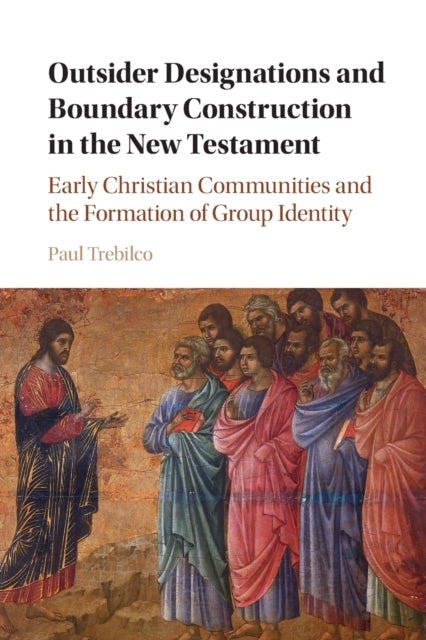
Outsider Designations and Boundary Construction in the New Testament: Early Christian Communities and the Formation of Group Identity
Outsider Designations and Boundary Construction in the New Testament: Early Christian Communities and the Formation of Group Identity
💎 Earn 188 Points (£1.88) on this item.
We can order this item for you. Delivery usually takes about 4 to 6 weeks.
This item is not held in our immediate stock. We will order it for you after checkout.
Estimated delivery: About 4 to 6 weeks
YOU SAVE £2.24
- Condition: Brand new
- UK Delivery times: Usually arrives within 2 - 3 working days
- UK Shipping: Fee starts at £2.39. Subject to product weight & dimension
Bulk ordering. Want 15 or more copies? Get a personalised quote and bigger discounts. Learn more about bulk orders.
Couldn't load pickup availability
- More about Outsider Designations and Boundary Construction in the New Testament: Early Christian Communities and the Formation of Group Identity
Early Christians used terms such as unbelievers, outsiders, sinners, Gentiles, and Jews to refer to non-members. Paul Trebilco explores the usage and development of these terms across the New Testament, drawing on insights from social identity theory, sociolinguistics, and the sociology of deviance. His analysis leads to new conclusions about the identity and character of the early Christian movement, the range of relations between early Christians and outsiders, and the theology of particular New Testament authors.
\n Format: Paperback / softback
\n Length: 370 pages
\n Publication date: 11 November 2021
\n Publisher: Cambridge University Press
\n
Early Christians referred to non-members of their faith as outsiders or non-believers. They used a range of terms to describe these individuals, including unbelievers, outsiders, sinners, Gentiles, and Jews. These terms were used to differentiate between those who were part of the Christian community and those who were not.
The usage of these outsider designations in the New Testament can be traced back to the earliest days of the Christian movement. In the book of Acts, for example, Paul refers to the Gentiles as "the uncircumcised" and the Jews as "the circumcised." These terms were used to emphasize the divide between the two groups and to highlight the importance of circumcision as a marker of belonging to the Jewish faith.
Over time, the usage of these outsider designations evolved and became more complex. In the book of Romans, for example, Paul uses the term "Gentiles" to refer to all non-Jewish people, regardless of their cultural or religious background. He argues that all people are sinners and that salvation is available to all, regardless of their ethnicity or religion.
The outsider designations used by early Christians were not just about differentiating between groups of people but also about constructing boundaries between the Christian community and the wider world. These terms were used to create a sense of belonging and identity for those who were part of the Christian community and to marginalize and exclude those who were not.
Trebilco's book-length investigation of these questions explores the usage and development of these outsider designations across the New Testament. He draws on insights from social identity theory, sociolinguistics, and the sociology of deviance to investigate how these terms function in boundary construction across several texts.
One of the key findings of Trebilco's analysis is that the outsider designations used by early Christians were not just about differentiating between groups of people but also about constructing boundaries between the Christian community and the wider world. These terms were used to create a sense of belonging and identity for those who were part of the Christian community and to marginalize and exclude those who were not.
Another key finding of Trebilco's analysis is that the outsider designations used by early Christians were not just about differentiating between groups of people but also about constructing boundaries between the Christian community and the wider world. These terms were used to create a sense of belonging and identity for those who were part of the Christian community and to marginalize and exclude those who were not.
Trebilco's analysis also leads to new conclusions about the identity and character of the early Christian movement. He argues that the early Christian movement was not just a religious movement but also a social movement that sought to transform the wider world. He suggests that the outsider designations used by early Christians were part of this broader social movement and were used to create a sense of identity and purpose for those who were part of the Christian community.
In conclusion, the outsider designations used by early Christians were not just about differentiating between groups of people but also about constructing boundaries between the Christian community and the wider world. These terms were used to create a sense of belonging and identity for those who were part of the Christian community and to marginalize and exclude those who were not. Trebilco's book-length investigation of these questions provides valuable insights into the identity and character of the early Christian movement and the range of relations between early Christians and outsiders.
\n Weight: 566g\n
Dimension: 152 x 231 x 28 (mm)\n
ISBN-13: 9781108408141\n
Edition number: New ed\n
This item can be found in:
UK and International shipping information
UK and International shipping information
UK Delivery and returns information:
- Delivery within 2 - 3 days when ordering in the UK.
- Shipping fee for UK customers from £2.39. Fully tracked shipping service available.
- Returns policy: Return within 30 days of receipt for full refund.
International deliveries:
Shulph Ink now ships to Australia, Belgium, Canada, France, Germany, Ireland, Italy, India, Luxembourg Saudi Arabia, Singapore, Spain, Netherlands, New Zealand, United Arab Emirates, United States of America.
- Delivery times: within 5 - 10 days for international orders.
- Shipping fee: charges vary for overseas orders. Only tracked services are available for most international orders. Some countries have untracked shipping options.
- Customs charges: If ordering to addresses outside the United Kingdom, you may or may not incur additional customs and duties fees during local delivery.