Tim Williams
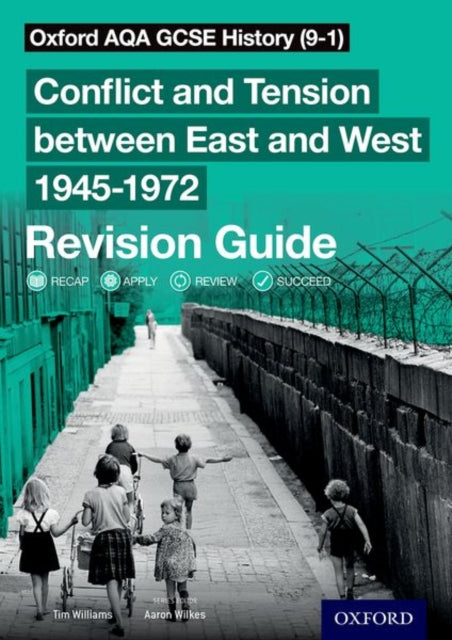
Oxford AQA GCSE History (9-1): Conflict and Tension between East and West 1945-1972 Revision Guide
Oxford AQA GCSE History (9-1): Conflict and Tension between East and West 1945-1972 Revision Guide
YOU SAVE £1.61
- Condition: Brand new
- UK Delivery times: Usually arrives within 2 - 3 working days
- UK Shipping: Fee starts at £3.89. Subject to product weight & dimension
Bulk ordering. Want 15 or more copies? Get a personalised quote and bigger discounts. Learn more about bulk orders.
Couldn't load pickup availability
- More about Oxford AQA GCSE History (9-1): Conflict and Tension between East and West 1945-1972 Revision Guide
The Oxford AQA GCSE History (9-1) Conflict and Tension between East and West 1945-1972 Revision Guide is a comprehensive resource for students studying the Cold War. It covers key events, applies knowledge with revision activities, and provides step-by-step exam guidance. Perfect for use alongside the Student Book and Kerboodle, or as a stand-alone resource for independent revision.
Format: Paperback / softback
Length: 72 pages
Publication date: 18 October 2018
Publisher: Oxford University Press
The Cold War, a period of intense geopolitical tension and conflict between the United States and the Soviet Union, had a profound impact on world politics and international relations from 1945 to 1972. This Conflict and Tension between East and West Revision Guide is part of the popular Oxford AQA GCSE History (9-1) series, written by our original author team to match the new AQA specification. The guide covers exactly what your students require to succeed in the Paper 1 Conflict and Tension between East and West Wider World Depth Study exams.
Recap key events of the Cold War with clear visual diagrams and brief points, helping your students to understand the historical context and significance of this period. Apply knowledge with targeted revision activities that test basic comprehension, then apply understanding towards exam-style questions. Review and track revision with progress checklists, suggested activity answers, and Exam Practice sections.
Step-by-step exam guidance based on the popular "How to" student book feature, providing your students with a clear roadmap to success. Examiner Tip features most up-to-date expert advice and identifies common exam mistakes, helping your students to avoid common pitfalls and boost their confidence on all AQA GCSE Conflict and Tension question types.
Perfect for use alongside the Student Book and Kerboodle, or as a stand-alone resource for independent revision, this revision guide helps your students recap, apply, and review their way towards exam success.
The Cold War was a period of intense geopolitical tension and conflict between the United States and the Soviet Union, lasting from 1945 to 1972. It was characterized by a series of proxy wars, arms races, and ideological clashes, with the two superpowers engaged in a constant struggle for global dominance.
The Cold War began shortly after World War II, when the United States and the Soviet Union emerged as the world's two superpowers. The two countries had different ideologies and goals, with the United States promoting democracy, capitalism, and individual freedom, while the Soviet Union advocated communism, socialism, and state control.
The Cold War was marked by a series of events that shaped the world's political landscape. These included the Berlin Airlift, the Cuban Missile Crisis, the Vietnam War, and the collapse of the Soviet Union in 1991.
The Cold War had a profound impact on world politics and international relations. It led to the establishment of NATO, a military alliance of Western countries designed to counter Soviet aggression. It also led to the development of nuclear weapons, which were used in the atomic bombings of Hiroshima and Nagasaki in 1945.
The Cold War also had a significant impact on the lives of ordinary people around the world. It led to the emergence of the Cold War mentality, in which people were divided into two camps, with those who supported the United States and those who supported the Soviet Union. It also led to the development of a global arms race, in which countries competed to develop more powerful weapons and technologies.
The Cold War ended in 1991 with the collapse of the Soviet Union. This marked the end of a period of intense geopolitical tension and conflict that had lasted for decades. The collapse of the Soviet Union was a result of a combination of factors, including economic collapse, political instability, and the rise of democratic movements in Eastern Europe.
The end of the Cold War was a significant milestone in world history. It marked the end of a period of global uncertainty and instability and paved the way for a new era of international cooperation and peace. However, the legacy of the Cold War continues to be felt today, and the world is still dealing with the consequences of this period of conflict.
In conclusion, the Cold War was a period of intense geopolitical tension and conflict between the United States and the Soviet Union that had a profound impact on world politics and international relations. It was marked by a series of events that shaped the world's political landscape and led to the development of nuclear weapons and the Cold War mentality. The Cold War ended in 1991 with the collapse of the Soviet Union, but its legacy continues to be felt today.
Weight: 222g
Dimension: 209 x 296 x 5 (mm)
ISBN-13: 9780198432883
UK and International shipping information
UK and International shipping information
We deliver throughout the United Kingdom and to 128 countries and territories worldwide, including the United States, Australia, Canada, Germany, Spain and France.