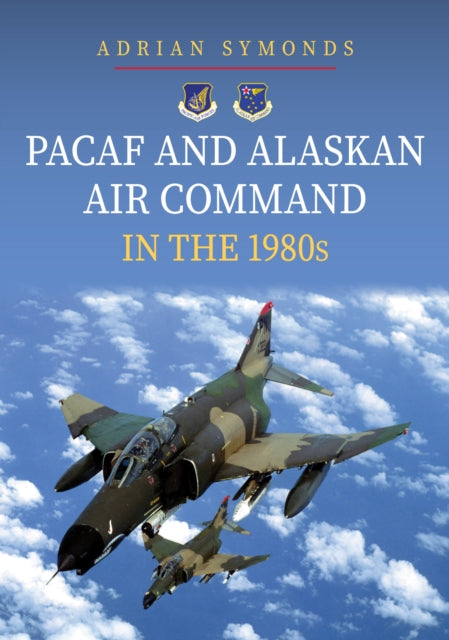
Adrian Symonds
PACAF and Alaskan Air Command in the 1980s
PACAF and Alaskan Air Command in the 1980s
YOU SAVE £5.05
- Condition: Brand new
- UK Delivery times: Usually arrives within 2 - 3 working days
- UK Shipping: Fee starts at £3.89. Subject to product weight & dimension
Bulk ordering. Want 15 or more copies? Get a personalised quote and bigger discounts. Learn more about bulk orders.
Couldn't load pickup availability
- More about PACAF and Alaskan Air Command in the 1980s
PACAF and AAC were Major Commands of the United States Air Force, responsible for units stationed in Hawaii, Japan, South Korea, and the Philippines, facing threats from the Soviet Union, China, and North Korea. They received modernised equipment during the 1980s and were supported by aircraft deployed from the contiguous United States.
Format: Paperback / softback
Length: 96 pages
Publication date: 15 September 2024
Publisher: Amberley Publishing
Pacific Air Forces (PACAF) and Alaskan Air Command (AAC) - Major Commands of the United States Air Force
The United States Air Force was divided into several Major Commands, each with its own unique responsibilities. Two of these Major Commands were the Pacific Air Forces (PACAF) and the Alaskan Air Command (AAC). PACAF was responsible for units stationed in Hawaii, Japan, South Korea, and the Philippines, covering an area of over 100 million square miles. Its primary focus was on the threats posed by the Soviet Union, the Peoples Republic of China, and North Korea. On the other hand, AAC was responsible for providing air-defence forces, which were operationally tasked by North American Aerospace Defense Command (NORAD), as well as other tactical units stationed within the state of Alaska. Both commands received modernized equipment during the 1980s, and they were supported by aircraft deployed from the contiguous United States by Strategic Air Command, Tactical Air Command, Military Airlift Command, Air National Guard, and Air Force Reserve units.
PACAF's Area of Responsibility
PACAF's area of responsibility was vast and diverse. It included the Pacific Ocean, the Indian Ocean, and the Arctic Ocean, as well as the surrounding landmasses. The command was responsible for defending these areas from any potential threats, including air attacks, naval attacks, and ground attacks. To achieve this, PACAF had a wide range of aircraft and weapons at its disposal, including fighter jets, bombers, helicopters, and surface-to-air missiles. The command also had a network of radar and surveillance systems that provided early warning of any potential threats. PACAF's forces were constantly on alert, ready to respond to any emergency that may arise. They conducted regular training exercises and participated in joint exercises with other military units to improve their skills and coordination. Despite the challenges that they faced, PACAF's forces were successful in maintaining peace and stability in the region. They played a crucial role in the Cold War, and their efforts were recognized by the United States government and the international community.
AAC's Role in Air-Defence
AAC's role in air-defence was equally important. The command was responsible for providing air-defence forces to protect the state of Alaska from any potential threats. These forces included fighter jets, bombers, helicopters, and surface-to-air missiles. AAC's forces were constantly on alert, ready to respond to any emergency that may arise. They conducted regular training exercises and participated in joint exercises with other military units to improve their skills and coordination. AAC's forces were also responsible for providing support to other military units in the state of Alaska, including the Alaska Army National Guard and the Alaska Air National Guard. Despite the challenges that they faced, AAC's forces were successful in maintaining peace and stability in the region. They played a crucial role in the Cold War, and their efforts were recognized by the United States government and the international community.
Modernization in the 1980s
During the 1980s, PACAF and AAC received modernized equipment that greatly improved their capabilities. This equipment included advanced fighter jets, bombers, helicopters, and surface-to-air missiles. The modernization program was designed to improve the command's ability to respond to any potential threats, including air attacks, naval attacks, and ground attacks. The equipment was also designed to be more efficient and cost-effective, which allowed the commands to save money and resources. The modernization program was a significant investment for the United States Air Force, and it paid off in the long run. PACAF and AAC's forces were able to operate more effectively and efficiently, and they were able to respond to any emergency that may arise.
Support from Strategic Air Command, Tactical Air Command, Military Airlift Command, Air National Guard, and Air Force Reserve
PACAF and AAC were supported by a number of other military units, including Strategic Air Command, Tactical Air Command, Military Airlift Command, Air National Guard, and Air Force Reserve units. These units provided support in a variety of ways, including providing aircraft, weapons, and personnel. Strategic Air Command provided aircraft that were used for long-range missions, while Tactical Air Command provided aircraft that were used for short-range missions. Military Airlift Command provided aircraft that were used for transporting troops and equipment, while Air National Guard and Air Force Reserve units provided personnel that were used for support and maintenance. The support provided by these units was essential to the success of PACAF and AAC's operations.
Conclusion
The Pacific Air Forces (PACAF) and the Alaskan Air Command (AAC) were two of the United States Air Force's Major Commands during the 1980s. PACAF was responsible for units stationed in Hawaii, Japan, South Korea, and the Philippines, covering an area of over 100 million square miles. Its primary focus was on the threats posed by the Soviet Union, the Peoples Republic of China, and North Korea. AAC was responsible for providing air-defence forces, which were operationally tasked by North American Aerospace Defense Command (NORAD), as well as other tactical units stationed within the state of Alaska. Both commands received modernized equipment during the 1980s, and they were supported by aircraft deployed from the contiguous United States by Strategic Air Command, Tactical Air Command, Military Airlift Command, Air National Guard, and Air Force Reserve units. The modernization program was a significant investment for the United States Air Force, and it paid off in the long run. PACAF and AAC's forces were able to operate more effectively and efficiently, and they were able to respond to any emergency that may arise. The support provided by these units was essential to the success of PACAF and AAC's operations.
Weight: 304g
Dimension: 233 x 165 x 11 (mm)
ISBN-13: 9781398115842
UK and International shipping information
UK and International shipping information
We deliver throughout the United Kingdom and to 128 countries and territories worldwide, including the United States, Australia, Canada, Germany, Spain and France.