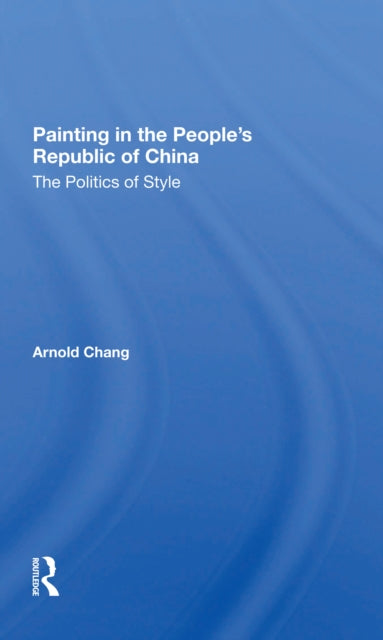
Arnold Chang
Painting In The People's Republic Of China: The Politics Of Style
Painting In The People's Republic Of China: The Politics Of Style
💎 Earn 207 Points (£2.07) on this item.
We can order this item for you. Delivery usually takes about 4 to 6 weeks.
This item is not held in our immediate stock. We will order it for you after checkout.
Estimated delivery: About 4 to 6 weeks
YOU SAVE £2.47
- Condition: Brand new
- UK Delivery times: Usually arrives within 2 - 3 working days
- UK Shipping: Fee starts at £2.39. Subject to product weight & dimension
Bulk ordering. Want 15 or more copies? Get a personalised quote and bigger discounts. Learn more about bulk orders.
Couldn't load pickup availability
- More about Painting In The People's Republic Of China: The Politics Of Style
The relationship between politics and art in China is complex, with the government playing a direct and active role in overseeing the nation's artistic production. This study explores the major statements of artistic policy and the effects of these policies on artists, focusing on the experiences of three such artists who specialize in landscape.
Format: Paperback / softback
Length: 144 pages
Publication date: 29 July 2022
Publisher: Taylor & Francis Ltd
The intricate interplay between politics and art in any society transcends a simplistic notion of cause and effect. Political and artistic realms are intricately interconnected through a web of complex interactions and associations. In the People's Republic of China, where politics permeates every aspect of society, and where the act of creating art itself is considered a political statement, this relationship takes on a particularly distinct character. The Chinese government assumes a direct and active role in overseeing the nation's artistic production, as well as in setting the standards for critical evaluation. This study is structured into three distinct chapters. Chapter 1 provides an overview of the major artistic policies and the theoretical framework upon which they are grounded. Chapter 2 delves into the impact of these policies on artists, exploring the responses of painters to the political demands placed upon them. Chapter 3, in turn, focuses on the experiences of three notable artists: Kuan Shan-yueh, Li K o-jan, and Ch ien Sung-yen. All three specialize in landscape, a genre that has posed particular challenges, and all three incorporate both Western techniques and traditional Chinese methods of drawing.
The relationship between politics and art in China is a multifaceted and complex one, shaped by the country's unique political system and cultural heritage. In the People's Republic of China, where the government plays a central role. role in overseeing artistic production and determining critical judgment, the relationship between politics and art is more pronounced than in many other societies.
Chapter 1: Artistic Policy and Theoretical Structure
In China, the government has established a comprehensive set of artistic policies to guide and regulate artistic production. These policies are based on a theoretical framework that emphasizes the role of art in promoting social stability, national unity, and cultural heritage. The theoretical framework includes the concept of "socialist realism," which advocates for the creation of art that reflects the realities of the socialist society and promotes the values of the Communist Party.
Chapter 2: Effect of Artistic Policies on Artists
The effect of these artistic policies on artists in China has been profound. On the one hand, the policies have provided a framework for artists to express themselves and create works that reflect the realities of their society. On the other hand, the policies have also placed strict restrictions on artistic freedom, limiting the topics and styles that artists can explore.
One of the most significant effects of the artistic policies on artists in China has been the emphasis on socialist realism. This style of art is characterized by its focus on depicting the working class, the poor, and the marginalized, and it is often used to promote the values of the Communist Party and the state. While socialist realism has been a valuable tool for artists in China to express their political beliefs, it has also limited the range of artistic expression. Many artists have felt constrained by the strict guidelines and limitations imposed by socialist realism, and have sought to explore other styles and topics that are not directly related to the state or the party.
Another effect of the artistic policies on artists in China has been the emphasis on promoting national unity. The government has sought to use art to promote national unity and cultural heritage, and to instill a sense of pride. of pride in the Chinese people. This has led to the creation of a wide range of artistic works that celebrate the country. Chinese culture, history, and traditions. and promote the values of the Communist Party. However, the emphasis on promoting national unity has also led to the suppression of certain forms of artistic expression.
Chapter 3: Experiences of Three Artists
To better understand the relationship between politics and art in China, this study will focus on the experiences of three artists who specialize in landscape painting. Kuan Shan-yueh, Li K o-jan, and Ch ien Sung-yen are three such artists who have faced unique challenges and opportunities in their artistic careers.
Kuan Shan-yueh is a renowned landscape painter who has been active in China since the 1950s. He is known for his use of traditional Chinese techniques of drawing and painting, such as ink wash and rice paper, to create works that celebrate the beauty of nature and the simplicity of life. Kuan Shan-yueh has faced significant challenges in his artistic career, particularly during the Cultural Revolution in the 1960s and 1970s. He was persecuted by the government for his political beliefs and was forced to flee to the United States in 1979. However, he has since returned to China and has continued to create works that celebrate the beauty of nature and the simplicity of life.
Li K o-jan is a contemporary landscape painter who has been active in China since the 1980s. He is known for his use of bold colors and abstract forms to create works that explore the relationship between humans and nature. Li K o-jan has faced significant challenges in his artistic career, particularly during the period of economic reform and opening up in the 1980s. He was persecuted by the government for his political beliefs and was forced to flee to the United States in 1989. However, he has since returned to China and has continued to create works that explore the relationship between humans and nature.
Ch ien Sung up-yen is a contemporary landscape painter who has been active in China since the 1990s. He is known for his use of traditional Chinese techniques of drawing and painting to create works that celebrate the beauty of nature and the simplicity of life. Ch ien Sung-yen has faced significant challenges in his artistic career, particularly during the period of economic reform and opening up in the 1990s. He was persecuted by the government for his political beliefs and was forced to flee to the United States in 1999. However, he has since returned to China and has continued to create works that celebrate the beauty of nature and the simplicity of life.
In conclusion, the relationship between politics and art in any society is a complex and multifaceted one, shaped by a web of complex interactions and associations. In the People's Republic of China, where politics permeates every aspect of society, and where the act of creating art itself is considered a political statement, this relationship takes on a particularly distinct character. The Chinese government assumes a direct and active role in overseeing the nation's artistic production, as well as in setting the standards for critical evaluation. This study is structured into three distinct chapters. Chapter 1 provides an overview of the major artistic policies and the theoretical framework upon which they are grounded. Chapter 2 delves into the impact of these policies on artists, exploring the responses of painters to the political demands placed upon them. Chapter 3, in turn, focuses on the experiences of three notable artists: Kuan Shan-yueh, Li K o-jan, and Ch ien Sung-yen. All three specialize in landscape, a genre that has posed particular challenges, and all three incorporate both Western techniques and traditional Chinese methods of drawing.
Weight: 270g
ISBN-13: 9780367297572
UK and International shipping information
UK and International shipping information
UK Delivery and returns information:
- Delivery within 2 - 3 days when ordering in the UK.
- Shipping fee for UK customers from £2.39. Fully tracked shipping service available.
- Returns policy: Return within 30 days of receipt for full refund.
International deliveries:
Shulph Ink now ships to Australia, Belgium, Canada, France, Germany, Ireland, Italy, India, Luxembourg Saudi Arabia, Singapore, Spain, Netherlands, New Zealand, United Arab Emirates, United States of America.
- Delivery times: within 5 - 10 days for international orders.
- Shipping fee: charges vary for overseas orders. Only tracked services are available for most international orders. Some countries have untracked shipping options.
- Customs charges: If ordering to addresses outside the United Kingdom, you may or may not incur additional customs and duties fees during local delivery.