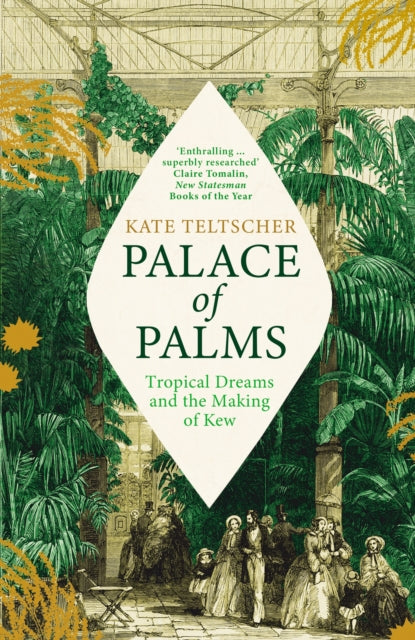
Kate Teltscher
Palace of Palms: Tropical Dreams and the Making of Kew
Palace of Palms: Tropical Dreams and the Making of Kew
💎 Earn 35 Points (£0.35) on this item.
YOU SAVE £2.92
- Condition: Brand new
- UK Delivery times: Usually arrives within 2 - 3 working days
- UK Shipping: Fee starts at £2.39. Subject to product weight & dimension
Bulk ordering. Want 15 or more copies? Get a personalised quote and bigger discounts. Learn more about bulk orders.
Couldn't load pickup availability
- More about Palace of Palms: Tropical Dreams and the Making of Kew
The Palm House in Kew Gardens is a magnificent glass building that was commissioned by Sir William Hooker, designed by Richard Turner, and managed by John Smith. It is a story of breathtaking ambition, scientific discovery, and the remarkable men who made it possible.
\n Format: Paperback / softback
\n Length: 400 pages
\n Publication date: 10 June 2021
\n Publisher: Pan Macmillan
\n
Palace of Palms: A Glorious Green Adventure Story
Ann Treneman, The Times Books of the Year
"The most enthralling historical book I've read this year." - Claire Tomalin, New Statesman
Books of the Year
Daringly innovative when it opened in 1848, the Palm House in Kew Gardens remains one of the most beautiful glass buildings in the world today.
Seemingly weightless, vast, and yet light, the Palm House floats free from architectural convention, at once monumental and ethereal. From a distance, the crowns of the palms within are silhouetted in the central dome; close to, banana leaves thrust themselves against the glass. To enter it is to enter a tropical fantasy. The body is assaulted by heat, light, and the smell of damp vegetation.
In "Palace of Palms," Kate Teltscher tells the extraordinary story of its creation and of the Victorians' obsession with the palms that filled it. It is a story of breathtaking ambition, scientific discovery, and, crucially, of the remarkable men whose vision it was.
The Palm House was commissioned by the charismatic first Director of Kew, Sir William Hooker, designed by the audacious Irish engineer, Richard Turner, and managed by Kew's forthright curator, John Smith, who battled with boilers and floods to ensure the survival of the rare and wondrous plants it housed.
The Palm House's construction was a remarkable feat of engineering and design. The building was constructed using a unique system of iron and glass, which allowed it to be lightweight and yet strong enough to withstand the harsh British weather. The central dome, which houses the palm trees, was designed to be a masterpiece of engineering, with a series of arches and columns supporting the glass roof.
The Palm House's interior was equally impressive, with a series of rooms and galleries designed to showcase the plants and flowers that filled it. The rooms were filled with exotic plants from around the world, including orchids, bromeliads, and cacti. The walls were decorated with murals and paintings, which depicted scenes from tropical landscapes and botanical gardens.
The Palm House's creation was not without its challenges. The building was plagued by problems with boilers and floods, which threatened to destroy the rare and delicate plants it housed. Smith and his team worked tirelessly to ensure the survival of the plants, battling with the weather and the machinery to keep the Palm House running smoothly.
Despite the challenges, the Palm House's success was undeniable. It became a popular attraction for visitors from around the world, who came to marvel at the beauty and exoticism of the plants and flowers that filled it. The Palm House also played a significant role in the scientific discovery of plants and flowers. Kew Gardens became a hub of botanical research, with scientists studying the plants and flowers that filled the Palm House and using their findings to develop new techniques and technologies for plant cultivation.
In conclusion, the Palm House in Kew Gardens is a magnificent example of architectural and scientific innovation. It is a story of breathtaking ambition, scientific discovery, and the remarkable men whose vision it was. The Palm House's creation was a remarkable feat of engineering and design, and its success has had a lasting impact on the world of botanical research and conservation. The Palm House remains a testament to the power of human creativity and ingenuity, and a symbol of the beauty and wonder of the natural world.
\n Weight: 310g\n
Dimension: 130 x 196 x 32 (mm)\n
ISBN-13: 9781529004885\n \n
This item can be found in:
UK and International shipping information
UK and International shipping information
UK Delivery and returns information:
- Delivery within 2 - 3 days when ordering in the UK.
- Shipping fee for UK customers from £2.39. Fully tracked shipping service available.
- Returns policy: Return within 30 days of receipt for full refund.
International deliveries:
Shulph Ink now ships to Australia, Belgium, Canada, France, Germany, Ireland, Italy, India, Luxembourg Saudi Arabia, Singapore, Spain, Netherlands, New Zealand, United Arab Emirates, United States of America.
- Delivery times: within 5 - 10 days for international orders.
- Shipping fee: charges vary for overseas orders. Only tracked services are available for most international orders. Some countries have untracked shipping options.
- Customs charges: If ordering to addresses outside the United Kingdom, you may or may not incur additional customs and duties fees during local delivery.