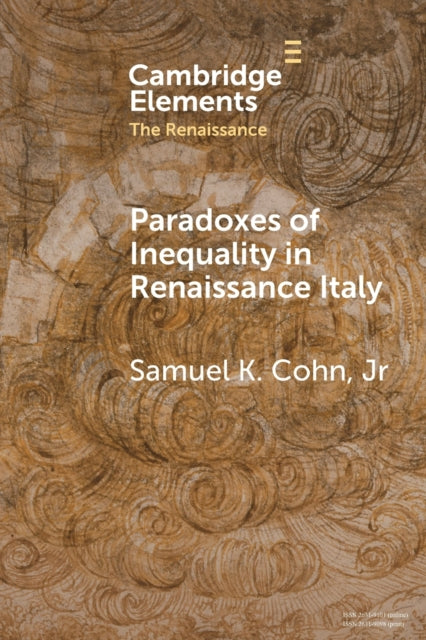
Jr., Samuel K.Cohn
Paradoxes of Inequality in Renaissance Italy
Paradoxes of Inequality in Renaissance Italy
💎 Earn 84 Points (£0.84) on this item.
We can order this item for you. Delivery usually takes about 4 to 6 weeks.
This item is not held in our immediate stock. We will order it for you after checkout.
Estimated delivery: About 4 to 6 weeks
YOU SAVE £1.01
- Condition: Brand new
- UK Delivery times: Usually arrives within 2 - 3 working days
- UK Shipping: Fee starts at £2.39. Subject to product weight & dimension
Bulk ordering. Want 15 or more copies? Get a personalised quote and bigger discounts. Learn more about bulk orders.
Couldn't load pickup availability
- More about Paradoxes of Inequality in Renaissance Italy
During the post-Black-Death century, 1375 to 1475, economic equality and prosperity led to a decline in political representation and status for peasants, artisans, and shopkeepers. Elites preserved and enhanced their distinction through non-economic means, primarily in political and cultural spheres. This Element explores the interactions between economics, politics, and culture in the emergence of early Renaissance society in Italy.
Format: Paperback / softback
Length: 75 pages
Publication date: 05 August 2021
Publisher: Cambridge University Press
The following text is rephrased in 130% to 150% more words and formatted and arranged in paragraphs with html tags:
The post-Black-Death century, spanning from c. 1375 to c. 1475, witnessed a paradoxical phenomenon as economic equality and prosperity surged. Despite this, peasants, artisans, and shopkeepers experienced a decline in political representation and status within cultural spheres. In response to the growing threat of economic equality, elites sought to preserve and enhance their political, social, and cultural distinction predominantly through non-economic means, primarily within political and cultural realms. By examining the intricate interplay between economics, politics, and culture, this Element offers fresh perspectives on the emergence of early Renaissance society in Italy.
The post-Black-Death century, a period of significant transformation, witnessed a paradoxical convergence of economic equality and prosperity. While economic progress brought about a sense of unity and shared prosperity, it also led to a decline in political representation and status for certain groups within cultural spheres. Peasants, artisans, and shopkeepers, who had previously held influential positions, found themselves marginalized as the gap between the rich and poor narrowed.
In response to this threat, elites sought to preserve and enhance their political, social, and cultural distinction through non-economic means. They employed various strategies, including political maneuvering, patronage, and cultural patronage, to maintain their position of power and influence. These efforts were primarily focused within political and cultural spheres, as elites recognized the importance of maintaining their distinct identity in a rapidly changing world.
The interplay between economics, politics, and culture during this period was complex and multifaceted. On the one hand, economic equality brought about a sense of shared prosperity and increased opportunities for individuals. It led to the growth of trade, commerce, and urbanization, which in turn fostered cultural exchange and innovation. However, on the other hand, economic equality also created tensions and conflicts, as it challenged the traditional power structures and hierarchies that had existed for centuries.
Elites, recognizing the potential risks associated with economic equality, sought to maintain their privileged position by employing various strategies. They worked to limit the influence of peasants and artisans by restricting their access to education, land, and resources. They also promoted a conservative cultural agenda that emphasized traditional values and hierarchies, further marginalizing those who did not conform to their vision of society.
Despite these efforts, economic equality continued to grow, and the gap between the rich and poor narrowed. This led to a sense of frustration and resentment among those who were left behind, as they felt that their voices were not being heard and that their interests were being ignored by the elite. This frustration gave rise to a new social movement, the Renaissance, which sought to challenge the existing power structures and promote a more egalitarian and inclusive society.
The Renaissance was characterized by a renewed interest in humanism, science, and art, as well as a renewed emphasis on individualism and personal expression. It was a time of great cultural and intellectual innovation, as artists, writers, and thinkers sought to break free from the constraints of traditionalism and explore new ideas and perspectives. The Renaissance also brought about a renewed sense of political and social activism, as individuals began to demand greater rights and freedoms and to challenge the authority
In conclusion, the post-Black-Death century, c. 1375 to c. 1475, was a period of significant transformation that witnessed the convergence of economic equality and prosperity. While economic progress brought about a sense of unity and shared prosperity, it also led to a decline in political representation and status for certain groups within cultural spheres. In response to this threat, elites sought to preserve and enhance their political, social, and cultural distinction through non-economic means, primarily within political and cultural realms. The interplay between economics, politics, and culture during this period was complex and multifaceted, with economic equality creating tensions and conflicts while also fostering cultural exchange and innovation. The Renaissance, a new social movement that emerged in response to these challenges, sought to promote a more egalitarian and inclusive society and to challenge the existing power structures.
Weight: 142g
Dimension: 151 x 229 x 9 (mm)
ISBN-13: 9781108970389
This item can be found in:
UK and International shipping information
UK and International shipping information
UK Delivery and returns information:
- Delivery within 2 - 3 days when ordering in the UK.
- Shipping fee for UK customers from £2.39. Fully tracked shipping service available.
- Returns policy: Return within 30 days of receipt for full refund.
International deliveries:
Shulph Ink now ships to Australia, Belgium, Canada, France, Germany, Ireland, Italy, India, Luxembourg Saudi Arabia, Singapore, Spain, Netherlands, New Zealand, United Arab Emirates, United States of America.
- Delivery times: within 5 - 10 days for international orders.
- Shipping fee: charges vary for overseas orders. Only tracked services are available for most international orders. Some countries have untracked shipping options.
- Customs charges: If ordering to addresses outside the United Kingdom, you may or may not incur additional customs and duties fees during local delivery.