Sean Carroll
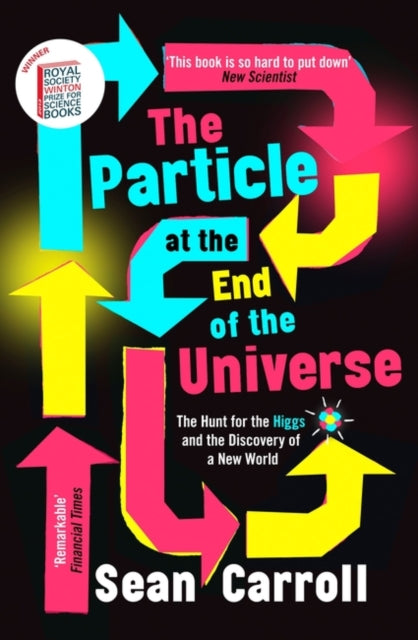
Particle at the End of the Universe: Winner of the Royal Society Winton Prize
Particle at the End of the Universe: Winner of the Royal Society Winton Prize
💎 Earn 38 Points (£0.38) on this item.
YOU SAVE £5.33
- Condition: Brand new
- UK Delivery times: Usually arrives within 2 - 3 working days
- UK Shipping: Fee starts at £2.39. Subject to product weight & dimension
Bulk ordering. Want 15 or more copies? Get a personalised quote and bigger discounts. Learn more about bulk orders.
Couldn't load pickup availability
- More about Particle at the End of the Universe: Winner of the Royal Society Winton Prize
The Higgs discovery was a monumental achievement, but it was also fraught with risks and skulduggery. Sean Carroll's book provides an insightful and riveting account of the project, revealing the insights, rivalry, and wonder that fueled the discovery.
Format: Paperback / softback
Length: 352 pages
Publication date: 01 August 2019
Publisher: Oneworld Publications
The Higgs boson, the universe's most elusive particle, was the key to unlocking the mysteries of physics. However, pursuing such a monumental project as the Large Hadron Collider (LHC) came with significant risks and occasional skulduggery. In this captivating and comprehensive account, renowned physicist Sean Carroll delves into the insights, rivalries, and wonders that fueled the Higgs discovery, taking readers on a thrilling journey to the forefront of modern physics.
The Higgs Boson: The Greatest Science Story of Our Time
The Higgs boson, the universe's most elusive particle, was the key to unlocking the mysteries of physics. However, pursuing such a monumental project as the Large Hadron Collider (LHC) came with significant risks and occasional skulduggery. In this captivating and comprehensive account, renowned physicist Sean Carroll delves into the insights, rivalries, and wonders that fueled the Higgs discovery, taking readers on a thrilling journey to the forefront of modern physics.
The Quest for the Higgs Boson
The Higgs boson was first proposed in the 1960s by Peter Higgs and others as a way to explain the origin of mass in the universe. However, it was not until the 1990s that the LHC was built and began to search for the particle. The project was fraught with challenges, including the need to create a massive underground laboratory, the development of complex particle detectors, and the management of a large team of scientists and engineers.
Despite these challenges, the LHC made significant progress in the search for the Higgs boson. In 2012, the ATLAS and CMS experiments at the LHC announced the discovery of a new particle with a mass of approximately 125 GeV, which was consistent with the Higgs boson. This discovery was a major milestone in the history of physics, and it has since led to a deeper understanding of the universe's fundamental laws.
However, the discovery of the Higgs boson was not without its controversies. Some scientists argued that the particle was not the Higgs boson, but rather a different particle that had similar properties. This debate continued for several years, and it was only in 2015 that the LHC finally confirmed the discovery of the Higgs boson.
The Higgs boson has had a profound impact on our understanding of the universe. It has helped to explain the origin of mass, the nature of dark matter, and the behavior of elementary particles. It has also led to the development of new technologies, such as the Large Hadron Collider and the Higgs Factory, which are designed to study the particle in greater detail.
Despite its many successes, the LHC has also faced its share of challenges. In 2013, the LHC suffered a catastrophic failure that resulted in the loss of several billion dollars worth of equipment. This failure was caused by a faulty electrical connection, and it led to a temporary shutdown of the LHC.
In response to this failure, the LHC has undergone a major overhaul. The new LHC, which is expected to begin operation in 2020, will be even more powerful than the original LHC. It will have a larger circumference, a higher energy, and a more sophisticated particle detector. This will allow the LHC to study the Higgs boson in greater detail and to discover new particles and phenomena.
In conclusion, the Higgs boson is the universe's most elusive particle, and it has played a critical role in unlocking the mysteries of physics. The Large Hadron Collider (LHC) has been a monumental project that has faced significant risks and occasional skulduggery, but it has made significant progress in the search for the Higgs boson. The discovery of the Higgs boson has had a profound impact on our understanding of the universe, and it has led to the development of new technologies and the study of the particle in greater detail. While the LHC has faced its share of challenges, it is expected to continue to play a critical role in the future of physics.
Weight: 318g
Dimension: 198 x 130 x 27 (mm)
ISBN-13: 9781786076069
UK and International shipping information
UK and International shipping information
UK Delivery and returns information:
- Delivery within 2 - 3 days when ordering in the UK.
- Shipping fee for UK customers from £2.39. Fully tracked shipping service available.
- Returns policy: Return within 30 days of receipt for full refund.
International deliveries:
Shulph Ink now ships to Australia, Belgium, Canada, France, Germany, Ireland, Italy, India, Luxembourg Saudi Arabia, Singapore, Spain, Netherlands, New Zealand, United Arab Emirates, United States of America.
- Delivery times: within 5 - 10 days for international orders.
- Shipping fee: charges vary for overseas orders. Only tracked services are available for most international orders. Some countries have untracked shipping options.
- Customs charges: If ordering to addresses outside the United Kingdom, you may or may not incur additional customs and duties fees during local delivery.