Stephan Fruhling,Andrew O'Neil
Partners in Deterrence: Us Nuclear Weapons and Alliances in Europe and Asia
Partners in Deterrence: Us Nuclear Weapons and Alliances in Europe and Asia
💎 Earn 110 Points (£1.10) on this item.
We can order this item for you. Delivery usually takes about 4 to 6 weeks.
This item is not held in our immediate stock. We will order it for you after checkout.
Estimated delivery: About 4 to 6 weeks
YOU SAVE £2.87
- Condition: Brand new
- UK Delivery times: Usually arrives within 2 - 3 working days
- UK Shipping: Fee starts at £2.39. Subject to product weight & dimension
Bulk ordering. Want 15 or more copies? Get a personalised quote and bigger discounts. Learn more about bulk orders.
Couldn't load pickup availability
- More about Partners in Deterrence: Us Nuclear Weapons and Alliances in Europe and Asia
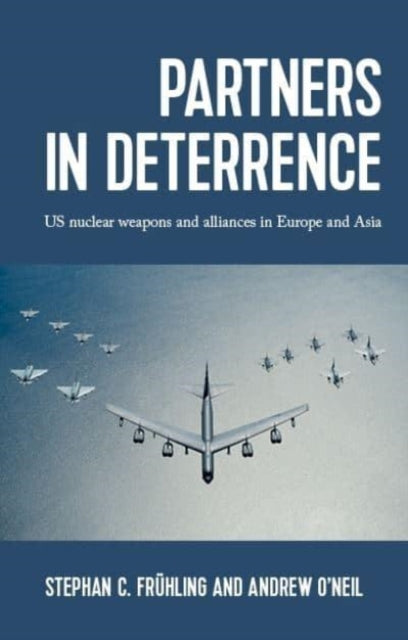
This book explores the history of America's nuclear posture worldwide, delving into alliance structures and interactions during and since the end of the Cold War to uncover the underlying dynamics of nuclear weapons cooperation between the US and its allies. Combining in-depth empirical analysis with an accessible theoretical lens, it reveals that US allies have wielded significant influence in shaping nuclear weapons cooperation with the US in ways that reflect their own objectives.
Format: Paperback / softback
Length: 256 pages
Publication date: 30 May 2023
Publisher: Manchester University Press
From the dawn of the atomic age to the present day, nuclear weapons have played a pivotal role in shaping the internal dynamics of US alliances in Europe and Asia. However, the level and nature of nuclear weapons cooperation among these allies have exhibited significant variations over time. In order to unravel the complex dynamics of nuclear weapons cooperation between the United States and its allies, this book delves into the historical trajectory of America's nuclear posture across the globe, examining alliance structures and interactions during and after the Cold War.
By employing a combination of in-depth empirical analysis and a user-friendly theoretical framework, the book sheds light on how US allies have exerted substantial influence in shaping nuclear weapons cooperation with the United States, often reflecting their unique objectives. It argues that alliances are dynamic ecosystems of exchange rather than mere instruments of external balancing, and institutional perspectives provide a novel lens through which to understand how structured cooperation can foster policy convergence.
Chapter 1: The Genesis of Nuclear Weapons Cooperation
The history of nuclear weapons cooperation between the United States and its allies can be traced back to the aftermath of World War II. In the early years of the Cold War, the United States and the Soviet Union emerged as the dominant superpowers, each possessing a vast arsenal of nuclear weapons. As tensions between the two nations escalated, the need for cooperation in the development and deployment of nuclear weapons became increasingly apparent.
One of the earliest examples of nuclear weapons cooperation was the Manhattan Project, a joint effort by the United States and the United Kingdom to develop the first atomic bomb. The project was a massive undertaking that involved the recruitment of top scientists, engineers, and military personnel from both countries. The project's success was a significant milestone in the history of nuclear weapons development and marked the beginning of a long-standing partnership between the United States and the United Kingdom.
Over the years, nuclear weapons cooperation between the United States and its allies expanded to include other countries in Europe and Asia. The North Atlantic Treaty Organization (NATO), established in 1949, was a key forum for nuclear weapons cooperation among Western European nations. NATO's founding principles emphasized collective defense and the mutual protection of each member state, and nuclear weapons played a central role in fulfilling these objectives.
Chapter 2: Alliance Structures and Interaction
Alliance structures and interactions have played a critical role in shaping nuclear weapons cooperation between the United States and its allies. Different alliances have adopted different approaches to nuclear weapons cooperation, reflecting their respective national interests and security concerns.
One of the most notable examples of alliance structures and interactions is the North Atlantic Treaty Organization (NATO). NATO was established in 1949 as a response to the growing threat posed by the Soviet Union. The alliance's primary objective was to promote collective defense among its member states and to deter the Soviet Union from expanding its influence in Europe.
NATO's nuclear weapons cooperation has evolved over the years. Initially, the alliance relied on a "two-track" approach, where member states maintained separate nuclear forces and shared nuclear intelligence. However, over time, NATO has moved towards a more integrated approach, where member states have pooled their nuclear resources and shared nuclear intelligence.
Chapter 3: The End of the Cold War and the Changing Nuclear Landscape
The end of the Cold War in 1991 marked a significant turning point in the history of nuclear weapons cooperation. With the collapse of the Soviet Union, the United States emerged as the sole superpower, and the need for nuclear weapons cooperation among its allies became less urgent. However, the end of the Cold War also brought about new challenges and opportunities for nuclear weapons cooperation.
One of the most significant challenges was the proliferation of nuclear weapons and the risk of their use in conflict. The end of the Cold War saw the emergence of new nuclear states, such as India and Pakistan, and the proliferation of nuclear weapons technology to non-state actors, such as terrorist organizations. This posed a significant threat to global security and required the United States and its allies to work together to address these challenges.
Chapter 4: The Influence of US Allies on Nuclear Weapons Cooperation
US allies have played a significant role in shaping nuclear weapons cooperation with the United States. Different allies have adopted different approaches to nuclear weapons cooperation, reflecting their own national interests and security concerns.
One of the most notable examples of the influence of US allies on nuclear weapons cooperation is the North Atlantic Treaty Organization (NATO). NATO was established in 1949 as a response to the growing threat posed by the Soviet Union. The alliance's primary objective was to promote collective defense among its member states and to deter the Soviet Union from expanding its influence in Europe.
NATO's nuclear weapons cooperation has evolved over the years. Initially, the alliance relied on a "two-track" approach, where member states maintained separate nuclear forces and shared nuclear intelligence. However, over time, NATO has moved towards a more integrated approach, where member states have pooled their nuclear resources and shared nuclear intelligence.
Chapter 5: Conclusion
In conclusion, nuclear weapons have played a pivotal role in shaping the internal dynamics of US alliances in Europe and Asia. The level and nature of nuclear weapons cooperation among these allies have exhibited significant variations over time. This book has explored the history of America's nuclear posture worldwide, delving into alliance structures and interactions during and since the end of the Cold War to uncover the underlying dynamics of nuclear weapons cooperation between the US and its allies.
By combining in-depth empirical analysis with an accessible theoretical lens, the book has revealed that US allies have wielded significant influence in shaping nuclear weapons cooperation with the US in ways that reflect their own, often idiosyncratic, objectives. Alliances are ecosystems of exchange rather than mere tools of external balancing, and institutional perspectives can offer an unprecedented insight into how structured cooperation can promote policy convergence.
As the world continues to grapple with the challenges posed by nuclear weapons, it is essential to understand the complex dynamics of nuclear weapons cooperation between the United States and its allies. This book provides a valuable contribution to the literature on this topic and offers insights that can help policymakers navigate the complex terrain of nuclear security.
Weight: 398g
Dimension: 154 x 234 x 17 (mm)
ISBN-13: 9781526171856
This item can be found in:
UK and International shipping information
UK and International shipping information
UK Delivery and returns information:
- Delivery within 2 - 3 days when ordering in the UK.
- Shipping fee for UK customers from £2.39. Fully tracked shipping service available.
- Returns policy: Return within 30 days of receipt for full refund.
International deliveries:
Shulph Ink now ships to Australia, Belgium, Canada, France, Germany, Ireland, Italy, India, Luxembourg Saudi Arabia, Singapore, Spain, Netherlands, New Zealand, United Arab Emirates, United States of America.
- Delivery times: within 5 - 10 days for international orders.
- Shipping fee: charges vary for overseas orders. Only tracked services are available for most international orders. Some countries have untracked shipping options.
- Customs charges: If ordering to addresses outside the United Kingdom, you may or may not incur additional customs and duties fees during local delivery.