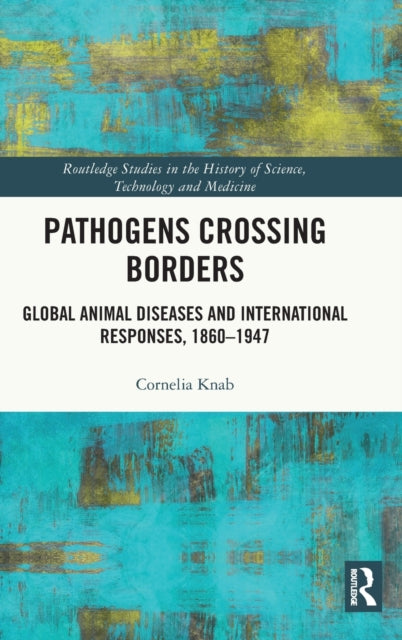
Cornelia Knab
Pathogens Crossing Borders: Global Animal Diseases and International Responses, 1860-1947
Pathogens Crossing Borders: Global Animal Diseases and International Responses, 1860-1947
💎 Earn 594 Points (£5.94) on this item.
YOU SAVE £36.11
- Condition: Brand new
- UK Delivery times: Usually arrives within 2 - 3 working days
- UK Shipping: Fee starts at £2.39. Subject to product weight & dimension
Bulk ordering. Want 15 or more copies? Get a personalised quote and bigger discounts. Learn more about bulk orders.
Couldn't load pickup availability
- More about Pathogens Crossing Borders: Global Animal Diseases and International Responses, 1860-1947
The increasing globalization of trade, travel, and transport since the mid-19th century has led to the spread of contagious animal diseases over greater distances in a shorter time. Borders and national control strategies proved insufficient to stop the pathogens, leading to the issue of epizootics being among the first topics addressed by international meetings. Pathogens Crossing Borders explores the history of international efforts to contain and prevent the spread of animal diseases from the early 1860s to the years after the Second World War, investigating how disease experts, politicians, and state authorities developed concepts, practices, and institutional structures to tackle the spread of animal diseases across borders.
Format: Hardback
Length: 228 pages
Publication date: 02 August 2022
Publisher: Taylor & Francis Ltd
The increasing globalization of trade, travel, and transport since the mid-19th century has brought about unforeseen consequences, one of which is the rapid spread of contagious animal diseases over greater distances in shorter periods than ever before. Borders and national control strategies have proven inadequate in halting the spread of these pathogens. It is not surprising, therefore, that the issue of epizootics, or epidemics of animals, was among the first topics to be addressed by international meetings since the 1860s.
Pathogens Crossing Borders delves into the historical narrative of international endeavors to contain and prevent the spread of animal diseases from the early 1860s to the years following the Second World War. As a pioneering contribution to global history and the history of internationalism, the book explores how disease experts, politicians, and state authorities have developed concepts, practices, and institutional frameworks at the international level to address the cross-border spread of animal diseases. By closely examining their activities in navigating a problem area that remains of immense political, social, public health, and economic significance, the book sheds light on the historical challenges of finding common international responses to complex and pressing global issues that often lack straightforward solutions.
The increasing interconnectedness of the world due to globalization has facilitated the rapid transmission of animal diseases across borders. This has posed significant challenges for governments and international organizations, as the spread of these diseases can have far-reaching consequences for public health, agriculture, and the economy. One of the primary challenges is the lack of effective communication and coordination between countries, which can hinder the rapid response to outbreaks and the sharing of information and resources.
Another challenge is the lack of a comprehensive international legal framework that governs the trade and movement of animals and animal products. This can create loopholes that allow the illegal trade of diseased animals and products, further exacerbating the spread of diseases. Additionally, the increasing demand for animal products, particularly meat and dairy, has led to increased pressure on natural resources and the environment, which can also contribute to the spread of diseases.
To address these challenges, governments and international organizations have implemented various measures to prevent and control the spread of animal diseases. These measures include the establishment of disease surveillance systems, the implementation of quarantine and border control measures, the development of vaccines and treatments, and the promotion of animal health and welfare.
One of the most significant achievements in the field of animal disease control has been the development of the World Animal Health Organization (WAHO), an international organization that coordinates and supports the efforts of countries to prevent and control animal diseases. WAHO has played a crucial role in developing international standards for animal health, promoting the exchange of information and resources, and providing technical assistance to countries in need.
In conclusion, the increasing globalization of trade, travel, and transport has had a significant impact on the spread of animal diseases. While borders and national control strategies have proven inadequate in halting the spread of these pathogens, international efforts to contain and prevent the spread of animal diseases have been ongoing since the early 1860s. Through the development of disease surveillance systems, quarantine and border control measures, vaccines and treatments, and the promotion of animal health and welfare, governments and international organizations have made significant progress in preventing and controlling the spread of animal diseases. However, there is still much work to be done to ensure that the world is prepared for future outbreaks and that the impact of animal diseases on public health, agriculture, and the economy is minimized.
Weight: 600g
Dimension: 234 x 156 (mm)
ISBN-13: 9780367471880
This item can be found in:
UK and International shipping information
UK and International shipping information
UK Delivery and returns information:
- Delivery within 2 - 3 days when ordering in the UK.
- Shipping fee for UK customers from £2.39. Fully tracked shipping service available.
- Returns policy: Return within 30 days of receipt for full refund.
International deliveries:
Shulph Ink now ships to Australia, Belgium, Canada, France, Germany, Ireland, Italy, India, Luxembourg Saudi Arabia, Singapore, Spain, Netherlands, New Zealand, United Arab Emirates, United States of America.
- Delivery times: within 5 - 10 days for international orders.
- Shipping fee: charges vary for overseas orders. Only tracked services are available for most international orders. Some countries have untracked shipping options.
- Customs charges: If ordering to addresses outside the United Kingdom, you may or may not incur additional customs and duties fees during local delivery.