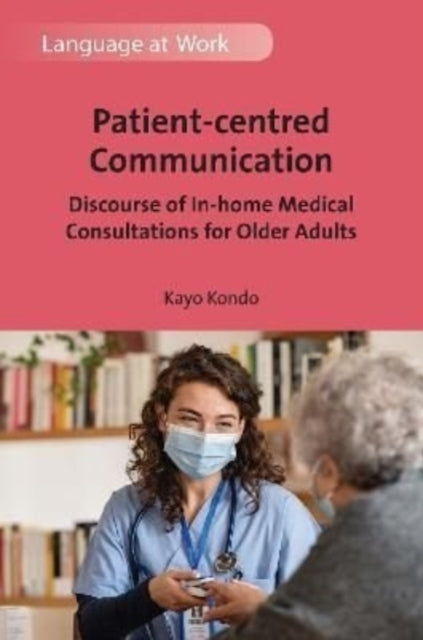
Kayo Kondo
Patient-centred Communication: Discourse of In-home Medical Consultations for Older Adults
Patient-centred Communication: Discourse of In-home Medical Consultations for Older Adults
💎 Earn 454 Points (£4.54) on this item.
YOU SAVE £19.13
- Condition: Brand new
- UK Delivery times: Usually arrives within 2 - 3 working days
- UK Shipping: Fee starts at £2.39. Subject to product weight & dimension
Bulk ordering. Want 15 or more copies? Get a personalised quote and bigger discounts. Learn more about bulk orders.
Couldn't load pickup availability
- More about Patient-centred Communication: Discourse of In-home Medical Consultations for Older Adults
This book explores the use of patient-/person-centered communication in healthcare for ageing populations, using an ethnographic approach and interviews with physicians in Tokyo, Japan. It highlights the linguistic dimensions of person-centered communication and discusses sociocultural differences between countries. The author proposes a framework for future training.
Format: Hardback
Length: 240 pages
Publication date: 12 August 2022
Publisher: Multilingual Matters
This book offers a thorough examination of the application of patient- and person-centered communication in delivering healthcare to older populations through an ethnographic approach to physician in-home medical consultations in Tokyo, Japan, coupled with interviews with physicians. It centers on showcasing how linguistic aspects of person-centered communication function by providing case study examples, as well as the sociocultural variations between the United States, the United Kingdom, Japan, and other societies where person-centered communication models are implemented. The author employs her framework, which incorporates face and politeness theory, and makes suggestions for future training.
Introduction:
The healthcare system is facing significant challenges as the global population continues to age. One of the most pressing issues is the provision of quality care that meets the unique needs and preferences of older individuals. Patient- and person-centered communication (PCC) has emerged as a promising approach to addressing this challenge. PCC is a communication style that prioritizes the patient's perspective, values, and needs, and aims to establish a collaborative and respectful relationship between the patient and healthcare provider.
Objectives:
The primary objective of this book is to provide a comprehensive analysis of the use of PCC in providing healthcare to older populations through an ethnographic approach to physician in-home medical consultations in Tokyo, Japan. Additionally, the book aims to explore the sociocultural differences between the United States, the United Kingdom, Japan, and other societies in which PCC models are employed. By examining these differences, the book seeks to identify the factors that contribute to the success or failure of PCC in different contexts and to make recommendations for future training and practice.
Methodology:
The study was conducted using an ethnographic approach, which involves immersing oneself in the culture and practices of a particular group or community. In this case, the author spent several months conducting fieldwork in Tokyo, Japan, where she observed and interviewed physicians who provided in-home medical consultations to older populations. The author also conducted interviews with healthcare professionals, policymakers, and older individuals to gain a deeper understanding of the healthcare system and the challenges faced by older populations.
Findings:
The findings of the study revealed several key insights into the use of PCC in providing healthcare to older populations. Firstly, the study highlighted the importance of understanding the linguistic dimensions of PCC. Language plays a crucial role in shaping the way healthcare providers communicate with patients and can have a significant impact on the quality of care provided. The study found that there were significant differences in the way healthcare providers communicate with patients in different cultures, and that these differences can have a profound impact on the patient's experience and outcomes.
Secondly, the study explored the sociocultural differences between the United States, the United Kingdom, Japan, and other societies in which PCC models are employed. The study found that there were significant variations in the way healthcare providers approach patient-centered care in different cultures. For example, in the United States, there is a strong emphasis on the individual's autonomy and self-determination, while in Japan, there is a greater emphasis on the collective and interdependent nature of society. These differences can impact the way healthcare providers communicate with patients and the way patients perceive their care.
Thirdly, the study identified several factors that contribute to the success or failure of PCC in different contexts. These factors include the level of training and education of healthcare providers, the availability of resources and technology, and the cultural and social norms of the community. The study found that healthcare providers who receive training in PCC and have access to the necessary resources and technology are more likely to provide high-quality care that meets the needs and preferences of older individuals.
Recommendations:
Based on the findings of the study, the author makes several recommendations for future training and practice. Firstly, the author suggests that healthcare providers should receive training in PCC that incorporates the linguistic dimensions of communication and the sociocultural differences between different societies. This training should focus on developing skills in effective communication, empathy, and cultural competence.
Secondly, the author suggests that healthcare providers should have access to the necessary resources and technology to provide high-quality care to older individuals. This includes access to electronic health records, telemedicine, and other technologies that can facilitate communication and collaboration between healthcare providers and patients.
Thirdly, the author suggests that healthcare providers should work to establish collaborative relationships with older individuals and their families. This includes building trust and respect and working to understand the individual's perspective and preferences.
Finally, the author suggests that policymakers should be aware of the cultural and social norms of the community in which they are providing care. This includes being sensitive to cultural differences in communication styles, values, and beliefs and working to establish a respectful and collaborative relationship with the community.
Conclusion:
In conclusion, this book provides a comprehensive analysis of the use of PCC in providing healthcare to older populations through an ethnographic approach to physician in-home medical consultations in Tokyo, Japan. The study highlights the importance of understanding the linguistic dimensions of PCC and the sociocultural differences between different societies. The findings of the study suggest that healthcare providers who receive training in PCC and have access to the necessary resources and technology are more likely to provide high-quality care that meets the needs and preferences of older individuals. By implementing these recommendations, healthcare providers can improve the quality of care provided to older populations and help to ensure that they receive the care they need and deserve.
Weight: 500g
Dimension: 241 x 162 x 20 (mm)
ISBN-13: 9781800415881
This item can be found in:
UK and International shipping information
UK and International shipping information
UK Delivery and returns information:
- Delivery within 2 - 3 days when ordering in the UK.
- Shipping fee for UK customers from £2.39. Fully tracked shipping service available.
- Returns policy: Return within 30 days of receipt for full refund.
International deliveries:
Shulph Ink now ships to Australia, Belgium, Canada, France, Germany, Ireland, Italy, India, Luxembourg Saudi Arabia, Singapore, Spain, Netherlands, New Zealand, United Arab Emirates, United States of America.
- Delivery times: within 5 - 10 days for international orders.
- Shipping fee: charges vary for overseas orders. Only tracked services are available for most international orders. Some countries have untracked shipping options.
- Customs charges: If ordering to addresses outside the United Kingdom, you may or may not incur additional customs and duties fees during local delivery.