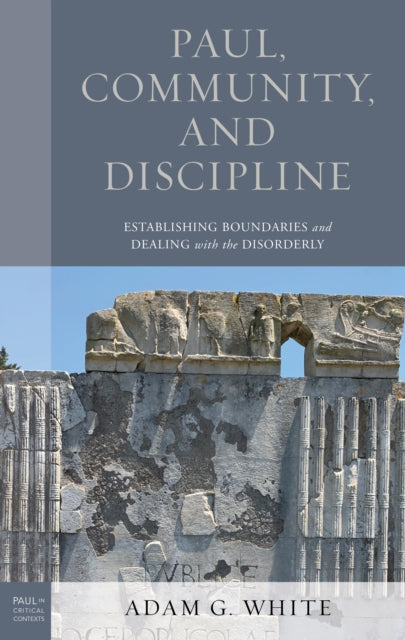
Adam G. White
Paul, Community, and Discipline: Establishing Boundaries and Dealing with the Disorderly
Paul, Community, and Discipline: Establishing Boundaries and Dealing with the Disorderly
We can order this item for you. Delivery usually takes about 4 to 6 weeks.
This item is not held in our immediate stock. We will order it for you after checkout.
Estimated delivery: About 4 to 6 weeks
- Condition: Brand new
- UK Delivery times: Usually arrives within 2 - 3 working days
- UK Shipping: Fee starts at £3.89. Subject to product weight & dimension
Bulk ordering. Want 15 or more copies? Get a personalised quote and bigger discounts. Learn more about bulk orders.
Couldn't load pickup availability
- More about Paul, Community, and Discipline: Establishing Boundaries and Dealing with the Disorderly
Paul established Christian communities based on inclusivity, love, and concern for others, but when these core tenets were challenged, exile and expulsion were used. Adam G. White examines the practice of exile and expulsion in the Graeco-Roman world and the Pauline letters in light of this context, arguing that Paul's communities are both a continuation and a divergence from contemporary practices.
Format: Hardback
Length: 282 pages
Publication date: 01 October 2021
Publisher: Rowman & Littlefield
Paul, a prominent figure in the early Christian church, played a significant role in establishing numerous Christian communities across the Roman Empire. These communities were characterized by their commitment to inclusivity, mutual love, and shared concern for their members. However, as time passed, these core values faced challenges and were sometimes undermined. In his book, "Paul, Community, and Discipline: Establishing Boundaries and Dealing with the Disorderly," Adam G. White delves into the practice of exile and expulsion in the cities of the Graeco-Roman world and the specific social institutions of the family, school, association, and synagogue. He then examines the Pauline letters in light of this context, arguing that what we see in Paul's communities is both a continuation of and a divergence from contemporary practices.
Paul's communities were founded on the principles of inclusivity, mutual love, and shared concern for other members. These values were deeply ingrained in the culture and society of the time, and they played a crucial role in shaping the early Christian church. However, as the church grew and spread across different regions, it encountered various challenges and obstacles. One of these challenges was the practice of exile and expulsion.
In the cities of the Graeco-Roman world, exile and expulsion were common practices used to deal with disorder and disobedience. Individuals who were deemed to be a threat to the social order or who violated the laws of the city were often exiled or expelled. This practice was not limited to the Christian community but was also prevalent in other religious and social groups.
In the book, Adam G. White examines the practice of exile and expulsion in the cities of the Graeco-Roman world and the specific social institutions of the family, school, association, and synagogue. He argues that the Pauline letters provide valuable insights into how Paul responded to these challenges and how he established boundaries within his communities.
One of the key insights that White draws from the Pauline letters is the importance of maintaining order and discipline within the community. Paul recognized that disorder and chaos could undermine the core values of the community and lead to the erosion of its identity. He therefore emphasized the need for strict rules and regulations to govern the behavior of members.
Paul's emphasis on order and discipline was not without its challenges, however. Some members of the community may have viewed these rules as restrictive and oppressive, and they may have resisted them. Paul's response to this resistance was to appeal to the authority of God and the law. He argued that the rules were not meant to be a burden but were a means of protecting the community and promoting its growth.
Another challenge that Paul faced was the issue of diversity within his communities. The early Christian church was made up of people from different backgrounds and cultures, and this diversity could sometimes lead to tensions and conflicts. Paul recognized the importance of unity and harmony within the community and worked to promote these values. He encouraged members to respect and appreciate each other's differences and to work together to achieve common goals.
Despite these challenges, Paul's communities continued to thrive and grow. They were characterized by their commitment to the core values of inclusivity, mutual love, and shared concern for other members. These communities played a significant role in shaping the early Christian church and contributed to the spread of Christianity throughout the Roman Empire.
In conclusion, Paul, Community, and Discipline: Establishing Boundaries and Dealing with the Disorderly provides valuable insights into the practice of exile and expulsion in the cities of the Graeco-Roman world and the specific social institutions of the family, school, association, and synagogue. It also examines the Pauline letters in light of this context, arguing that what we see in Paul's communities is both a continuation of and a divergence from contemporary practices. The book highlights the importance of maintaining order and discipline within the community, promoting unity and harmony, and dealing with diversity and conflict. It is a valuable resource for anyone interested in the early Christian church and its development.
Weight: 617g
Dimension: 229 x 160 x 27 (mm)
ISBN-13: 9781978711914
UK and International shipping information
UK and International shipping information
We deliver throughout the United Kingdom and to 128 countries and territories worldwide, including the United States, Australia, Canada, Germany, Spain and France.