GregoryBrew
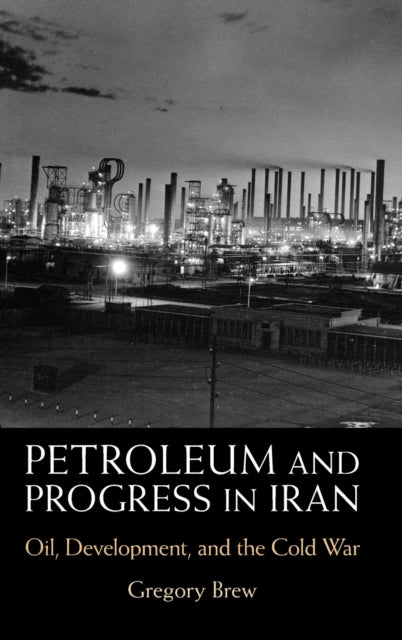
Petroleum and Progress in Iran: Oil, Development, and the Cold War
Petroleum and Progress in Iran: Oil, Development, and the Cold War
💎 Earn 387 Points (£3.87) on this item.
We can order this item for you. Delivery usually takes about 4 to 6 weeks.
This item is not held in our immediate stock. We will order it for you after checkout.
Estimated delivery: About 4 to 6 weeks
YOU SAVE £4.59
- Condition: Brand new
- UK Delivery times: Usually arrives within 2 - 3 working days
- UK Shipping: Fee starts at £2.39. Subject to product weight & dimension
Bulk ordering. Want 15 or more copies? Get a personalised quote and bigger discounts. Learn more about bulk orders.
Couldn't load pickup availability
- More about Petroleum and Progress in Iran: Oil, Development, and the Cold War
Iran became the world's first petro-state from the 1940s to 1960s, supported by oil revenue and an industrializing economy. Gregory Brew's book explores how the Pahlavi petro-state emerged from interactions with American developmentalists, Pahlavi technocrats, and oil companies, contextualizing Iran's pro-Western alignment and slide into petrolic authoritarianism.
Format: Hardback
Length: 261 pages
Publication date: 22 December 2022
Publisher: Cambridge University Press
Iran's transformation from the 1940s to the 1960s marked a remarkable journey towards becoming the world's first petro-state. During this period, oil emerged as the primary source of state revenue, propelling the country towards industrialization, the expansion of the middle class, and the establishment of a robust administrative and military apparatus. In his insightful book, Gregory Brew delves into the intricate dynamics that shaped the emergence of the Pahlavi petro-state. Drawing upon a wealth of American and Iranian sources, Brew meticulously outlines how a confluence of global and local forces converged to give rise to this unique regime.
The shah's particular form of oil-based authoritarianism, as Brew reveals, evolved through interactions with American developmentalists, Pahlavi technocrats, and major oil companies. These interactions occurred against the backdrop of the United States' Cold War policy and the coup d'état of August 1953. By placing oil at the center of the Cold War narrative, Brew contextualizes Iran's pro-Western alignment and its gradual slide into petrolic authoritarianism.
This book is a testament to Brew's extensive research and synthesis of a wide range of sources and research methods. Through his meticulous analysis, he demonstrates that the Pahlavi petro-state was not a spontaneous creation but rather a meticulously crafted and constructed entity. It was not solely the result of the actions of the Pahlavi shah but rather the outcome of a complex interplay of political, economic, and social forces.
One of the key themes that Brew explores is the role of foreign influence in shaping Iran's development. He highlights how the United States, in particular, played a significant role in shaping the country's oil industry and its political institutions. The book sheds light on the intricate negotiations and agreements that took place between American and Iranian officials, as well as the impact of American policies on Iran's domestic politics.
Brew also delves into the internal dynamics of the Pahlavi regime. He examines the shah's authoritarianism, the role of the military and security forces, and the challenges faced by the country's political opposition. The book provides a nuanced understanding of the complex power dynamics that governed the Pahlavi petro-state and the challenges that the regime faced in maintaining its grip on power.
In conclusion, Gregory Brew's book is a valuable contribution to the study of Iran's political history. It offers a comprehensive and nuanced understanding of the Pahlavi petro-state's emergence, its evolution, and its impact on Iran's political and economic landscape. By placing oil at the center of the narrative, Brew contextualizes Iran's pro-Western alignment and its gradual slide into petrolic authoritarianism. The book demonstrates that the Pahlavi petro-state was not solely the product of the shah's actions but rather the result of a complex web of forces that included global and local factors. This book will be of interest to scholars, researchers, and anyone interested in understanding the history of Iran and the role of oil in shaping its political and economic trajectory.
ISBN-13: 9781009206341
UK and International shipping information
UK and International shipping information
UK Delivery and returns information:
- Delivery within 2 - 3 days when ordering in the UK.
- Shipping fee for UK customers from £2.39. Fully tracked shipping service available.
- Returns policy: Return within 30 days of receipt for full refund.
International deliveries:
Shulph Ink now ships to Australia, Belgium, Canada, France, Germany, Ireland, Italy, India, Luxembourg Saudi Arabia, Singapore, Spain, Netherlands, New Zealand, United Arab Emirates, United States of America.
- Delivery times: within 5 - 10 days for international orders.
- Shipping fee: charges vary for overseas orders. Only tracked services are available for most international orders. Some countries have untracked shipping options.
- Customs charges: If ordering to addresses outside the United Kingdom, you may or may not incur additional customs and duties fees during local delivery.