Jane F. Thrailkill
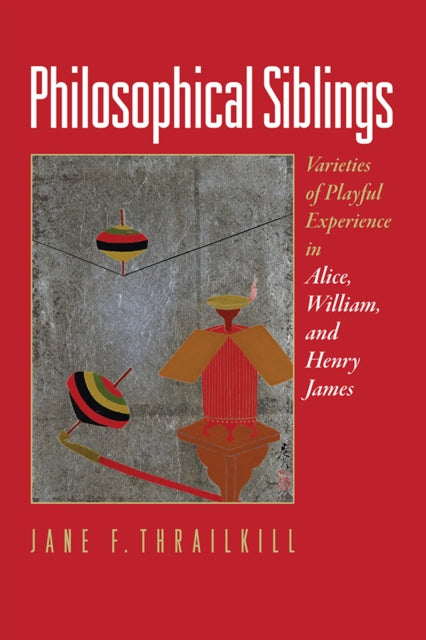
Philosophical Siblings: Varieties of Playful Experience in Alice, William, and Henry James
Philosophical Siblings: Varieties of Playful Experience in Alice, William, and Henry James
💎 Earn 214 Points (£2.14) on this item.
YOU SAVE £5.16
- Condition: Brand new
- UK Delivery times: Usually arrives within 2 - 3 working days
- UK Shipping: Fee starts at £2.39. Subject to product weight & dimension
Bulk ordering. Want 15 or more copies? Get a personalised quote and bigger discounts. Learn more about bulk orders.
Couldn't load pickup availability
- More about Philosophical Siblings: Varieties of Playful Experience in Alice, William, and Henry James
The three iconic figures of nineteenth-century American culture and letters, Alice James, William James, and Henry James, were siblings, children of the storied James family. Jane F. Thrailkill's Philosophical Siblings explores their writings collectively, revealing their shared project of showing how minds meet in a world teeming with possibilities and risks. Their intellectual playfulness is both message and medium, manifested in an expressive style that exploits incongruity, delights in absurdities, and sometimes inflicts the sting of critique. Their writings model how human beings accomplish high-wire acts of perception and creation.
Format: Hardback
Length: 312 pages
Publication date: 01 February 2022
Publisher: University of Pennsylvania Press
William James, a pivotal figure in American psychology and philosophy, stands as a towering cornerstone. Alongside him, Henry James, renowned for his literary prowess and critical acumen, emerges as a preeminent author and literary critic. These three iconic figures, hailing from the illustrious James family, carved their paths in nineteenth-century American culture and letters, yet their realms of cultural authority and their audiences seemed to diverge. The diarist, the psychologist, and the novelist have seldom been viewed as interconnected, their writings seldom being considered in a collective context.
In her book "Philosophical Siblings," Jane F. Thrailkill delves into the intriguing question of what new narrative emerges when we examine the writings of the Jameses collectively. By approaching the Jameses as intimate thinkers engaged in a shared intellectual playground, Thrailkill unveils their collaborative project—a blend of psychological and philosophical inquiry—to explore how minds interact within a world brimming with possibilities and risks.
In the realm of nineteenth-century psychology, scientists toiled in laboratories, meticulously studying isolated individuals, tracking their eye movements, and meticulously timing their reactions. Their objective was to unravel the intricate workings of the human machine, to better understand the intricate mechanisms that governed human behavior.
In stark contrast, the Jameses approached discovery through philosophical toys—ludic devices that illuminated quirks of perception, offering both entertainment and intellectual stimulation. With a childlike sense of humor, their intellectual playfulness took on a dual role as both message and medium, manifesting itself in an expressive style that reveled in incongruity, embraced absurdities, and, at times, delivered subtle critiques.
Most importantly, the Jameses' writings serve as a model for how human beings navigate the delicate balance between perception and creation. They did not merely present a novel, interactive theory of mind; rather, they vividly dramatized it through their writings, portraying it as a curiosity-driven practice. Through their playful exploration of the human psyche, the Jameses offered a glimpse into the intricate dance between the conscious and unconscious, between perception and interpretation.
In conclusion, the Jameses—Alice, William, and Henry—stand as towering figures in nineteenth-century American culture and letters. Their distinct paths and audiences may have separated them, but their collective body of work reveals a profound interconnectedness. By studying their writings collectively, we gain a deeper understanding of their shared project, a philosophical and psychological exploration of the human mind in a world of endless possibilities. Through their expressive style, incongruity, absurdity, and subtle critique, the Jameses modeled how human beings engage in the high-wire acts of perception and creation, leaving an indelible mark on the intellectual landscape of their era.
Weight: 646g
Dimension: 161 x 236 x 29 (mm)
ISBN-13: 9780812253320
This item can be found in:
UK and International shipping information
UK and International shipping information
UK Delivery and returns information:
- Delivery within 2 - 3 days when ordering in the UK.
- Shipping fee for UK customers from £2.39. Fully tracked shipping service available.
- Returns policy: Return within 30 days of receipt for full refund.
International deliveries:
Shulph Ink now ships to Australia, Belgium, Canada, France, Germany, Ireland, Italy, India, Luxembourg Saudi Arabia, Singapore, Spain, Netherlands, New Zealand, United Arab Emirates, United States of America.
- Delivery times: within 5 - 10 days for international orders.
- Shipping fee: charges vary for overseas orders. Only tracked services are available for most international orders. Some countries have untracked shipping options.
- Customs charges: If ordering to addresses outside the United Kingdom, you may or may not incur additional customs and duties fees during local delivery.