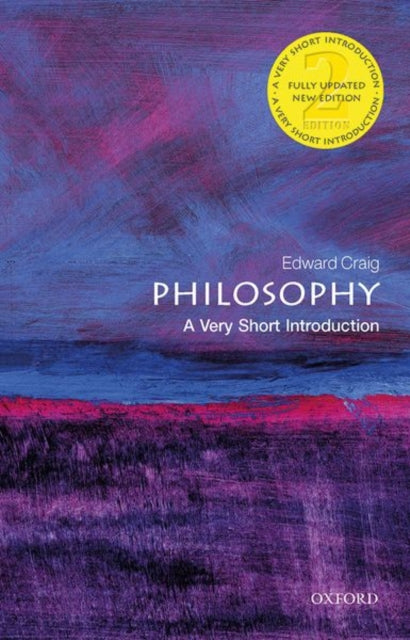
EdwardCraig
Philosophy: A Very Short Introduction
Philosophy: A Very Short Introduction
💎 Earn 35 Points (£0.35) on this item.
YOU SAVE £2.92
- Condition: Brand new
- UK Delivery times: Usually arrives within 2 - 3 working days
- UK Shipping: Fee starts at £3.89. Subject to product weight & dimension
Bulk ordering. Want 15 or more copies? Get a personalised quote and bigger discounts. Learn more about bulk orders.
Couldn't load pickup availability
- More about Philosophy: A Very Short Introduction
This Very Short Introduction discusses key questions in philosophy, such as ethics, knowledge, and the self, through readings from Plato, Hume, Descartes, Hegel, Darwin, and Buddhist writers. It emphasizes the importance of philosophy, explains its relationship to other areas, and explores the contexts in which it has been done. The new edition includes a chapter on free will and the Problem of Evil.
Format: Paperback / softback
Length: 168 pages
Publication date: 24 September 2020
Publisher: Oxford University Press
Philosophy is a profound and enduring exploration of fundamental questions about the nature of reality, existence, and knowledge. It delves into the core of human experience and seeks to unravel the mysteries of the universe. In this essay, we will explore some of the key questions that philosophy engages with and consider how we can approach them.
One of the central questions in philosophy is the nature of existence. What is the essence of being? What are the fundamental elements that make up the world we perceive? Philosophers have grappled with this question for centuries, and there are many different perspectives on the matter. Some philosophers argue that existence is purely material, while others suggest that it is a combination of material and spiritual elements. Others believe that existence is an illusion created by our minds.
Another important question in philosophy is the nature of knowledge. How do we know what we know? What are the sources of our knowledge? Philosophers have explored this question from many different angles, including empiricism, rationalism, and intuition. Empiricists believe that knowledge is gained through experience, while rationalists argue that knowledge is gained through reason and logic. Intuitionists believe that knowledge is gained through a direct connection to the world around us.
The nature of the self is another central question in philosophy. Who are we? What are our essential qualities? What is the relationship between the self and the world around us? Philosophers have explored this question from many different perspectives, including psychologism, dualism, and materialism. Psychologism believes that the self is the product of our minds and experiences, while dualism believes that the self is a combination of the mind and the body. Materialism believes that the self is purely material.
Ethics is another important area of philosophy that deals with questions about the right. What is the right thing to do? How should we live our lives? What are the moral principles that guide our actions? Philosophers have explored this question from many different perspectives, including utilitarianism, deontology, and virtue ethics. Utilitarianism believes that the right to do is the right thing to do if it results in the greatest good for the greatest number of people, while deontology believes that the right number of people is the right thing to do based on moral principles. Virtue ethics believes that the right thing to do is the right thing to do based on the cultivation of virtuous character.
The problem of evil is another challenging question in philosophy. How can evil exist in a world created by a good God? How can there be suffering and pain in a world that is supposed to be perfect? Philosophers have grappled with this question for centuries, and there are many different perspectives on the matter. Some philosophers argue that evil is a necessary evil, that it is a result of human free will, while others argue that it is an inherent part of the world.
Kant's argument on the source of moral obligation is another important philosophical concept. What is the source of moral obligation? How do we know what is right and wrong? Kant argued that moral obligation is based on a sense of duty, that we have a moral duty to act in a certain way based on our moral principles.
In conclusion, philosophy is a rich and complex field that engages with a wide range of fundamental questions about the nature of reality, existence, and knowledge. It is a field that has been explored by many different philosophers throughout history, and there are many different perspectives on the matter. By exploring these questions, we can gain a deeper understanding of ourselves and the world around us and develop a more ethical and informed perspective on our lives.
Weight: 152g
Dimension: 112 x 173 x 14 (mm)
ISBN-13: 9780198861775
Edition number: 2 Revised edition
UK and International shipping information
UK and International shipping information
We deliver throughout the United Kingdom and to 128 countries and territories worldwide, including the United States, Australia, Canada, Germany, Spain and France.