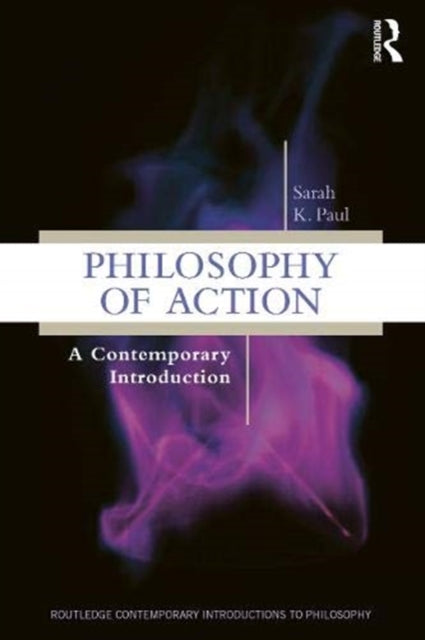
Sarah Paul
Philosophy of Action: A Contemporary Introduction
Philosophy of Action: A Contemporary Introduction
💎 Earn 198 Points (£1.98) on this item.
YOU SAVE £2.35
- Condition: Brand new
- UK Delivery times: Usually arrives within 2 - 3 working days
- UK Shipping: Fee starts at £2.39. Subject to product weight & dimension
Bulk ordering. Want 15 or more copies? Get a personalised quote and bigger discounts. Learn more about bulk orders.
Couldn't load pickup availability
- More about Philosophy of Action: A Contemporary Introduction
This book provides an accessible and inclusive overview of the major debates in the philosophy of action, covering approaches taken by Donald Davidson, G.E.M. Anscombe, and others. It is an ideal introduction for advanced undergraduates and philosophers seeking a primer on these issues.
\n Format: Paperback / softback
\n Length: 178 pages
\n Publication date: 30 December 2020
\n Publisher: Taylor & Francis Ltd
\n
This comprehensive book provides an accessible and inclusive exploration of the central debates in the philosophy of action. It delves into the diverse approaches taken by renowned philosophers such as Donald Davidson, G.E.M. Anscombe, and many others to address fundamental questions like what constitutes intentional actions and how do reasons explain these actions? The book also explores various topics such as intention, practical knowledge, the strength and weakness of will, self-governance, and collective agency. Organized into ten chapters, each accompanied by introductions, conclusions, and annotated suggested reading lists, this book serves as an ideal primer for advanced undergraduates and philosophers interested in delving into these critical issues.
Introduction:
The philosophy of action is a fundamental branch of philosophy that examines the nature and scope of human actions. It seeks to understand why we act the way we do, what motivates us, and how we can improve our moral and ethical decision-making. This book aims to provide an accessible and comprehensive overview of the major debates in the philosophy of action.
Approaches to the Philosophy of Action:
The book explores the distinct approaches taken by philosophers such as Donald Davidson, G.E.M. Anscombe, and others to understanding intentional actions. Davidson's approach emphasizes the role of intention in action, while Anscombe focuses on the concept of practical knowledge and its relationship to moral judgment. Other philosophers, such as John McDowell and Robert Brandom, explore the nature of self-governance and the role of reasons in explaining our actions.
Intention:
Intention plays a central role in the philosophy of action. Philosophers argue about whether intention is necessary for action, what it is, and how it relates to our moral responsibility. Davidson argues that intention is essential for action, while Anscombe argues that practical knowledge is sufficient for moral judgment. McDowell and Brandom, on the other hand, argue that intention is not necessary for action but can be useful in understanding our moral commitments.
Practical Knowledge:
Practical knowledge is another key concept in the philosophy of action. Philosophers argue about whether practical knowledge is innate or acquired, how it relates to moral judgment, and whether it can be justified. Anscombe argues that practical knowledge is acquired through experience and is essential for moral judgment, while McDowell argues that it is innate and can be justified through reason.
Self-Governance:
Self-governance is the ability to control our own actions and decisions. Philosophers argue about whether we have the capacity for self-governance, what it requires, and how it relates to our moral responsibility. Davidson argues that we have the capacity for self-governance, while Anscombe argues that it requires a certain level of rationality and self-awareness.
Collective Agency:
Collective agency refers to the ability of individuals to work together to achieve common goals. Philosophers argue about whether collective agency is possible, what it requires, and how it relates to individual moral responsibility. Davidson argues that collective agency is possible, while Anscombe argues that it requires a certain level of social cooperation and mutual understanding.
Conclusion:
In conclusion, this book offers an accessible and comprehensive exploration of the major debates in the philosophy of action. It provides a valuable introduction to the diverse approaches taken by philosophers and helps readers to understand the key concepts and issues in this field. By exploring intention, practical knowledge, self-governance, collective agency, and other topics, this book provides a foundation for further study and discussion in the philosophy of action.
\n Weight: 288g\n
Dimension: 459 x 153 x 23 (mm)\n
ISBN-13: 9781138642744\n \n
UK and International shipping information
UK and International shipping information
UK Delivery and returns information:
- Delivery within 2 - 3 days when ordering in the UK.
- Shipping fee for UK customers from £2.39. Fully tracked shipping service available.
- Returns policy: Return within 30 days of receipt for full refund.
International deliveries:
Shulph Ink now ships to Australia, Belgium, Canada, France, Germany, Ireland, Italy, India, Luxembourg Saudi Arabia, Singapore, Spain, Netherlands, New Zealand, United Arab Emirates, United States of America.
- Delivery times: within 5 - 10 days for international orders.
- Shipping fee: charges vary for overseas orders. Only tracked services are available for most international orders. Some countries have untracked shipping options.
- Customs charges: If ordering to addresses outside the United Kingdom, you may or may not incur additional customs and duties fees during local delivery.