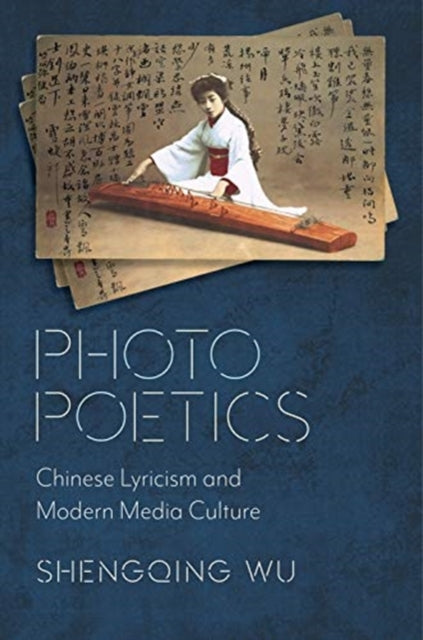
Shengqing Wu
Photo Poetics: Chinese Lyricism and Modern Media Culture
Photo Poetics: Chinese Lyricism and Modern Media Culture
💎 Earn 120 Points (£1.20) on this item.
YOU SAVE £5.93
- Condition: Brand new
- UK Delivery times: Usually arrives within 2 - 3 working days
- UK Shipping: Fee starts at £2.39. Subject to product weight & dimension
Bulk ordering. Want 15 or more copies? Get a personalised quote and bigger discounts. Learn more about bulk orders.
Couldn't load pickup availability
- More about Photo Poetics: Chinese Lyricism and Modern Media Culture
Chinese poetry has a long history of interaction with the visual arts, and Shengqing Wu's book "Photo Poetics" explores how the new medium of photography was transformed by Chinese aesthetic culture in the late Qing and early Republican eras. It analyzes a wide range of practices and genres, including self-representation in portrait photography, gifts of inscribed photographs, mass-media circulation of images of beautiful women, and photography of ghosts, immortals, and imagined landscapes. Wu argues that the Chinese lyrical tradition provided rich resources for artistic creativity, self-expression, and embodied experience in the face of an increasingly technological and image-oriented society.
Format: Paperback / softback
Length: 384 pages
Publication date: 08 December 2020
Publisher: Columbia University Press
Chinese poetry has a rich and intricate history of intertwining with the visual arts, a relationship that has been nurtured and celebrated throughout centuries. Classical aesthetic thought held that painting, calligraphy, and poetry were not only distinct art forms but also cross-fertilizing and mutually enriching. This belief stemmed from the understanding that each discipline had its unique language and expressive capabilities, and when combined, they could create a harmonious and profound artistic experience.
However, the arrival of photography, a transformative technology that reshaped the way we see and represent the world, presented a new challenge to the traditional poetic tradition. How would the Chinese poetic tradition adapt to this new medium, and what kind of creative possibilities would it unlock?
Shengqing Wu, a scholar of Chinese literature and visual culture, has delved into these questions in her groundbreaking book, "Photo Poetics." Through extensive archival research into illustrated magazines, poetry collections, and vintage photographs, Wu explores the complex negotiations between poetry and photography in the late Qing and early Republican eras. She examines how traditional textual forms collaborated with the new visual culture, and how the two mediums influenced and shaped each other.
One of the key themes of Wu's book is the exploration of self-representation in portrait photography. During the late Qing and early Republican periods, photography became increasingly popular among the Chinese elite, and many individuals sought to capture their likenesses in a professional setting. Wu analyzes how poetry and photography intersected in this context, examining how poets used visual imagery and metaphorical language to convey their identities and emotions. She also explores how portrait photography became a means of self-expression and empowerment for women, who were often marginalized in traditional Chinese society.
Another fascinating aspect of Wu's study is the gift of inscribed photographs. During this period, photographs were often accompanied by written captions or poems, creating a hybrid form of art that blurred the boundaries between photography and literature. Wu examines how these inscribed photographs were used as a means of expressing love, friendship, and familial bonds, as well as how they contributed to the formation of a new visual culture that was influenced by both Chinese and Western traditions.
Mass-media circulation of images of beautiful women is another theme that Wu explores in "Photo Poetics." During the late Qing and early Republican periods, illustrated magazines and newspapers were flooded with images of women who were depicted as idealized and glamorous. Wu analyzes how these images shaped public perceptions of beauty and femininity, as well as how they contributed to the development of a consumer culture that was driven by the desire for visual pleasure.
Finally, Wu examines photography of ghosts, immortals, and imagined landscapes in "Photo Poetics." During this period, Chinese literature and art were heavily influenced by the belief in supernatural beings and the afterlife. Wu analyzes how photography was used to capture and represent these supernatural entities, as well as how it contributed to the formation of a new genre of Chinese literature that was influenced by both traditional and modern beliefs.
Through her interdisciplinary study spanning literary studies, visual culture, and media history, Wu offers an original account of media culture in early twentieth-century China and the formation of Chinese literary and visual modernities. "Photo Poetics" is a groundbreaking work that sheds light on the complex and multifaceted relationship between poetry and photography, and how these two mediums influenced and shaped each other in the context of a rapidly changing world.
In conclusion, Chinese poetry has a long and rich history of interaction with the visual arts, and the arrival of photography presented a new challenge to the traditional poetic tradition. Shengqing Wu's "Photo Poetics" is a groundbreaking work that explores the complex negotiations between poetry and photography in the late Qing and early Republican eras, examining how traditional textual forms collaborated with the new visual culture. Through her extensive archival research and interdisciplinary approach, Wu offers an original account of media culture in early twentieth-century China and the formation of Chinese literary and visual modernities. This book is a must-read for anyone interested in the intersection of literature, visual art, and media history, and it provides valuable insights into the ways in which these three disciplines have shaped each other over time.
Weight: 626g
Dimension: 155 x 233 x 26 (mm)
ISBN-13: 9780231192217
UK and International shipping information
UK and International shipping information
UK Delivery and returns information:
- Delivery within 2 - 3 days when ordering in the UK.
- Shipping fee for UK customers from £2.39. Fully tracked shipping service available.
- Returns policy: Return within 30 days of receipt for full refund.
International deliveries:
Shulph Ink now ships to Australia, Belgium, Canada, France, Germany, Ireland, Italy, India, Luxembourg Saudi Arabia, Singapore, Spain, Netherlands, New Zealand, United Arab Emirates, United States of America.
- Delivery times: within 5 - 10 days for international orders.
- Shipping fee: charges vary for overseas orders. Only tracked services are available for most international orders. Some countries have untracked shipping options.
- Customs charges: If ordering to addresses outside the United Kingdom, you may or may not incur additional customs and duties fees during local delivery.