Shulph Ink
Photovoltaics for Space: Key Issues, Missions and Alternative Technologies
Photovoltaics for Space: Key Issues, Missions and Alternative Technologies
💎 Earn 1061 Points (£10.61) on this item.
- Condition: Brand new
- UK Delivery times: Usually arrives within 2 - 3 working days
- UK Shipping: Fee starts at £2.39. Subject to product weight & dimension
Bulk ordering. Want 15 or more copies? Get a personalised quote and bigger discounts. Learn more about bulk orders.
Couldn't load pickup availability
- More about Photovoltaics for Space: Key Issues, Missions and Alternative Technologies
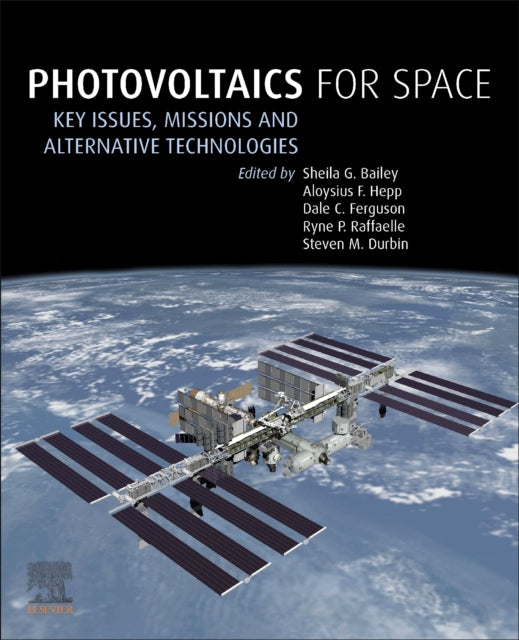
Solar panels are the primary source of power for sensors, heating, cooling, and communications on spacecraft. Photovoltaics for Space: Key Issues, Missions, and Alternative Technologies provides an overview of the challenges to efficiently producing solar power in near-Earth space and beyond, including materials and device architectures.
Format: Paperback / softback
Length: 500 pages
Publication date: 01 September 2022
Publisher: Elsevier Science Publishing Co Inc
Solar panels have long been a staple of electric power in space, serving as the primary source of energy for various spacecraft components such as sensors, active heating and cooling systems, and communications. Photovoltaics for Space: Key Issues, Missions, and Alternative Technologies offers a comprehensive exploration of the challenges and solutions involved in efficiently generating solar power in near-Earth space and beyond.
The book is structured into four sections, each comprising detailed introductory and background material as well as a compilation of in-depth space environment, materials processing, technology, and mission overviews contributed by international experts.
In the first section, the authors provide an overview of the key issues and challenges associated with producing solar power in space. They discuss the materials and device architectures developed to overcome environmental and mission-specific barriers, such as radiation, extreme temperatures, and vacuum conditions.
The second section delves into the missions and applications of photovoltaics in space. It highlights the role of solar panels in powering satellites, space probes, and manned missions, including the International Space Station (ISS) and the Mars Rover program. The authors explore the design considerations and performance metrics for space power systems, such as power-to-weight ratio, effectiveness at end of operational life (EOL), and specific mission objectives and goals.
The third section focuses on the materials used in photovoltaics for space applications. It discusses the selection of materials that can withstand the harsh space environment, including solar cells, encapsulants, and backsheets. The authors explore the advancements in material science and manufacturing techniques that have enabled the development of more durable and efficient solar panels.
The fourth section explores alternative technologies for solar power generation in space. It discusses the use of concentrator photovoltaics, tandem solar cells, and other innovative solar panel designs that can enhance the efficiency and reliability of space power systems. The authors also discuss the potential benefits and drawbacks of these alternative technologies and their potential applications in future space missions.
Throughout the book, the authors provide practical insights and recommendations for designing and optimizing space power systems performance. They discuss the importance of considering power-to-weight ratio, effectiveness at EOL, and mission-specific objectives in the design process. The authors also highlight the role of simulation and modeling in predicting the performance of space power systems and optimizing their design.
Photovoltaics for Space: Key Issues, Missions, and Alternative Technologies is an invaluable resource for practitioners and advanced students interested in learning about the background, materials, devices, environmental challenges, missions, and future for photovoltaics in space exploration. The book offers a comprehensive and up-to-date overview of the field, providing a solid foundation for further research and development in this critical area.
In conclusion, solar panels have played a pivotal role in powering
In conclusion, solar panels have played a pivotal role in powering space exploration, providing a reliable and sustainable source of electric power for various spacecraft components. Photovoltaics for Space: Key Issues, Missions, and Alternative Technologies offers a comprehensive exploration of the challenges and solutions involved in efficiently generating solar power in near-Earth space and beyond. The book provides valuable insights and recommendations for designing and optimizing space power systems, highlighting the importance of considering power-to-weight ratio, effectiveness at end of operational life, and mission-specific objectives. With its comprehensive coverage of the field, this book is an invaluable resource for practitioners and advanced students interested in learning about the background, materials, devices, environmental challenges, missions, and future for photovoltaics in space exploration.
Dimension: 235 x 191 (mm)
ISBN-13: 9780128233009
This item can be found in:
UK and International shipping information
UK and International shipping information
UK Delivery and returns information:
- Delivery within 2 - 3 days when ordering in the UK.
- Shipping fee for UK customers from £2.39. Fully tracked shipping service available.
- Returns policy: Return within 30 days of receipt for full refund.
International deliveries:
Shulph Ink now ships to Australia, Belgium, Canada, France, Germany, Ireland, Italy, India, Luxembourg Saudi Arabia, Singapore, Spain, Netherlands, New Zealand, United Arab Emirates, United States of America.
- Delivery times: within 5 - 10 days for international orders.
- Shipping fee: charges vary for overseas orders. Only tracked services are available for most international orders. Some countries have untracked shipping options.
- Customs charges: If ordering to addresses outside the United Kingdom, you may or may not incur additional customs and duties fees during local delivery.