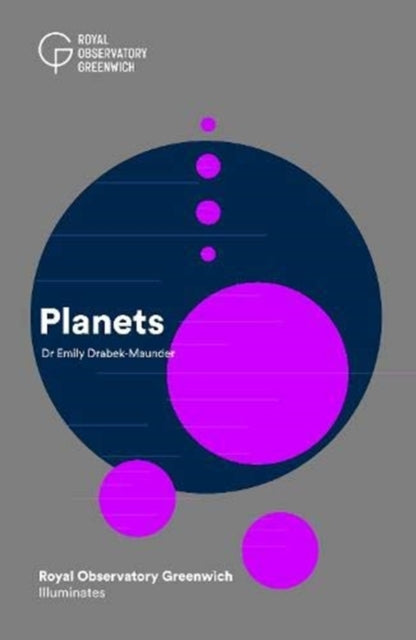
Emily Drabek-Maunder,Royal Observatory Greenwich
Planets
Planets
💎 Earn 35 Points (£0.35) on this item.
YOU SAVE £2.92
- Condition: Brand new
- UK Delivery times: Usually arrives within 2 - 3 working days
- UK Shipping: Fee starts at £3.89. Subject to product weight & dimension
Bulk ordering. Want 15 or more copies? Get a personalised quote and bigger discounts. Learn more about bulk orders.
Couldn't load pickup availability
- More about Planets
Our neighboring bodies are unique and fascinating places, with days longer than their years. Humanity's understanding of planets has changed drastically since ancient times, but there is still much to learn. Could there be life on Mars? How many planets exist outside the Solar System? Is there another Earth out there? And why can't we call Pluto a planet anymore?
Format: Paperback / softback
Length: 120 pages
Publication date: 11 February 2021
Publisher: National Maritime Museum
From a planet with a hexagonal storm to the home of the Solar System's largest volcano, our neighboring bodies are unique and fascinating places. Where else would you find somewhere with days longer than its years?
Humanity's understanding of planets has changed drastically since ancient times, when early astronomers mistook the lights they saw in the sky for wandering stars. We've come a long way since then, but there's still so much we don't know. Could there be life on Mars? How many planets exist outside the Solar System? Is there another Earth out there? And why can't we call Pluto a planet anymore?
Discover more in this essential guide to planets in the Solar System and beyond by astronomer Dr. Emily Drabek-Maunder of the Royal Observatory Greenwich.
Planets in the Solar System
The Solar System is home to eight planets, each with its own unique characteristics and features. Here's a brief overview of each planet:
Mercury: Mercury is the smallest planet in the Solar System and the closest to the Sun. It has a cratered surface and a thin atmosphere, making it difficult for life to survive.
Venus: Venus is the second planet from the Sun and is known for its extreme heat and pressure. It has a thick atmosphere that traps heat and creates a greenhouse effect, making it the hottest planet in the Solar System.
Earth: Earth is the third planet from the Sun and is known as the "home of life." It has a diverse range of ecosystems and a stable atmosphere that supports life.
Mars: Mars is the fourth planet from the Sun and is often referred to as the "Red Planet." It has a thin atmosphere and a surface that is covered in dust and sand, making it difficult for life to survive.
Jupiter: Jupiter is the largest planet in the Solar System and is known for its Great Red Spot, a massive storm that has been raging for hundreds of years. It has a thick atmosphere that contains many moons and asteroids.
Saturn: Saturn is the sixth planet from the Sun and is known for its beautiful rings. It has a thick atmosphere that contains many moons and has a magnetic field that is stronger than Jupiter's.
Uranus: Uranus is the seventh planet from the Sun and is known for its tilted axis, which causes it to rotate on its side. It has a thin atmosphere that contains many moons and has a magnetic field that is weaker than Saturn's.
Neptune: Neptune is the eighth planet from the Sun and is known for its deep blue color and strong winds. It has a thick atmosphere that contains many moons and has a magnetic field that is weaker than Uranus's.
Planets beyond the Solar System
In addition to the eight planets in the Solar System, there are many other celestial bodies that are known as exoplanets. Exoplanets are planets that orbit other stars, and they can be found in a wide range of star systems. Here are some of the most notable exoplanets:
Kepler-186f: Kepler-186f is the first exoplanet to be discovered orbiting a Sun-like star. It is approximately 1.4 times the size of Earth and is located in the habitable zone of its star, which means that it may be able to support life.
TRAPPIST-1: TRAPPIST-1 is a system of seven planets that orbit a small, cool star. The planets in this system are extremely close to each other, and they have a wide range of temperatures, making them potentially habitable.
Gliese 581c: Gliese 581c is a planet that orbits a red dwarf star. It is approximately 1.4 times the size of Earth and is located in the habitable zone of its star, which means that it may be able to support life.
TESS: TESS is a space telescope that is designed to search for exoplanets. It has discovered over 1,000 exoplanets so far, and it is continuing to search for more.
The Search for Life on Other Planets
One of the most exciting areas of astronomy is the search for life on other planets. Scientists are using a variety of techniques to try to detect signs of life on other planets, including:
Radial Velocity: Radial velocity is the method used to detect the gravitational pull of a planet on its star. By measuring the radial velocity of a planet, scientists can determine its mass and distance from its star. This information can be used to determine whether a planet is in the habitable zone of its star, which is the range of distances from a star where liquid water can exist on the surface of a planet.
Transit Observations: Transit observations are the method used to detect the passage of a planet in front of its star. When a planet passes in front of its star, it blocks a small amount of light from the star, causing a dip in the star's brightness. By measuring the size and duration of these dips, scientists can determine the size and mass of the planet and determine whether it is in the habitable zone of its star.
Spectroscopy: Spectroscopy is the method used to analyze the light emitted by a planet. By analyzing the light emitted by a planet, scientists can determine its temperature, composition, and atmospheric conditions. This information can be used to determine whether a planet is in the habitable zone of its star and whether it is capable of supporting life.
The Future of the Search for Life on Other Planets
The search for life on other planets is an ongoing area of research, and scientists are continuing to develop new techniques and technologies to improve their ability to detect signs of life. In the future, it is likely that we will see more and more exoplanets discovered, and we will continue to improve our understanding of the conditions necessary for life to exist on other planets.
In conclusion, the Solar System is home to a diverse range of planets, each with its own unique characteristics and features. From the smallest planet to the largest planet, from the hottest planet to the coldest planet, from the closest planet to the farthest planet, there is something for everyone to explore and discover. The search for life on other planets is an ongoing area of research, and scientists are continuing to develop new techniques and technologies to improve their ability to detect signs of life. In the future, it is likely that we will see more and more exoplanets discovered, and we will continue to improve our understanding of the conditions necessary for life to exist on other planets.
Weight: 122g
Dimension: 176 x 129 x 14 (mm)
ISBN-13: 9781906367824
UK and International shipping information
UK and International shipping information
We deliver throughout the United Kingdom and to 128 countries and territories worldwide, including the United States, Australia, Canada, Germany, Spain and France.