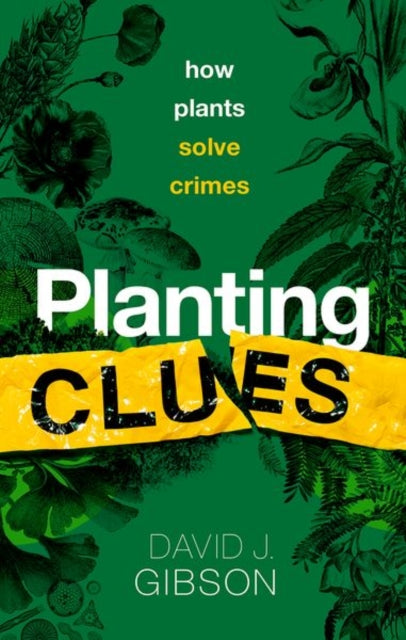
David J.Gibson
Planting Clues: How plants solve crimes
Planting Clues: How plants solve crimes
💎 Earn 84 Points (£0.84) on this item.
YOU SAVE £7.01
- Condition: Brand new
- UK Delivery times: Usually arrives within 2 - 3 working days
- UK Shipping: Fee starts at £2.39. Subject to product weight & dimension
Bulk ordering. Want 15 or more copies? Get a personalised quote and bigger discounts. Learn more about bulk orders.
Couldn't load pickup availability
- More about Planting Clues: How plants solve crimes
Plants play an important role in modern forensics, from evidence in murder trials to botanical trafficking and poaching. This book explores how plants can help solve crimes and how plant crimes are solved, with examples such as Ian Huntley and Bruno Hauptman. It also traces the evolution of forensic botany.
Format: Hardback
Length: 256 pages
Publication date: 25 August 2022
Publisher: Oxford University Press
Discover the extraordinary role of plants in modern forensics, from their use as evidence in the trials of high-profile murderers such as Ted Bundy to high-value botanical trafficking and poaching.
We are all familiar with the role of blood spatters or fingerprints in solving crimes, from stories in the media of DNA testing or other biological evidence being used as the clinching evidence to incriminate a killer. This book lifts the lid on the equally important evidence from plants at a crime scene, from the incriminating presence of freshwater plants in the lungs of a drowning victim to rare botanical poisons in the evening gin and tonic, to exotic trafficked flowers and drugs.
In Planting Clues, David Gibson explores how plants can help to solve crimes, as well as how plant crimes are themselves solved. He discusses the botanical evidence that proved important in bringing a number of high-profile murderers such as Ian Huntley (the 2002 Shoham Murders), and Bruno Hauptman (the 1932 Baby Lindbergh kidnapping) to trial, from leaf fragments and wood anatomy to pollen and spores. Throughout, he traces the evolution of forensic botany and shares the fascinating stories that advanced its progress.
Freshwater plants have been found in the lungs of drowning victims, providing crucial evidence in criminal investigations. The presence of these plants can indicate that the victim was in or near a body of water at the time of their death, aiding in the identification of the location and circumstances surrounding the incident.
Rare botanical poisons can also play a significant role in forensics. For example, the poison hemlock, which is derived from a plant native to North Africa, has been used in numerous cases of murder and attempted murder. The distinctive symptoms of hemlock poisoning, such as muscle paralysis and respiratory failure, can provide valuable information to investigators.
Exotic trafficked flowers and drugs are also a growing concern in the field of forensics. These substances are often used as a means of money laundering and can be transported across international borders with ease. The identification and analysis of these substances can help to trace the source of illegal activities and bring criminals to justice.
Forensic botany has played a crucial role in the investigation and prosecution of many high-profile crimes. The use of botanical evidence has helped to convict murderers, identify the location of crime scenes, and even solve cold cases.
One notable example is the case of Ian Huntley, a British nurse who was convicted of the murder of two young girls in 1996. Huntley was suspected of being involved in the deaths of several other children, but the evidence against him was circumstantial. However, forensic botany was used to identify the presence of a rare plant species found on the clothing of one of the victims. This plant was not native to the area where the murders took place, and it was used as a key piece of evidence in Huntley's conviction.
Another example is the case of Bruno Hauptman, a German-American businessman who was convicted of the kidnapping of Charles Lindbergh's 20-month-old son in 1932. Hauptman was suspected of being involved in several other kidnappings, but the evidence against him was circumstantial. However, forensic botany was used to identify the presence of a rare plant species found on a piece of luggage that was stolen from Lindbergh's home. This plant was not native to the United States, and it was used as a key piece of evidence in Hauptman's conviction.
Forensic botany has also been used to identify the location of crime scenes. For example, the presence of specific plant species in soil samples can help to pinpoint the location of a buried body or the site of a crime.
In conclusion, plants play an extraordinary role in modern forensics. From their use as evidence in the trials of high-profile murderers to their role in high-value botanical trafficking and poaching, plants provide valuable information that can help to solve crimes and bring criminals to justice. Forensic botany has played a crucial role in the investigation and prosecution of many high-profile crimes, and it is an area that is constantly evolving and advancing. As our understanding of plants and their role in the environment continues to grow, we can expect to see even more innovative and effective uses of botanical evidence in the future.
Weight: 376g
Dimension: 145 x 223 x 28 (mm)
ISBN-13: 9780198868606
This item can be found in:
UK and International shipping information
UK and International shipping information
UK Delivery and returns information:
- Delivery within 2 - 3 days when ordering in the UK.
- Shipping fee for UK customers from £2.39. Fully tracked shipping service available.
- Returns policy: Return within 30 days of receipt for full refund.
International deliveries:
Shulph Ink now ships to Australia, Belgium, Canada, France, Germany, Ireland, Italy, India, Luxembourg Saudi Arabia, Singapore, Spain, Netherlands, New Zealand, United Arab Emirates, United States of America.
- Delivery times: within 5 - 10 days for international orders.
- Shipping fee: charges vary for overseas orders. Only tracked services are available for most international orders. Some countries have untracked shipping options.
- Customs charges: If ordering to addresses outside the United Kingdom, you may or may not incur additional customs and duties fees during local delivery.