DK
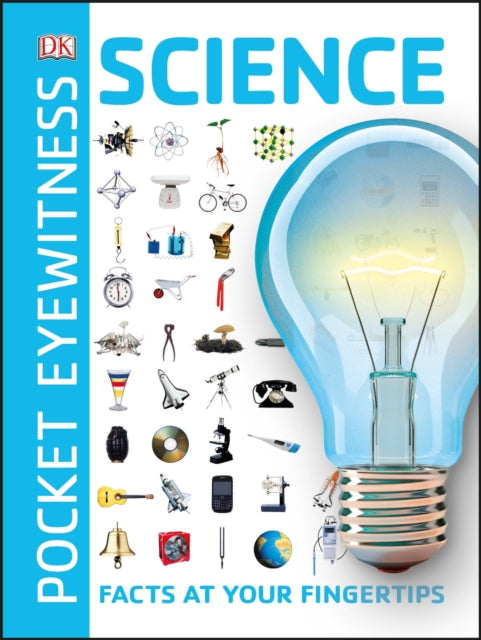
Pocket Eyewitness Science: Facts at Your Fingertips
Pocket Eyewitness Science: Facts at Your Fingertips
💎 Earn 24 Points (£0.24) on this item.
YOU SAVE £2.05
- Condition: Brand new
- UK Delivery times: Usually arrives within 2 - 3 working days
- UK Shipping: Fee starts at £2.39. Subject to product weight & dimension
Bulk ordering. Want 15 or more copies? Get a personalised quote and bigger discounts. Learn more about bulk orders.
Couldn't load pickup availability
- More about Pocket Eyewitness Science: Facts at Your Fingertips
DK Pocket Eyewitness Science is a guide to essential topics in science, including matter, energy, and animals, with bite-sized chunks of information and engaging photographs. It explains how science shapes the world around us and is packed with encyclopedic stats, engaging photographs, and genius gem facts.
Format: Paperback / softback
Length: 160 pages
Publication date: 03 May 2018
Publisher: Dorling Kindersley Ltd
Discover the fascinating world of science with this comprehensive guide! From the mysteries of matter to the wonders of energy and the captivating creatures that inhabit our planet, this guide is your ticket to becoming a science superstar.
In this guide, you'll embark on a journey of discovery, exploring the fundamental concepts that shape our world. You'll delve into the fascinating realm of matter, learning about its properties, structures, and behaviors. You'll discover how atoms and molecules combine to form the building blocks of everything we see and touch.
But that's not all! You'll also explore the incredible world of energy. From the electricity that powers our homes to the electromagnetism that governs our technology, you'll learn about the different forms of energy and how they interact with each other. You'll discover the secrets of energy production, transmission, and consumption, and how it impacts our daily lives.
And that's not all! You'll also delve into the animal kingdom, discovering the amazing diversity of life on our planet. You'll learn about the different species, their adaptations, and their interactions with each other and their environment. You'll discover the principles of evolution, genetics, and ecology, and how they explain the evolution of species and the functioning of ecosystems.
But that's not all! You'll also explore the fascinating world of chemistry, learning about the chemical reactions that occur in our bodies and the environment. You'll discover the properties of matter, the structure of molecules, and the different types of chemical reactions. You'll learn about the periodic table, the elements, and their properties, and how they are used in everyday life.
And that's not all! You'll also explore the incredible world of physics, learning about the laws that govern the behavior of matter and energy. You'll discover the principles of motion, gravity, and electromagnetism, and how they shape the world around us. You'll learn about the different branches of physics, such as mechanics, thermodynamics, and quantum mechanics, and how they contribute to our understanding of the universe.
So, whether you're a curious child, a passionate student, or an aspiring scientist, this guide is your ultimate resource for unlocking the secrets of science. With its engaging content, stunning photographs, and informative charts and diagrams, you'll be able to grasp the complexities of science and apply them to your everyday life.
So, what are you waiting for? Start your journey of discovery today and become a science superstar!
Science is a fascinating subject that plays a crucial role in shaping the world around us. It encompasses a wide range of topics, from the smallest particles to the largest galaxies, and everything in between. In this guide, we'll explore some of the essential topics in science, including matter, energy, and animals.
Matter is the fundamental building block of the universe. It can exist in different states, such as solid, liquid, and gas, and can take on various forms and structures. Matter is composed of atoms, which are the smallest units of matter that can be divided into smaller units. Atoms are made up of three particles: protons, electrons, and neutrons. Protons and neutrons are located in the nucleus of the atom, while electrons orbit around the nucleus.
One of the most important properties of matter is its mass. The mass of an object determines its weight and its gravitational force. The mass of an atom is determined by the number of protons and neutrons in the nucleus, and the mass of an element is determined by the number of protons in the nucleus. For example, the mass of an atom of hydrogen is 1.0079 amu, while the mass of an atom of gold is 196.96727 amu.
Another important property of matter is its density. The density of an object is the mass of the object per unit volume. The density of an object can be determined by dividing its mass by its volume. For example, the density of water is 1.0 g/cm^3, while the density of steel is 7.85 g/cm^3.
Matter can also interact with other objects through forces. The three main forces that govern the behavior of matter are gravity, electromagnetism, and the strong nuclear force. Gravity is the force that pulls objects towards each other, while electromagnetism is the force that governs the behavior of charged particles. The strong nuclear force is the force that holds protons and neutrons together in the nucleus of an atom.
Energy is another essential topic in science. It is the energy that an object possesses due to its motion or its state of being. Energy can be transferred from one object to another through various means, such as heat, light, sound, and electricity.
One of the most common forms of energy is heat. Heat is the energy that is transferred from one object to another when they come into contact. The temperature of an object is a measure of the amount of heat that it possesses. For example, the temperature of a hot cup of coffee is higher than the temperature of a cold cup of coffee.
Light is another form of energy that is important in science. Light is the electromagnetic radiation that is emitted by objects and travels through space. The different colors of light are caused by the different wavelengths of the electromagnetic radiation. For example, red light has a longer wavelength than blue light, which means that it travels slower through space.
Sound is another form of energy that is important in science. Sound is the vibration of matter that produces a sound wave. The different sounds that we hear are caused by the different vibrations of matter. For example, the sound of a piano is caused by the vibration of the strings that are attached to the piano.
Electricity is another form of energy that is important in science. Electricity is the flow of charged particles, such as electrons, through a conductor. The flow of electricity can be used to power various devices, such as lights, computers, and appliances.
In addition to these forms of energy, there are also other types of energy, such as nuclear energy and kinetic energy. Nuclear energy is the energy that is released from the nucleus of an atom, while kinetic energy is the energy that an object possesses due to its motion.
Animals are another essential topic in science. Animals are living organisms that are capable of reproducing, growing, and adapting to their environment. There are millions of different species of animals on Earth, and each species has its own unique characteristics and adaptations.
One of the most important characteristics of animals is their anatomy. Animals are made up of various organs and tissues, such as the brain, heart, lungs, and kidneys. Each organ and tissue is responsible for a specific function, and together they make up the body of an animal.
Animals also have a nervous system that is responsible for transmitting signals from the brain to the rest of the body. The nervous system is made up of neurons, which are cells that transmit electrical signals. The nervous system is also responsible for the perception of stimuli, such as sight, sound, and touch.
Animals also have a digestive system that is responsible for breaking down food and absorbing nutrients. The digestive system is made up of various organs, such as the stomach, intestines, and liver. The digestive system is also responsible for the excretion of waste products.
Animals also have a respiratory system that is responsible for breathing. The respiratory system is made up of the lungs and the trachea. The lungs are responsible for the exchange of oxygen and carbon dioxide between the air and the blood, while the trachea is responsible for delivering air to the lungs.
Animals also have a reproductive system that is responsible for the production of offspring. The reproductive system is made up of various organs, such as the ovaries, testes, and uterus. The reproductive system is also responsible for the maintenance of the sex organs and the production of hormones.
In addition to their anatomy and physiology, animals also have a social structure that is important for their survival. Animals live in groups, and each group has its own social hierarchy and social interactions. The social structure of an animal is determined by a variety of factors, such as the size of the group, the dominance of the group, and the social interactions of the group members.
One of the most important social interactions of animals is mating. Mating is the process by which two animals reproduce and produce offspring. Mating can occur between two individuals of the same species or between individuals of different species. Mating can also occur between individuals of the same sex or between individuals of different sexes.
Mating is an important part of the reproductive cycle of an animal. It is the process by which new individuals are produced and the genetic diversity of the population is maintained. Mating can also be a stressful and dangerous process, as animals may be subjected to predators, competition, and environmental factors.
In conclusion, science is a fascinating subject that encompasses a wide range of topics, from the smallest particles to the largest galaxies, and everything in between. In this guide, we've explored some of the essential topics in science, including matter, energy, and animals.
Matter is the fundamental building block of the universe, and it is composed of atoms, which are the smallest units of matter that can be divided into smaller units. The mass of an object determines its weight and its gravitational force, and the density of an object is the mass of the object per unit volume. Matter can also interact with other objects through forces, such as gravity, electromagnetism, and the strong nuclear force.
Energy is another essential topic in science, and it is the energy that an object possesses due to its motion or its state of being. The different forms of energy include heat, light, sound, and electricity. Heat is the energy that is transferred from one object to another when they come into contact, while light is the electromagnetic radiation that is emitted by objects and travels through space. Sound is the vibration of matter that produces a sound wave, and electricity is the flow of charged particles through a conductor.
Animals are living organisms that are capable of reproducing, growing, and adapting to their environment. Animals are made up of various organs and tissues, such as the brain, heart, lungs, and kidneys, and they have a nervous system that is responsible for transmitting signals from the brain to the rest of the body. Animals also have a digestive system that is responsible for breaking down food and absorbing nutrients, a respiratory system that is responsible for breathing, and a reproductive system that is responsible for the production of offspring. Animals also have a social structure that is important for their survival, and mating is an important part of the reproductive cycle of an animal.
In conclusion, science is a fascinating subject that encompasses a wide range of topics, from the smallest particles to the largest galaxies, and everything in between. By understanding the fundamental concepts of matter, energy, and animals, we can better understand the world around us and the role that science plays in shaping our future.
Weight: 120g
Dimension: 125 x 98 x 10 (mm)
ISBN-13: 9780241343692
UK and International shipping information
UK and International shipping information
UK Delivery and returns information:
- Delivery within 2 - 3 days when ordering in the UK.
- Shipping fee for UK customers from £2.39. Fully tracked shipping service available.
- Returns policy: Return within 30 days of receipt for full refund.
International deliveries:
Shulph Ink now ships to Australia, Belgium, Canada, France, Germany, Ireland, Italy, India, Luxembourg Saudi Arabia, Singapore, Spain, Netherlands, New Zealand, United Arab Emirates, United States of America.
- Delivery times: within 5 - 10 days for international orders.
- Shipping fee: charges vary for overseas orders. Only tracked services are available for most international orders. Some countries have untracked shipping options.
- Customs charges: If ordering to addresses outside the United Kingdom, you may or may not incur additional customs and duties fees during local delivery.