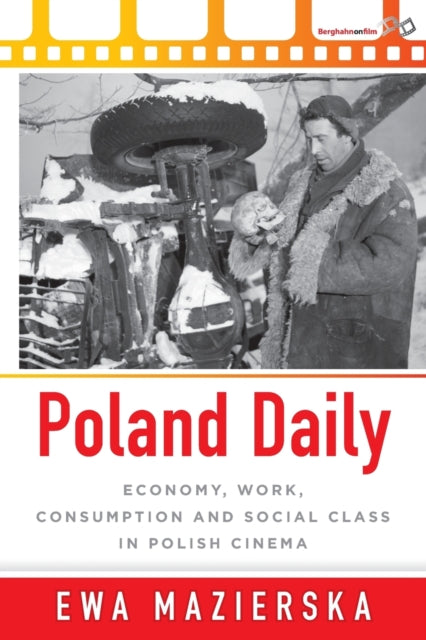
Ewa Mazierska
Poland Daily: Economy, Work, Consumption and Social Class in Polish Cinema
Poland Daily: Economy, Work, Consumption and Social Class in Polish Cinema
💎 Earn 119 Points (£1.19) on this item.
We can order this item for you. Delivery usually takes about 4 to 6 weeks.
This item is not held in our immediate stock. We will order it for you after checkout.
Estimated delivery: About 4 to 6 weeks
YOU SAVE £4.04
- Condition: Brand new
- UK Delivery times: Usually arrives within 2 - 3 working days
- UK Shipping: Fee starts at £2.39. Subject to product weight & dimension
Bulk ordering. Want 15 or more copies? Get a personalised quote and bigger discounts. Learn more about bulk orders.
Couldn't load pickup availability
- More about Poland Daily: Economy, Work, Consumption and Social Class in Polish Cinema
Poland's cinema has been influenced by its changing economic and political regimes, from prewar "embedded liberalism" to state socialism and neoliberalism, reflecting and resisting these ideologies. This volume is the first to analyze the nation's film history through the lenses of political economy and social class.
Format: Paperback / softback
Length: 346 pages
Publication date: 14 January 2022
Publisher: Berghahn Books
Over the past century, Poland, like many Eastern European nations, has experienced a series of distinct economic and political systems, ranging from prewar "embedded liberalism" to the state socialism of the Soviet era and finally to the present neoliberal era. These shifting historical contexts have had a profound impact on Polish cinema, influencing it both in terms of reflecting and challenging these changes. This groundbreaking volume is the first to comprehensively examine the entire history of Polish cinema, spanning from the reestablishment of an independent Poland in 1918 to the present day. By analyzing the film industry through the lenses of political economy and social class, the book sheds light on how Polish cinema has documented ordinary life while simultaneously carrying the distinctive marks of various ideologies.
The emergence of an independent Poland in 1918 marked a significant turning point in the country's film history. Prior to this, Polish cinema had been heavily influenced by the German and Russian film industries, which had imposed their own cultural and artistic norms on the country. However, with the establishment of a Polish government, there was a renewed interest in developing a national cinema that could reflect the unique experiences and perspectives of the Polish people.
During the interwar period, Polish cinema experienced a period of growth and experimentation. Directors such as Andrzej Wajda, Krzysztof Kieślowski, and Roman Polanski emerged as prominent figures in the industry, and their films explored a wide range of social and political issues, including the Holocaust, communism, and the struggle for independence. These films were often critical of the Soviet regime and its policies, and they played a significant role in shaping public opinion in Poland.
However, the rise of communism in Poland in the 1940s brought about a period of repression and censorship. The government tightly controlled the film industry, and any films that were deemed to be critical of the regime were banned or censored. This period saw the emergence of a group of filmmakers known as the "Solidarity" movement, who were committed to creating films that would promote the values of democracy and freedom.
Despite the challenges of the communist era, Polish cinema continued to thrive. Directors such as Wajda, Kieślowski, and Polanski continued to make films that were critical of the regime and that explored the complexities of Polish society. These films were often smuggled out of the country and screened at international film festivals, where they received critical acclaim and helped to raise awareness of the plight of the Polish people.
In the post-communist era, Poland has experienced a period of economic growth and political stability. The country has become a member of the European Union and has embraced a market-oriented economic model. This has led to a resurgence of interest in Polish cinema, with a new generation of filmmakers emerging who are eager to explore the country's rich cultural heritage and contemporary social issues.
One of the most notable features of Polish cinema in the post-communist era is its commitment to social and political commentary. Directors such as Pawel Pawlikowski, Agnieszka Holland, and Jerzy Skolimowski have made films that address a wide range of issues, including poverty, inequality, and the effects of globalization. These films have been praised for their nuanced portrayal of complex characters and their ability to engage with the audience on a deep emotional level.
Another notable feature of Polish cinema in the post-communist era is its emphasis on visual style and aesthetics. Directors such as Pawlikowski and Holland have been known for their use of striking imagery, innovative camera work, and bold color palettes. These elements have helped to create a distinctive and memorable film language that has attracted a growing international audience.
In conclusion, Polish cinema has a rich and complex history that has been shaped by a series of economic and political regimes. From the prewar era of embedded liberalism to the state socialism of the Soviet era and finally to the present neoliberal moment, Polish cinema has been both a mirror and a resistor of these changes. This volume is the first to analyze the entirety of Polish cinema's history through the lenses of political economy and social class, showing how Polish cinema documented ordinary life while bearing the hallmarks of specific ideologies.
Over the past century, Poland, like many Eastern European nations, has experienced a series of distinct economic and political systems, ranging from prewar "embedded liberalism" to the state socialism of the Soviet era and finally to the present neoliberal era. These shifting historical contexts have had a profound impact on Polish cinema, influencing it both in terms of reflecting and challenging these changes. This groundbreaking volume is the first to comprehensively examine the entire history of Polish cinema, spanning from the reestablishment of an independent Poland in 1918 to the present day. By analyzing the film industry through the lenses of political economy and social class, the book sheds light on how Polish cinema has documented ordinary life while simultaneously carrying the distinctive marks of various ideologies.
The emergence of an independent Poland in 1918 marked a significant turning point in the country's film history. Prior to this, Polish cinema had been heavily influenced by the German and Russian film industries, which had imposed their own cultural and artistic norms on the country. However, with the establishment of a Polish government, there was a renewed interest in developing a national cinema that could reflect the unique experiences and perspectives of the Polish people.
During the interwar period, Polish cinema experienced a period of growth and experimentation. Directors such as Andrzej Wajda, Krzysztof Kieślowski, and Roman Polanski emerged as prominent figures in the industry, and their films explored a wide range of social and political issues, including the Holocaust, communism, and the struggle for independence. These films were often critical of the Soviet regime and its policies, and they played a significant role in shaping public opinion in Poland.
However, the rise of communism in Poland in the 1940s brought about a period of repression and censorship. The government tightly controlled the film industry, and any films that were deemed to be critical of the regime were banned or censored. This period saw the emergence of a group of filmmakers known as the "Solidarity" movement, who were committed to creating films that would promote the values of democracy and freedom.
Despite the challenges of the communist era, Polish cinema continued to thrive. Directors such as Wajda, Kieślowski, and Polanski continued to make films that were critical of the regime and that explored the complexities of Polish society. These films were often smuggled out of the country and screened at international film festivals, where they received critical acclaim and helped to raise awareness of the plight of the Polish people.
In the post-communist era, Poland has experienced a period of economic growth and political stability. The country has become a member of the European Union and has embraced a market-oriented economic model. This has led to a resurgence of interest in Polish cinema, with a new generation of filmmakers emerging who are eager to explore the country's rich cultural heritage and contemporary social issues.
One of the most notable features of Polish cinema in the post-communist era is its commitment to social and political commentary. Directors such as Pawel Pawlikowski, Agnieszka Holland, and Jerzy Skolimowski have made films that address a wide range of issues, including poverty, inequality, and the effects of globalization. These films have been praised for their nuanced portrayal of complex characters and their ability to engage with the audience on a deep emotional level.
Another notable feature of Polish cinema in the post-communist era is its emphasis on visual style and aesthetics. Directors such as Pawlikowski and Holland have been known for their use of striking imagery, innovative camera work, and bold color palettes. These elements have helped to create a distinctive and memorable film language that has attracted a growing international audience.
In conclusion, Polish cinema has a rich and complex history that has been shaped by a series of economic and political regimes. From the prewar era of embedded liberalism to the state socialism of the Soviet era and finally to the present neoliberal moment, Polish cinema has been both a mirror and a resistor of these changes. This volume is the first to analyze the entirety of Polish cinema's history through the lenses of political economy and social class, showing how Polish cinema documented ordinary life while bearing the hallmarks of specific ideologies.
Weight: 512g
Dimension: 153 x 227 x 25 (mm)
ISBN-13: 9781800732094
This item can be found in:
UK and International shipping information
UK and International shipping information
UK Delivery and returns information:
- Delivery within 2 - 3 days when ordering in the UK.
- Shipping fee for UK customers from £2.39. Fully tracked shipping service available.
- Returns policy: Return within 30 days of receipt for full refund.
International deliveries:
Shulph Ink now ships to Australia, Belgium, Canada, France, Germany, Ireland, Italy, India, Luxembourg Saudi Arabia, Singapore, Spain, Netherlands, New Zealand, United Arab Emirates, United States of America.
- Delivery times: within 5 - 10 days for international orders.
- Shipping fee: charges vary for overseas orders. Only tracked services are available for most international orders. Some countries have untracked shipping options.
- Customs charges: If ordering to addresses outside the United Kingdom, you may or may not incur additional customs and duties fees during local delivery.