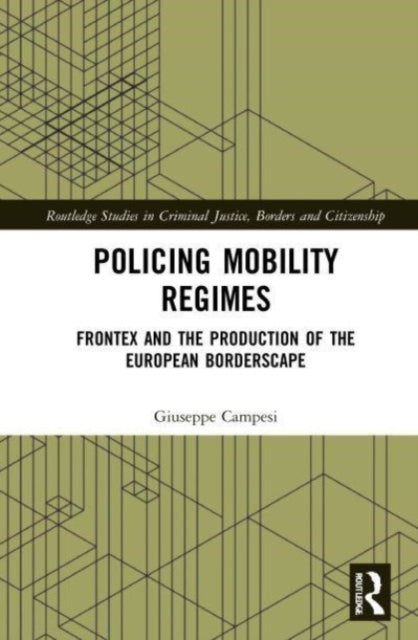
Giuseppe Campesi
Policing Mobility Regimes: Frontex and the Production of the European Borderscape
Policing Mobility Regimes: Frontex and the Production of the European Borderscape
💎 Earn 221 Points (£2.21) on this item.
YOU SAVE £2.63
- Condition: Brand new
- UK Delivery times: Usually arrives within 2 - 3 working days
- UK Shipping: Fee starts at £2.39. Subject to product weight & dimension
Bulk ordering. Want 15 or more copies? Get a personalised quote and bigger discounts. Learn more about bulk orders.
Couldn't load pickup availability
- More about Policing Mobility Regimes: Frontex and the Production of the European Borderscape
The Schengen area of free movement is under siege in Europe, with new barriers being erected, military assets being deployed, and sophisticated surveillance tools being used to track the flows of people crossing into European space. Policing Mobility Regimes offers a systematic analysis of the impact of Frontex on migration control strategies at the EU level and explores the meaning behind the attempt to develop a post-national border control strategy.
Format: Paperback / softback
Length: 310 pages
Publication date: 25 September 2023
Publisher: Taylor & Francis Ltd
More than three decades after its inception, the Schengen area of free movement faces significant challenges in Europe. New barriers are being erected along land borders, military assets are being increasingly deployed to patrol the Mediterranean, and sophisticated surveillance tools are being used to monitor the flows of people crossing into European space. This book brings together perspectives from political geography, critical criminology, and legal theory to analyze the impact of Frontex on migration control strategies at the EU level. It provides a detailed empirical description of the agency's organization and operational activities, exploring the meaning behind the attempt to develop a post-national border control strategy and its potential effects on the geopolitics of Europe's borders.
The book contributes to the broader theoretical debate on the relationships between migration, security, and the transformation of borders in contemporary Europe. It is accessible and compelling, appealing to a wide range of readers, including those engaged with criminology, sociology, geography, politics, and law, as well as those interested in learning about Europe's changing borders.
The Schengen area of free movement was established in 1985 with the aim of removing border controls between member states of the European Union (EU). However, since its inception, the area has faced several challenges, including increased migration flows, security concerns, and the rise of right-wing populism.
One of the key challenges facing the Schengen area is the increased flow of migrants and refugees into Europe. The Mediterranean region, in particular, has become a major entry point for migrants seeking to enter the EU, often risking their lives in the process. This has led to increased tensions between member states and has led to calls for stricter border controls.
In response to these challenges, the EU has implemented several measures to enhance border control, including the deployment of military assets to patrol the Mediterranean and the use of sophisticated surveillance tools to monitor the flows of people crossing into European space. Frontex, the EU's border management agency, has been at the forefront of these efforts.
Frontex is responsible for coordinating the border control efforts of member states and providing support to them in their efforts to prevent illegal migration and combat terrorism. The agency has a wide range of powers, including the ability to conduct border checks, arrest and detain migrants, and deport them. Frontex also operates a network of surveillance cameras, drones, and other technologies to monitor the borders and detect potential threats.
Despite its efforts, Frontex has faced criticism from several quarters. Some argue that the agency's powers are too broad and that it has been used to violate human rights and push migrants back to their countries of origin. Others argue that the agency's focus on border control has led to a neglect of other aspects of migration, such as the need for legal migration channels and the protection of migrants' rights.
Policing Mobility Regimes offers a systematic analysis of the impact that Frontex is having on migration control strategies at the EU level. The book is divided into three parts: an introduction, a review of the literature, and an empirical analysis.
In the introduction, the authors provide an overview of the Schengen area of free movement and the challenges it faces. They then introduce the concept of mobility regimes and explain how they can be used to analyze the impact of border control policies.
The review of the literature provides an overview of the existing literature on the impact of Frontex on migration control strategies. The authors identify key themes and trends in the literature and discuss how they relate to the impact of Frontex.
The empirical analysis provides a detailed description of the organization and operational activities of Frontex. The authors use a range of data sources, including official documents, interviews with key stakeholders, and fieldwork in several EU member states.
One of the key findings of the book is that Frontex is having a significant impact on migration control strategies at the EU level. The agency has helped to coordinate the border control efforts of member states and has provided them with support in their efforts to prevent illegal migration and combat terrorism. However, the book also highlights the limitations of Frontex's powers and the potential for human rights violations.
The authors argue that Frontex's focus on border control has led to a neglect of other aspects of migration, such as the need for legal migration channels and the protection of migrants' rights. They suggest that the EU should shift its focus towards a more comprehensive approach to migration that includes measures to address the root
In conclusion, Policing Mobility Regimes is a valuable contribution to the literature on the impact of border control policies on migration control strategies in contemporary Europe. The book offers a systematic analysis of the impact that Frontex is having on migration control strategies at the EU level and provides a detailed empirical description of the agency's organization and operational activities. The book will appeal to all those engaged with criminology, sociology, geography, politics, and law as well as all those interested in learning about Europes changing borders.
Weight: 492g
Dimension: 156 x 233 x 22 (mm)
ISBN-13: 9781032076546
This item can be found in:
UK and International shipping information
UK and International shipping information
UK Delivery and returns information:
- Delivery within 2 - 3 days when ordering in the UK.
- Shipping fee for UK customers from £2.39. Fully tracked shipping service available.
- Returns policy: Return within 30 days of receipt for full refund.
International deliveries:
Shulph Ink now ships to Australia, Belgium, Canada, France, Germany, Ireland, Italy, India, Luxembourg Saudi Arabia, Singapore, Spain, Netherlands, New Zealand, United Arab Emirates, United States of America.
- Delivery times: within 5 - 10 days for international orders.
- Shipping fee: charges vary for overseas orders. Only tracked services are available for most international orders. Some countries have untracked shipping options.
- Customs charges: If ordering to addresses outside the United Kingdom, you may or may not incur additional customs and duties fees during local delivery.