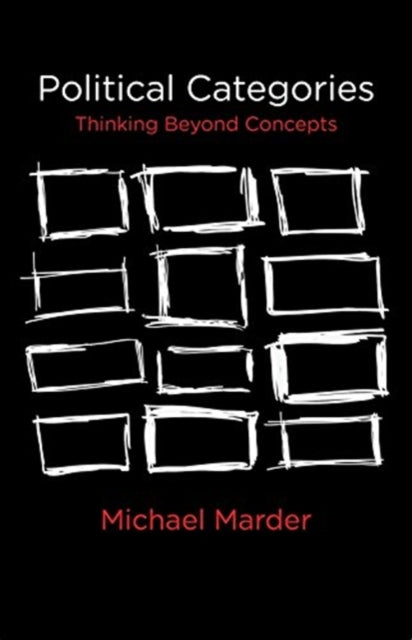
Michael Marder
Political Categories: Thinking Beyond Concepts
Political Categories: Thinking Beyond Concepts
💎 Earn 112 Points (£1.12) on this item.
We can order this item for you. Delivery usually takes about 4 to 6 weeks.
This item is not held in our immediate stock. We will order it for you after checkout.
Estimated delivery: About 4 to 6 weeks
YOU SAVE £5.53
- Condition: Brand new
- UK Delivery times: Usually arrives within 2 - 3 working days
- UK Shipping: Fee starts at £2.39. Subject to product weight & dimension
Bulk ordering. Want 15 or more copies? Get a personalised quote and bigger discounts. Learn more about bulk orders.
Couldn't load pickup availability
- More about Political Categories: Thinking Beyond Concepts
Western philosophy has dominated by the concept or idea that there is one sovereign notion or singular principle that can make reality explicable and bring all that exists under its sway. In modern politics, ideology plays this role. Michael Marder proposes a new methodology for political science and philosophy, "categorial thinking," which suggests that no category alone can exhaust the meaning of anything. His book offers readers a theoretical toolbox for the interpretation of political phenomena, processes, institutions, and ideas, encompassing political temporality and spatiality, the revolutionary and conservative modalities of political actuality, possibility, and necessity, quantitative and qualitative approaches, the meaning of political relations, and various senses of political being.
Format: Paperback / softback
Length: 272 pages
Publication date: 12 March 2019
Publisher: Columbia University Press
Western philosophy has been dominated by the concept or the idea—the belief that there is one sovereign notion or singular principle that can make reality explicable and bring all that exists under its sway. In modern politics, this role is played by ideology. Left, right, or center, political schools of thought share a metaphysics of simplification. We internalize a dominant, largely unnoticeable framework, oblivious to complex, plural, and occasionally conflicting or mutually contradictory explanations for what is the case.
In this groundbreaking work, Michael Marder proposes a new methodology for political science and philosophy, one which he terms “categorial thinking.” In contrast to the concept, no category alone can exhaust the meaning of anything: categories are so many folds, complications, respectful of multiplicity. Ranging from classical Aristotelian and Kantian philosophies to phenomenology and contemporary politics, Marder's book offers readers a theoretical toolbox for the interpretation of political phenomena, processes, institutions, and ideas. His categorial apparatus encompasses political temporality and spatiality; the revolutionary and conservative modalities of political actuality, possibility, and necessity; quantitative and qualitative approaches to the study of political reality; the meaning of political relations; and various senses of political being. Under this lens, the political appears not as a singular concept but as a family of categories, allowing room for new, plural, and often antagonistic ideas about the state, the people, sovereignty, and power.
Marder's categorial thinking is a powerful tool for understanding the complexities of political life. By recognizing that no single category can fully explain the world, we can begin to see the political as a rich and multifaceted phenomenon. This approach encourages us to think critically about the categories we use to understand the world and to consider the ways in which they shape our perceptions and interpretations. It also allows us to explore new and innovative ways of thinking about the political, such as through the lens of feminist, postcolonial, or critical race theory.
One of the key strengths of Marder's approach is its ability to bridge the gap between theory and practice. By providing a theoretical framework that can be applied to a wide range of political phenomena, Marder's book offers practical insights into the ways in which politics works. This approach is particularly valuable for those who are interested in developing a more nuanced and critical understanding of the political world, as it allows them to see the political in all its complexity and to develop strategies for navigating it effectively.
In conclusion, Marder's categorial thinking is a groundbreaking work that offers a new methodology for political science and philosophy. By recognizing the limitations of the concept and embracing the complexity of the political, Marder provides readers with a theoretical toolbox for the interpretation of political phenomena, processes, institutions, and ideas. This approach is particularly valuable for those who are interested in developing a more nuanced and critical understanding of the political world, as it allows them to see the political in all its complexity and to develop strategies for navigating it effectively.
Weight: 330g
Dimension: 140 x 216 x 19 (mm)
ISBN-13: 9780231188692
UK and International shipping information
UK and International shipping information
UK Delivery and returns information:
- Delivery within 2 - 3 days when ordering in the UK.
- Shipping fee for UK customers from £2.39. Fully tracked shipping service available.
- Returns policy: Return within 30 days of receipt for full refund.
International deliveries:
Shulph Ink now ships to Australia, Belgium, Canada, France, Germany, Ireland, Italy, India, Luxembourg Saudi Arabia, Singapore, Spain, Netherlands, New Zealand, United Arab Emirates, United States of America.
- Delivery times: within 5 - 10 days for international orders.
- Shipping fee: charges vary for overseas orders. Only tracked services are available for most international orders. Some countries have untracked shipping options.
- Customs charges: If ordering to addresses outside the United Kingdom, you may or may not incur additional customs and duties fees during local delivery.