Prof. ThomasDocherty
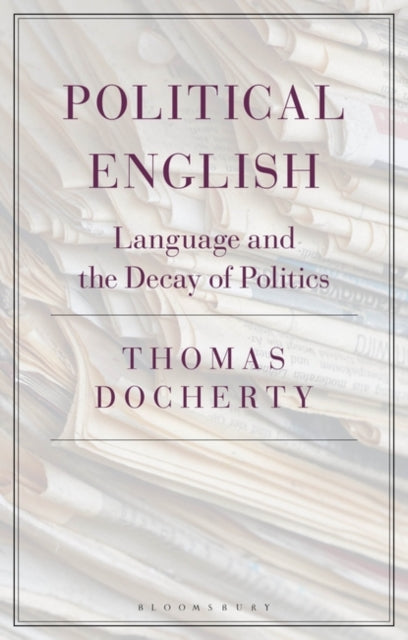
Political English: Language and the Decay of Politics
Political English: Language and the Decay of Politics
💎 Earn 122 Points (£1.22) on this item.
We can order this item for you. Delivery usually takes about 4 to 6 weeks.
This item is not held in our immediate stock. We will order it for you after checkout.
Estimated delivery: About 4 to 6 weeks
YOU SAVE £2.47
- Condition: Brand new
- UK Delivery times: Usually arrives within 2 - 3 working days
- UK Shipping: Fee starts at £2.39. Subject to product weight & dimension
Bulk ordering. Want 15 or more copies? Get a personalised quote and bigger discounts. Learn more about bulk orders.
Couldn't load pickup availability
- More about Political English: Language and the Decay of Politics
The English language has been a powerful weapon and a crucial battlefield for our divided politics, from post-truth politics to "no-platforming" on university campuses. Thomas Docherty's book explores the politics of the English language, its implications in the dynamics of political power, and the spaces it offers for dissent and resistance. It develops a powerful history for contemporary debates about propaganda, free speech, and truth-telling in our politics, taking examples from the US, UK, and beyond.
Format: Paperback / softback
Length: 248 pages
Publication date: 08 August 2019
Publisher: Bloomsbury Publishing PLC
The English language has played a pivotal role in shaping our divided politics, serving as both a powerful weapon and a critical battlefield. In his insightful and comprehensive intervention, Thomas Docherty delves into the politics of the English language, examining its implications in the dynamics of political power and the spaces it provides for dissent and resistance. Spanning from the authorized English of the King James Bible to the colonial project of University English Studies, this book offers a rich history that informs contemporary debates on propaganda, free speech, and truth-telling in our politics. Drawing examples from the United States, the United Kingdom, and beyond, including discussions about the Second Amendment and free-speech on campus, the Iraq War, and the Grenfell Tower fire, this book serves as a forceful and provocative return to Orwell's observation that a degraded political language is closely linked to an equally degraded political culture.
The English language has evolved over centuries, shaped by various factors such as cultural, social, and political developments. It has played a significant role in shaping our understanding of the world, our values, and our beliefs. However, the English language has also been used as a tool for propaganda, misinformation, and manipulation. In recent years, we have witnessed the rise of post-truth politics, where politicians and media outlets use false information and misleading narratives to gain political advantage. This has led to a decline in trust in institutions and a loss of faith in the democratic process.
One of the ways in which the English language has been used to promote post-truth politics is through the use of language that is ambiguous, misleading, or confusing. This can be seen in the way that politicians use complex language to avoid accountability or to obfuscate their true intentions. For example, instead of saying "I lied to the public," a politician may say "I misspoke" or "I made a mistake." This type of language is designed to deflect criticism and to create a sense of confusion, making it difficult for the public to hold politicians accountable.
Another way in which the English language has been used to promote post-truth politics is through the use of language that is designed to evoke emotions and to create a sense of fear or anxiety. This can be seen in the way that politicians use language to describe threats such as terrorism, immigration, and climate change. By using language that is designed to evoke fear, politicians can manipulate public opinion and gain support for their policies.
Furthermore, the English language has been used to promote post-truth politics through the use of language that is designed to divide people. This can be seen in the way that politicians use language to create stereotypes and to promote division between different groups of people. For example, politicians may use language to describe immigrants as "illegal" or to promote a narrative that Muslims are a threat to Western civilization. By using language that is designed to divide people, politicians can gain support for their policies and undermine the social fabric of society.
In addition to the use of language for propaganda and manipulation, the English language has also been used to promote censorship and to limit the freedom of speech. This can be seen in the way that governments and institutions use language to restrict the right to free speech on campus. For example, universities may use language to prohibit certain types of speech, such as hate speech or speech that is considered offensive or disrespectful. By using language to restrict the freedom of speech, universities can create a climate of fear and intimidation, making it difficult for students to express their opinions and engage in meaningful dialogue.
Furthermore, the English language has been used to promote censorship and to limit the freedom of speech in the media. This can be seen in the way that governments and institutions use language to restrict the reporting of certain events or to censor certain types of content. For example, governments may use language to prohibit the reporting of certain political events or to censor certain types of media content, such as news articles or documentaries that are considered critical of the government. By using language to restrict the freedom of speech, governments can control the narrative and limit the public's access to information.
Despite these challenges, the English language has also been used as a tool for resistance and dissent. This can be seen in the way that activists and artists use language to challenge the power of the state and to promote social change. For example, activists may use language to promote a narrative of resistance and to challenge the dominant power structures in society. Artists may use language to express their political beliefs and to challenge the status quo
In conclusion, the English language has played a pivotal role in shaping our divided politics, serving as both a powerful weapon and a critical battlefield. While it has been used to promote post-truth politics, misinformation, and manipulation, it has also been used as a tool for resistance and dissent. It is important that we recognize the power of the English language and work to promote a culture of truth-telling and accountability in our politics. This can be done by promoting a culture of critical thinking, by promoting a culture of empathy and understanding, and by promoting a culture of respect for the rights and freedoms of others. By doing so language, we can create a more inclusive and democratic society that is based on the values of truth, justice, and equality.
Weight: 276g
Dimension: 140 x 216 x 14 (mm)
ISBN-13: 9781350101388
UK and International shipping information
UK and International shipping information
UK Delivery and returns information:
- Delivery within 2 - 3 days when ordering in the UK.
- Shipping fee for UK customers from £2.39. Fully tracked shipping service available.
- Returns policy: Return within 30 days of receipt for full refund.
International deliveries:
Shulph Ink now ships to Australia, Belgium, Canada, France, Germany, Ireland, Italy, India, Luxembourg Saudi Arabia, Singapore, Spain, Netherlands, New Zealand, United Arab Emirates, United States of America.
- Delivery times: within 5 - 10 days for international orders.
- Shipping fee: charges vary for overseas orders. Only tracked services are available for most international orders. Some countries have untracked shipping options.
- Customs charges: If ordering to addresses outside the United Kingdom, you may or may not incur additional customs and duties fees during local delivery.