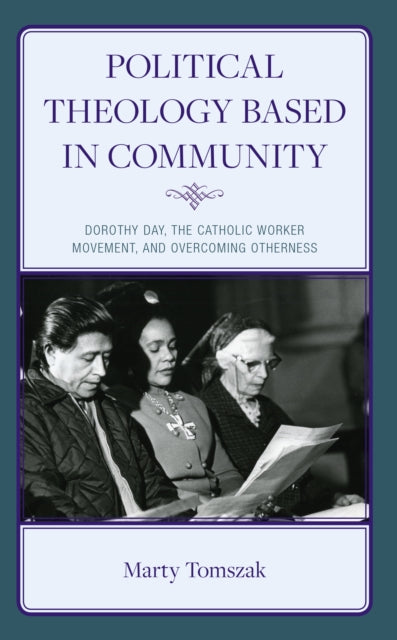
Marty Tomszak
Political Theology Based in Community: Dorothy Day, the Catholic Worker Movement, and Overcoming Otherness
Political Theology Based in Community: Dorothy Day, the Catholic Worker Movement, and Overcoming Otherness
💎 Earn 386 Points (£3.86) on this item.
We can order this item for you. Delivery usually takes about 4 to 6 weeks.
This item is not held in our immediate stock. We will order it for you after checkout.
Estimated delivery: About 4 to 6 weeks
YOU SAVE £7.77
- Condition: Brand new
- UK Delivery times: Usually arrives within 2 - 3 working days
- UK Shipping: Fee starts at £2.39. Subject to product weight & dimension
Bulk ordering. Want 15 or more copies? Get a personalised quote and bigger discounts. Learn more about bulk orders.
Couldn't load pickup availability
- More about Political Theology Based in Community: Dorothy Day, the Catholic Worker Movement, and Overcoming Otherness
Marty Tomszak's book explores the relationship between radical political theology, Catholic Worker movement, and Catholic Social Teaching, highlighting the hope for radical hospitality in addressing current crises through weak theology and Anatheism.
Format: Hardback
Length: 274 pages
Publication date: 15 October 2023
Publisher: Rowman & Littlefield
In his groundbreaking work, "Political Theology Based in Community: Dorothy Day, The Catholic Worker Movement, and Overcoming Otherness," Marty Tomszak skillfully weaves together the seemingly disparate realms of radical political theology, communally oriented pedagogy, the Catholic Worker movement, and Catholic Social Teaching to forge a novel approach to ethics in our contemporary world. By adopting weak theology and Anatheism, which were introduced to the fold by John Caputo and Richard Kearney, respectively, and partnering them with the groundbreaking work of Dorothy Day and Peter Maurin in their tireless efforts to serve the poor and marginalized, Tomszak unveils the profound hope that lies within radical hospitality for our global community. This hope is directed toward the distinct audiences of the academy, the Church, and society at large, as this radical ethic offers unique solutions to a multitude of pressing crises.
The Catholic Worker movement, founded by Dorothy Day and Peter Maurin in the 1930s, is a radical social movement that combines Catholic social teaching with a commitment to social justice and service to the poor and marginalized. The movement's philosophy is rooted in the teachings of Jesus Christ and the Catholic Church, particularly the social teachings of St. Augustine and St. Thomas Aquinas.
One of the key principles of the Catholic Worker movement is the concept of voluntary poverty, which means that members of the movement choose to live in simple, humble communities and to reject the materialism and consumerism of modern society. Members of the movement also work to establish community-based programs and services that address the root causes of poverty, such as homelessness, hunger, and addiction.
The Catholic Worker movement has a long history of advocating for social and political change, particularly through nonviolent resistance and direct action. Members of the movement have been involved in a wide range of social justice issues, including labor rights, women's rights, and peace and justice movements.
One of the most notable examples of the Catholic Worker movement's impact is the establishment of soup kitchens and homeless shelters around the world. These programs provide food, shelter, and support to people who are experiencing poverty and homelessness, and they have helped to reduce the number of people living in poverty and homelessness in many cities and countries.
In addition to their work in social services, the Catholic Worker movement also engages in political activism and advocacy. Members of the movement have been involved in protests and demonstrations against war, poverty, and injustice, and they have worked to promote policies that promote social and economic equality.
One of the key figures in the Catholic Worker movement is Dorothy Day, who was born in 1897 and died in 1980. Day was a journalist and social activist who founded the Catholic Worker movement in 1933 with Peter Maurin. Day was known for her commitment to social justice and her simple, humble lifestyle.
Day was a strong advocate for the poor and marginalized, and she believed that the Catholic Church had a responsibility to serve the poor and vulnerable. She also believed that the government had a responsibility to provide social and economic safety nets for people who were unable to support themselves.
Day's philosophy of voluntary poverty and her commitment to social justice have inspired many people around the world. The Catholic Worker movement has grown to include thousands of members in dozens of countries, and the movement continues to advocate for social and political change through nonviolent resistance and direct action.
Another key figure in the Catholic Worker movement is Peter Maurin, who was born in 1898 and died in 1978. Maurin was a French philosopher and social activist who founded the Catholic Worker movement with Dorothy Day. Maurin was known for his commitment to social justice and his vision of a society that was based on love and compassion.
Maurin believed that the Catholic Church had a unique role to play in promoting social justice and that the movement should be rooted in the teachings of Jesus Christ and the Catholic Church. He also believed that the movement should be decentralized and that it should be led by laypeople who were committed to serving the poor and marginalized.
Maurin's philosophy of social justice and his vision of a society based on love and compassion have inspired many people around the world. The Catholic Worker movement has grown to include thousands of members in dozens of countries, and the movement continues to advocate for social and political change through nonviolent resistance and direct action.
In conclusion, the Catholic Worker movement is a radical social movement that combines Catholic social teaching with a commitment to social justice and service to the poor and marginalized. The movement's philosophy is rooted in the teachings of Jesus Christ and the Catholic Church, particularly the social teachings of St. Augustine and St. Thomas Aquinas. The movement has a long history of advocating for social and political change, particularly through nonviolent resistance and direct action. The movement's key figures, including Dorothy Day and Peter Maurin, have inspired many people around the world with their commitment to social justice and their simple, humble lifestyles.
Weight: 558g
Dimension: 160 x 237 x 24 (mm)
ISBN-13: 9781978715455
UK and International shipping information
UK and International shipping information
UK Delivery and returns information:
- Delivery within 2 - 3 days when ordering in the UK.
- Shipping fee for UK customers from £2.39. Fully tracked shipping service available.
- Returns policy: Return within 30 days of receipt for full refund.
International deliveries:
Shulph Ink now ships to Australia, Belgium, Canada, France, Germany, Ireland, Italy, India, Luxembourg Saudi Arabia, Singapore, Spain, Netherlands, New Zealand, United Arab Emirates, United States of America.
- Delivery times: within 5 - 10 days for international orders.
- Shipping fee: charges vary for overseas orders. Only tracked services are available for most international orders. Some countries have untracked shipping options.
- Customs charges: If ordering to addresses outside the United Kingdom, you may or may not incur additional customs and duties fees during local delivery.