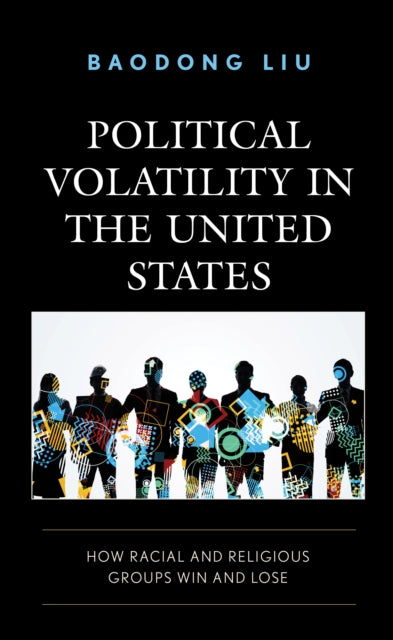
Baodong Liu
Political Volatility in the United States: How Racial and Religious Groups Win and Lose
Political Volatility in the United States: How Racial and Religious Groups Win and Lose
💎 Earn 451 Points (£4.51) on this item.
We can order this item for you. Delivery usually takes about 4 to 6 weeks.
This item is not held in our immediate stock. We will order it for you after checkout.
Estimated delivery: About 4 to 6 weeks
- Condition: Brand new
- UK Delivery times: Usually arrives within 2 - 3 working days
- UK Shipping: Fee starts at £3.89. Subject to product weight & dimension
Bulk ordering. Want 15 or more copies? Get a personalised quote and bigger discounts. Learn more about bulk orders.
Couldn't load pickup availability
- More about Political Volatility in the United States: How Racial and Religious Groups Win and Lose
The unexpected shift from the election of Barack Obama to the racial confrontations in the Trump era has led to a book that aims to provide a systemic model for understanding how political volatility throughout the U.S. history has had its root in two competing racial and religious groupings. The antagonism between the two competing identity groupings has led to a history of political volatility in the United States, contrary to the endless "political deadlocks" suggested by scholars of American political development.
Format: Hardback
Length: 244 pages
Publication date: 13 January 2022
Publisher: Lexington Books
The unexpected shift from the election of Barack Obama and the post-racial hope to the racial confrontations in the Trump era begs the question: Why did such a big volatile swing happen in such a short period of time? Uncertainty reigns in volatile political times. This book aims to provide a systemic model for understanding how political volatility throughout the U.S. history has had its root in two competing racial and religious groupings. Moreover,the groupings grounded in white supremacy and egalitarianism have collided,contested,and facilitated the configuration and reconfiguration of the atomic political structure. As demonstrated in this book,the antagonism between the two competing identity groupings led to a history of political volatility in the United States. Contrary to the endless “political deadlocks” suggested by the scholars of American political development,this book explains how and why the two orders persist,reach peaks of volatility,and why one temporarily achieves prominence over the other. Going beyond the simplistic view of racial and religious hierarchy,this book provides an account rooted in structural tensions,strategic imperatives,opportunities,and threats on collective actions.
The Unexpected Shift from Obama to Trump: Exploring the Roots of Political Volatility in the United States
The election of Barack Obama in 2008 brought with it a sense of post-racial hope and optimism, as many believed that the country had finally moved beyond its history of racial discrimination and inequality. However, the political landscape in the United States has since undergone a significant shift, with the election of Donald Trump in 2016 marking a return to racial confrontations and divisions. This shift has left many wondering why such a volatile swing has occurred in such a short period of time. In this book, we aim to provide a systemic model for understanding how political volatility has been rooted in two competing racial and religious groupings throughout U.S. history. These groupings, grounded in white supremacy and egalitarianism, have collided, contested, and facilitated the configuration and reconfiguration of the atomic political structure. Through a comprehensive analysis of historical events and social movements, we will explore how the antagonism between these two identity groupings has led to a history of political volatility in the United States. Contrary to the notion of endless "political deadlocks" suggested by scholars of American political development, this book explains how and why the two orders persist, reach peaks of volatility, and why one temporarily achieves prominence over the other. By going beyond the simplistic view of racial and religious hierarchy, we provide an account rooted in structural tensions, strategic imperatives, opportunities, and threats on collective actions.
The Unexpected Shift from Obama to Trump: Exploring the Roots of Political Volatility in the United States
The election of Barack Obama in 2008 brought with it a sense of post-racial hope and optimism, as many believed that the country had finally moved beyond its history of racial discrimination and inequality. However, the political landscape in the United States has since undergone a significant shift, with the election of Donald Trump in 2016 marking a return to racial confrontations and divisions. This shift has left many wondering why such a volatile swing has occurred in such a short period of time. In this book, we aim to provide a systemic model for understanding how political volatility has been rooted in two competing racial and religious groupings throughout U.S. history. These groupings, grounded in white supremacy and egalitarianism, have collided, contested, and facilitated the configuration and reconfiguration of the atomic political structure. Through a comprehensive analysis of historical events and social movements, we will explore how the antagonism between these two identity groupings has led to a history of political volatility in the United States. Contrary to the notion of endless "political deadlocks" suggested by scholars of American political development, this book explains how and why the two orders persist, reach peaks of volatility, and why one temporarily achieves prominence over the other. By going beyond the simplistic view of racial and religious hierarchy, we provide an account rooted in structural tensions, strategic imperatives, opportunities, and threats on collective actions.
The Unexpected Shift from Obama to Trump: Exploring the Roots of Political Volatility in the United States
The election of Barack Obama in 2008 brought with it a sense of post-racial hope and optimism, as many believed that the country had finally moved beyond its history of racial discrimination and inequality. However, the political landscape in the United States has since undergone a significant shift, with the election of Donald Trump in 2016 marking a return to racial confrontations and divisions. This shift has left many wondering why such a volatile swing has occurred in such a short period of time. In this book, we aim to provide a systemic model for understanding how political volatility has been rooted in two competing racial and religious groupings throughout U.S. history. These groupings, grounded in white supremacy and egalitarianism, have collided, contested, and facilitated the configuration and reconfiguration of the atomic political structure. Through a comprehensive analysis of historical events and social movements, we will explore how the antagonism between these two identity groupings has led to a history of political volatility in the United States. Contrary to the notion of endless "political deadlocks" suggested by scholars of American political development, this book explains how and why the two orders persist, reach peaks of volatility, and why one temporarily achieves prominence over the other. By going beyond the simplistic view of racial and religious hierarchy, we provide an account rooted in structural tensions, strategic imperatives, opportunities, and threats on collective actions.
Weight: 485g
Dimension: 236 x 163 x 19 (mm)
ISBN-13: 9781793651280
UK and International shipping information
UK and International shipping information
We deliver throughout the United Kingdom and to 128 countries and territories worldwide, including the United States, Australia, Canada, Germany, Spain and France.