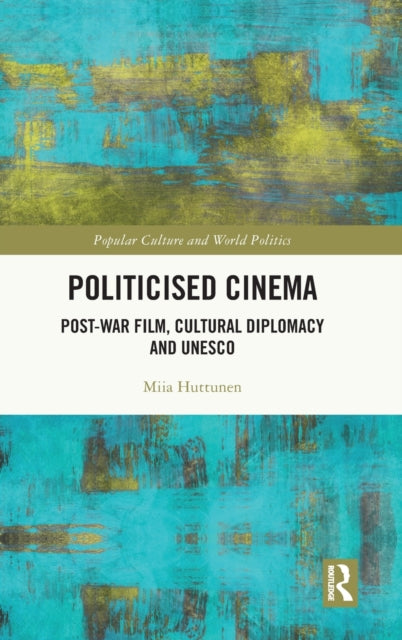
MiiaHuttunen
Politicised Cinema: Post-War Film, Cultural Diplomacy and UNESCO
Politicised Cinema: Post-War Film, Cultural Diplomacy and UNESCO
💎 Earn 811 Points (£8.11) on this item.
We can order this item for you. Delivery usually takes about 4 to 6 weeks.
This item is not held in our immediate stock. We will order it for you after checkout.
Estimated delivery: About 4 to 6 weeks
YOU SAVE £9.63
- Condition: Brand new
- UK Delivery times: Usually arrives within 2 - 3 working days
- UK Shipping: Fee starts at £2.39. Subject to product weight & dimension
Bulk ordering. Want 15 or more copies? Get a personalised quote and bigger discounts. Learn more about bulk orders.
Couldn't load pickup availability
- More about Politicised Cinema: Post-War Film, Cultural Diplomacy and UNESCO
Politicised Cinema shows how taking a collection of seemingly apolitical films and using them for explicit political aims can be a force for good. It analyzes the 1959 film catalogue Orient: A Survey of Films Produced in Countries of Arab and Asian Culture, which was published by UNESCO and the BFI to promote intercultural understanding between the East and the West. The author argues that the catalogue positions culture and its cinematic representations as a marker of difference between the Eastern and Western worlds, and shows how even major cultural conflicts can be reframed in service of UNESCO's cultural diplomatic agenda. The book explores how the catalogue of Eastern films deemed suitable for Western audiences became a weapon to fight against prejudice, intolerance, and bigotry in a politicized battle over dismantling the proclaimed link between difference and conflict.
Format: Hardback
Length: 166 pages
Publication date: 31 January 2022
Publisher: Taylor & Francis Ltd
Politicised Cinema explores the powerful potential of utilizing a collection of seemingly apolitical films as a tool to serve explicit political objectives. By examining the film catalogue "Orient: A Survey of Films Produced in Countries of Arab and Asian Culture," published by UNESCO and the BFI in 1959 with the aim of promoting intercultural understanding between the East and the West, the author makes a compelling argument for the significance of studying how films can be interpreted and manipulated to serve a specific political agenda, even when the films themselves were originally created with entirely different intentions.
The author delves into how the catalogue positions culture and its cinematic representations as a defining characteristic separating the Eastern and Western worlds. Through this analysis, the author demonstrates how even significant cultural conflicts such as the Cold War and the decolonization process can be reframed to align with UNESCO's cultural diplomatic agenda. The book explores the ways in which the catalogue of Eastern films deemed suitable for Western audiences became a weapon in the fight against prejudice, intolerance, and bigotry. It sheds light on how these films were used to challenge and dismantle the perceived link between difference and conflict, contributing to a more inclusive and understanding global society.
This book is of immense interest to students, researchers, and academics in various fields, including visual politics, cinematic international relations, cultural diplomacy, global governance, and international cultural politics. It provides valuable insights into the complex dynamics of film interpretation and its role in shaping public discourse. Film studies, Asian studies, and cultural studies scholars will find this book particularly enriching, as it offers a comprehensive examination of the cultural and political dimensions of cinema.
Furthermore, policymakers and practitioners in the fields of cultural diplomacy and cultural policy will find the empirical case study presented in the book to be of practical use in their work. The book offers valuable lessons and strategies for navigating the complex terrain of cultural exchange and promoting mutual understanding in a globalized world.
In conclusion, Politicised Cinema is a thought-provoking and insightful book that sheds light on the power of cinema as a tool for political expression and social change. By examining the ways in which films can be manipulated and interpreted to serve specific political agendas.
Weight: 490g
Dimension: 234 x 156 (mm)
ISBN-13: 9781032120003
This item can be found in:
UK and International shipping information
UK and International shipping information
UK Delivery and returns information:
- Delivery within 2 - 3 days when ordering in the UK.
- Shipping fee for UK customers from £2.39. Fully tracked shipping service available.
- Returns policy: Return within 30 days of receipt for full refund.
International deliveries:
Shulph Ink now ships to Australia, Belgium, Canada, France, Germany, Ireland, Italy, India, Luxembourg Saudi Arabia, Singapore, Spain, Netherlands, New Zealand, United Arab Emirates, United States of America.
- Delivery times: within 5 - 10 days for international orders.
- Shipping fee: charges vary for overseas orders. Only tracked services are available for most international orders. Some countries have untracked shipping options.
- Customs charges: If ordering to addresses outside the United Kingdom, you may or may not incur additional customs and duties fees during local delivery.