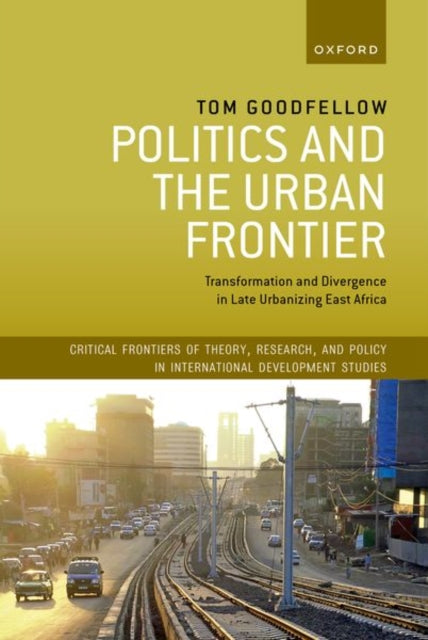
TomGoodfellow
Politics and the Urban Frontier: Transformation and Divergence in Late Urbanizing East Africa
Politics and the Urban Frontier: Transformation and Divergence in Late Urbanizing East Africa
💎 Earn 570 Points (£5.70) on this item.
- Condition: Brand new
- UK Delivery times: Usually arrives within 2 - 3 working days
- UK Shipping: Fee starts at £2.39. Subject to product weight & dimension
Bulk ordering. Want 15 or more copies? Get a personalised quote and bigger discounts. Learn more about bulk orders.
Couldn't load pickup availability
- More about Politics and the Urban Frontier: Transformation and Divergence in Late Urbanizing East Africa
Cities around the world are not merging into indistinguishable duplicates of one another, but urban formations remain diverse in their socioeconomic and spatial characteristics. This book argues that these differences are primarily rooted in politics and that if we continue to view cities as economic and technological projects to be managed rather than terrains of political bargaining and contestation, the quest for better urban futures is doomed to fail. It focuses on East Africa as the global urban frontier, offering a multi-scalar, historically-grounded, and interdisciplinary analysis of the urban transformations unfolding in the world's most dynamic crucible of urban change.
Format: Hardback
Length: 352 pages
Publication date: 18 October 2022
Publisher: Oxford University Press
Despite the growing influence of global technocratic ideals in city-building, cities worldwide retain distinct identities and characteristics. As the world urbanizes, urban formations exhibit diverse socioeconomic and spatial traits, holding varying potential to promote economic growth and social equity. In his book, Tom Goodfellow contends that these disparities primarily stem from political factors, and if we continue to perceive cities as mere economic and technological endeavors to be managed rather than arenas of political negotiations and contests, the pursuit of improved urban futures will inevitably fail.
Dominant critical perspectives on urban development often attribute differences to the varied effects of neoliberal regulatory institutions. However, this approach fails to acknowledge the multifaceted ways in which broader politics of capital accumulation and distribution shape distinct forms of transformation across different urban contexts. To unravel the politics that shape differential urban development, this book takes a focused approach by examining East Africa as the global urban frontier: the least urbanized but fastest urbanizing region globally. Drawing from a decade of research across three case study countries (Ethiopia, Rwanda, and Uganda), Politics and the Urban Frontier offers the first comprehensive comparative analysis of urban development trajectories in Eastern Africa and the political dynamics that underpin them. Through a lens of infrastructure investment, urban propertyscapes, street-level trading economies, and social movements, the book delves into the complex interplay between politics, urbanization, and the pursuit of better urban futures.
East Africa serves as a valuable case study due to its unique historical, cultural, and geographical characteristics. The region has witnessed rapid urbanization in recent decades, driven by factors such as population growth, economic development, and political instability. However, this urbanization has not been uniform or homogenous, with different cities and regions experiencing varying degrees of transformation and development. The book explores these disparities by examining the political dynamics that shape urban planning, infrastructure investment, property markets, and social movements in East Africa.
One of the key findings of the book is that politics plays a pivotal role in shaping urban development trajectories. Political decisions, whether made at the national, regional, or local levels, have significant consequences for urban infrastructure, property markets, and social dynamics. For example, government policies on land allocation, urban planning, and infrastructure development can influence the spatial distribution of resources, the accessibility of housing, and the growth of urban economies. Similarly, political conflicts, such as civil wars or political instability, can disrupt urban development processes, leading to the displacement of populations, the destruction of infrastructure, and the decline of urban economies.
Another important aspect of the book is its recognition of the diverse ways in which urban development processes are shaped by broader political dynamics. The book argues that neoliberal regulatory institutions alone cannot explain the diverse forms of transformation that occur in different urban places. Instead, it emphasizes the need to consider the wider politics of capital accumulation and distribution, which shape the incentives and constraints that govern urban development. For example, the global market for capital and the power dynamics between investors, governments, and local communities can influence the types of infrastructure projects that are pursued, the patterns of urbanization, and the distribution of benefits and costs.
Furthermore, the book highlights the role of social movements in shaping urban development processes. Social movements. Social movements, such as labor unions, community organizations, and environmental groups, play a critical role in advocating for urban rights, promoting social justice, and shaping urban policies. These movements often challenge the dominant narratives of urban development, highlighting the marginalized voices and experiences of urban populations. They also provide a platform for marginalized communities to mobilize and advocate for their interests, leading to changes in urban policies and practices.
In conclusion, Politics and the Urban Frontier offers a comprehensive and insightful analysis of the politics that shape differential urban development. By examining East Africa as the global urban frontier, the book provides a valuable case study for understanding the complex interplay between politics, urbanization, and the pursuit of better urban futures. The book emphasizes the need to recognize the diverse ways in which urban development processes are shaped by broader political dynamics, including neoliberal regulatory institutions, the wider politics of capital accumulation and distribution, and social movements. By understanding these dynamics, policymakers, urban planners, and community activists can work together to create more inclusive, sustainable, and equitable cities.
Weight: 692g
Dimension: 164 x 242 x 32 (mm)
ISBN-13: 9780198853107
This item can be found in:
UK and International shipping information
UK and International shipping information
UK Delivery and returns information:
- Delivery within 2 - 3 days when ordering in the UK.
- Shipping fee for UK customers from £2.39. Fully tracked shipping service available.
- Returns policy: Return within 30 days of receipt for full refund.
International deliveries:
Shulph Ink now ships to Australia, Belgium, Canada, France, Germany, Ireland, Italy, India, Luxembourg Saudi Arabia, Singapore, Spain, Netherlands, New Zealand, United Arab Emirates, United States of America.
- Delivery times: within 5 - 10 days for international orders.
- Shipping fee: charges vary for overseas orders. Only tracked services are available for most international orders. Some countries have untracked shipping options.
- Customs charges: If ordering to addresses outside the United Kingdom, you may or may not incur additional customs and duties fees during local delivery.