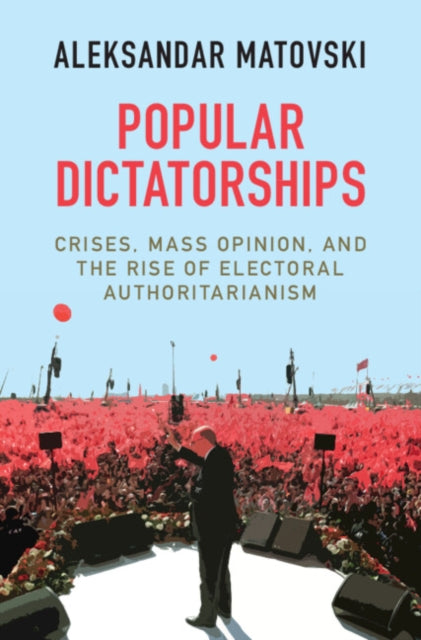
AleksandarMatovski
Popular Dictatorships: Crises, Mass Opinion, and the Rise of Electoral Authoritarianism
Popular Dictatorships: Crises, Mass Opinion, and the Rise of Electoral Authoritarianism
💎 Earn 179 Points (£1.79) on this item.
YOU SAVE £2.13
- Condition: Brand new
- UK Delivery times: Usually arrives within 2 - 3 working days
- UK Shipping: Fee starts at £2.39. Subject to product weight & dimension
Bulk ordering. Want 15 or more copies? Get a personalised quote and bigger discounts. Learn more about bulk orders.
Couldn't load pickup availability
- More about Popular Dictatorships: Crises, Mass Opinion, and the Rise of Electoral Authoritarianism
Electoral autocracies are the most widespread and resilient non-democracies today, ruling over a third of the world's countries. Popular Dictators argues that their success is due to their genuine popular appeal in countries experiencing deep political, economic, and security crises, making them the most significant threat to global peace and democracy.
Format: Hardback
Length: 316 pages
Publication date: 25 November 2021
Publisher: Cambridge University Press
Electoral autocracies, characterized by the adoption of democratic institutions but their subversion to rule as dictatorships, have emerged as the most prevalent, resilient, and malignant non-democracies today. These regimes have consistently held sway over a significant portion of the world's countries, including geopolitically significant states such as Russia, Turkey, Venezuela, Egypt, Indonesia, Nigeria, and Pakistan. Contrary to conventional beliefs, Popular Dictators challenges the notion that the success of electoral authoritarianism is solely attributed to these regimes' superior ability to repress, bribe, brainwash, and manipulate their societies into submission. Instead, the book argues that the appeal of these regimes stems from their genuine popularity among countries grappling with profound political, economic, and security crises. Elected strongmen promise efficient, strong-armed rule tempered by popular accountability, attracting widespread support in societies traumatized by turmoil, dysfunction, and injustice. By leveraging the ballot box, these strongmen are able to rule through legitimate means, presenting themselves as the solution to the crises plaguing their nations. Popular Dictators contends that this crisis legitimacy strategy makes electoral authoritarianism the most significant threat to global peace and democracy.
Introduction:
Electoral autocracies, characterized by the adoption of democratic institutions but their subversion to rule as dictatorships, have emerged as the most prevalent, resilient, and malignant non-democracies today. These regimes have consistently held sway over a significant portion of the world's countries, including geopolitically significant states such as Russia, Turkey, Venezuela, Egypt, Indonesia, Nigeria, and Pakistan. Contrary to conventional beliefs, Popular Dictators challenges the notion that the success of electoral authoritarianism is solely attributed to these regimes' superior ability to repress, bribe, brainwash, and manipulate their societies into submission. Instead, the book argues that the appeal of these regimes stems from their genuine popularity among countries grappling with profound political, economic, and security crises. Elected strongmen promise efficient, strong-armed rule tempered by popular accountability, attracting widespread support in societies traumatized by turmoil, dysfunction, and injustice. By leveraging the ballot box, these strongmen are able to rule through legitimate means, presenting themselves as the solution to the crises plaguing their nations. Popular Dictators contends that this crisis legitimacy strategy makes electoral authoritarianism the most significant threat to global peace and democracy.
The Rise of Electoral Autocracies:
Electoral autocracies have become increasingly prevalent in recent years, driven by a combination of factors. One of the primary drivers is the widespread perception that democratic institutions are ineffective and inefficient in addressing the complex challenges facing many countries. This perception is often reinforced by the failure of democratic governments to deliver on their promises of economic growth, social welfare, and security. In addition, political polarization and social unrest have also contributed to the rise of electoral autocracies. Many countries are experiencing deep divisions between different groups and communities, which can be exploited by authoritarian leaders to gain and maintain power. Furthermore, the global spread of information technology and social media has facilitated the spread of authoritarian ideologies and the mobilization of opposition groups.
The Popularity of Electoral Autocracies:
Despite their authoritarian nature, electoral autocracies have managed to maintain their grip on power by appealing to the masses. One of the key factors contributing to their popularity is the perception that they offer efficient, strong-armed rule tempered by popular accountability. Elected strongmen promise to address the pressing concerns of their citizens, such as economic inequality, political instability, and security threats. They also use populist rhetoric and social media to mobilize support and create a sense of belonging among their followers. In addition, electoral autocracies often benefit from the support of foreign powers, particularly those that share their authoritarian ideologies or have strategic interests in the region.
The Threat to Global Peace and Democracy:
Electoral autocracies pose a significant threat to global peace and democracy. One of the primary concerns is the erosion of democratic norms and institutions. Elected strongmen often undermine the rule of law, suppress freedom of expression, and curtail the rights of marginalized groups. This can lead to a breakdown of social cohesion and the emergence of authoritarianism. In addition, electoral autocracies can exacerbate regional and international conflicts. Authoritarian leaders often use their power to pursue their own interests, which can lead to tensions and conflicts with neighboring countries. Furthermore, electoral autocracies can undermine the international system of governance, particularly the United Nations and other international organizations.
Conclusion:
In conclusion, electoral autocracies have become the most widespread, resilient, and malignant non-democracies today. Their success is not solely attributed to their superior capacity to repress, bribe, brainwash, and manipulate their societies into submission, but is actually a product of their genuine popular appeal in countries experiencing deep political, economic, and security crises. Popular Dictators argues that this crisis legitimacy strategy makes electoral authoritarianism the most significant threat to global peace and democracy. It is essential to recognize the threat posed by these regimes and take steps to promote democratic governance and human rights. This includes supporting opposition groups, promoting civil society, and promoting the rule of law. By doing so, we can work towards a world where democracy is respected and protected, and where the rights and dignity of all individuals are upheld.
Weight: 592g
Dimension: 160 x 234 x 26 (mm)
ISBN-13: 9781316517802
This item can be found in:
UK and International shipping information
UK and International shipping information
UK Delivery and returns information:
- Delivery within 2 - 3 days when ordering in the UK.
- Shipping fee for UK customers from £2.39. Fully tracked shipping service available.
- Returns policy: Return within 30 days of receipt for full refund.
International deliveries:
Shulph Ink now ships to Australia, Belgium, Canada, France, Germany, Ireland, Italy, India, Luxembourg Saudi Arabia, Singapore, Spain, Netherlands, New Zealand, United Arab Emirates, United States of America.
- Delivery times: within 5 - 10 days for international orders.
- Shipping fee: charges vary for overseas orders. Only tracked services are available for most international orders. Some countries have untracked shipping options.
- Customs charges: If ordering to addresses outside the United Kingdom, you may or may not incur additional customs and duties fees during local delivery.