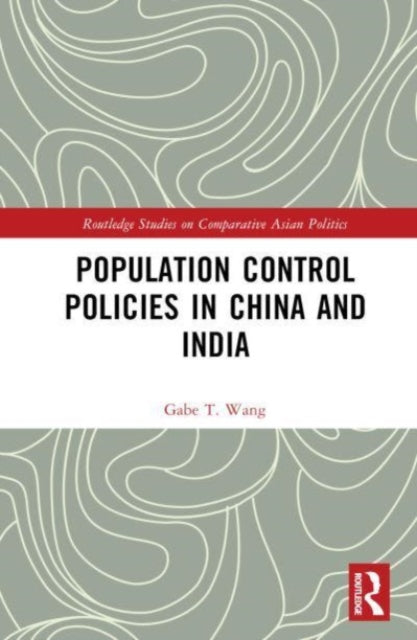
Gabe T.Wang
Population Control Policies in China and India: Comparisons with Social and Cultural Factors
Population Control Policies in China and India: Comparisons with Social and Cultural Factors
💎 Earn 811 Points (£8.11) on this item.
We can order this item for you. Delivery usually takes about 4 to 6 weeks.
This item is not held in our immediate stock. We will order it for you after checkout.
Estimated delivery: About 4 to 6 weeks
YOU SAVE £9.63
- Condition: Brand new
- UK Delivery times: Usually arrives within 2 - 3 working days
- UK Shipping: Fee starts at £3.89. Subject to product weight & dimension
Bulk ordering. Want 15 or more copies? Get a personalised quote and bigger discounts. Learn more about bulk orders.
Couldn't load pickup availability
- More about Population Control Policies in China and India: Comparisons with Social and Cultural Factors
China and India have implemented different population control policies to address their respective population issues. China's one-child policy has been effective in reducing population growth, while India's focus on maternal health and family planning has had a more comprehensive approach. Both policies have had impacts on social, economic, and environmental factors.
Format: Hardback
Length: 144 pages
Publication date: 14 July 2023
Publisher: Taylor & Francis Ltd
China and India, two of the world's most populous countries, have implemented various population control policies over the years to address the challenges posed by rapid population growth. This essay aims to compare and analyze the effectiveness of these policies in terms of their impact on population change and economic development.
China's population control policies have been in place for several decades. The country implemented a one-child policy in 1979, which restricted most couples to having one child. This policy was widely criticized for its coercive nature and its impact on women's rights and family dynamics. However, it was successful in reducing the country's population growth rate, which fell from 1.6% in 1979 to 0.4% in 2015.
India, on the other hand, has a more complex population control policy that includes a variety of measures, such as family planning programs, sex education, and incentives for smaller families. The country's population growth rate has been slower than China's, but it still poses significant challenges for economic development. In 2011, the government launched the National Family Planning Program, which aimed to provide access to family planning services and information to all couples. The program has been successful in increasing the use of contraceptives and reducing the birth rate, but it has also faced criticism for its coercive nature and its impact on women's rights.
One of the key differences between China's and India's population control policies is the level of government involvement. In China, the one-child policy was implemented at the national level and was enforced through coercive measures, such as fines and sterilizations. In contrast, India's population control policy is implemented at the state and local levels and includes a variety of measures, such as family planning programs, sex education, and incentives for smaller families.
Another difference between the two policies is the level of success they have achieved in reducing population growth. While China's one-child policy was successful in reducing the population growth rate, it also led to a significant gender imbalance and increased social and economic pressures on families. In contrast, India's population control policy has been more successful in reducing the birth rate, but it has also faced challenges in achieving its goals, such as resistance from religious and cultural groups.
Despite these differences, both China and India have faced similar challenges in terms of population growth and economic development. Both countries have large populations that put a strain on resources and infrastructure, and both countries have struggled to provide adequate healthcare, education, and employment opportunities for their citizens.
In conclusion, China and India's population control policies have had different levels of success in reducing population growth and achieving economic development. While China's one-child policy was successful in reducing the population growth rate, it also led to social and economic pressures on families and increased gender imbalances. In contrast, India's population control policy has been more successful in reducing the birth rate, but it has also faced challenges in achieving its goals and has faced resistance from religious and cultural groups. Both countries need to continue to work towards developing effective population control policies that balance the needs of their citizens and promote economic development.
Weight: 440g
Dimension: 234 x 156 (mm)
ISBN-13: 9781032309569
UK and International shipping information
UK and International shipping information
We deliver throughout the United Kingdom and to 128 countries and territories worldwide, including the United States, Australia, Canada, Germany, Spain and France.