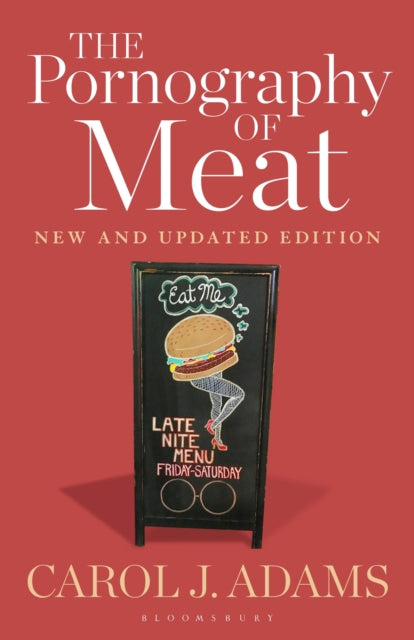
Carol J.Adams
Pornography of Meat: New and Updated Edition
Pornography of Meat: New and Updated Edition
💎 Earn 110 Points (£1.10) on this item.
We can order this item for you. Delivery usually takes about 4 to 6 weeks.
This item is not held in our immediate stock. We will order it for you after checkout.
Estimated delivery: About 4 to 6 weeks
YOU SAVE £2.88
- Condition: Brand new
- UK Delivery times: Usually arrives within 2 - 3 working days
- UK Shipping: Fee starts at £2.39. Subject to product weight & dimension
Bulk ordering. Want 15 or more copies? Get a personalised quote and bigger discounts. Learn more about bulk orders.
Couldn't load pickup availability
- More about Pornography of Meat: New and Updated Edition
The Pornography of Meat is a book by Carol J. Adams that explores the degrading interplay of language about women, domesticated animals, and meat in advertising, politics, and media. It includes more than 300 images and brings the book up to date to include expressions of misogyny in online media and advertising, the #MeToo movement, and the impact of Donald Trump and white supremacy on our political language.
Format: Paperback / softback
Length: 432 pages
Publication date: 29 October 2020
Publisher: Bloomsbury Publishing Plc
For over three decades, since the publication of her groundbreaking book "The Sexual Politics of Meat," Carol J. Adams and her readers have tirelessly documented and exposed the degrading interplay of language concerning women, domesticated animals, and meat in advertising, politics, and media. Serving as a sequel and visual companion to "The Sexual Politics of Meat," "The Pornography of Meat" charts the ongoing influence of this language and the ongoing fight against it. This new edition boasts over 300 images, most of which are new, and ensures that the book remains relevant by incorporating expressions of misogyny in online media and advertising, the #MeToo movement, and the impact of Donald Trump and white supremacy on our political language. Never has this book, or Adams's analysis, been more pertinent.
Introduction:
"The Sexual Politics of Meat" was a groundbreaking work that challenged the dominant narratives surrounding meat consumption and its relationship to gender and sexuality. It sparked a global conversation about the ways in which language and imagery shape our perceptions of meat and its role in our society. Since its publication, Carol J. Adams and her readers have continued to document and analyze the degrading interplay of language about women, domesticated animals, and meat in advertising, politics, and media.
"The Pornography of Meat" serves as a sequel and visual companion to "The Sexual Politics of Meat," continuing to explore the ongoing influence of this language and the fight against it. In this new edition, Adams and her team have compiled a wealth of information and images to illustrate the continued impact of this language on our society.
"The Pornography of Meat" includes over 300 images, most of which are new. These images provide a visual representation of the ways in which language about meat is used to objectify women, domesticated animals, and the environment. They also highlight the ways in which this language is used to promote violence and discrimination against women and animals.
The book also brings the reader up to date with the latest developments in the fight against this language. It includes discussions of the #MeToo movement, which has brought attention to the prevalence of sexual harassment and assault in the workplace, and the impact of Donald Trump and white supremacy on our political language.
"The Pornography of Meat" is a powerful and important book that provides a comprehensive analysis of the ways in which language about meat is used to perpetuate gender inequality and violence. It is a must-read for anyone who is interested in understanding the relationship between food, gender, and sexuality, and the ways in which these relationships are shaped by language and imagery.
The Degrading Interplay of Language:
Language about women, domesticated animals, and meat has been used to perpetuate a range of degrading and harmful stereotypes. In advertising, for example, meat is often portrayed as a symbol of masculinity and power, while women are depicted as subservient and passive. This language reinforces the idea that women are inferior to men and that they are not capable of making independent decisions about their food choices.
Similarly, domesticated animals are often portrayed as objects of pleasure and entertainment, while their treatment and welfare are often ignored. This language reinforces the idea that animals are not sentient beings with their own needs and desires, but rather tools for human use.
The degrading interplay of language about women, domesticated animals, and meat is not limited to advertising. It is also prevalent in politics and media. For example, political candidates and politicians often use language that reinforces gender stereotypes and reinforces the idea that women are not capable of holding positions of power.
Media outlets, including television, radio, and newspapers, also play a role in perpetuating these stereotypes. They often use imagery and language that objectify women and domesticated animals, and promote violence and discrimination against them.
The Fight Against This Language:
Despite the prevalence of this language, there have been ongoing efforts to fight against it. Activists, scholars, and artists have worked to challenge the dominant narratives surrounding meat consumption and its relationship to gender and sexuality.
One of the most notable efforts has been the #MeToo movement, which has brought attention to the prevalence of sexual harassment and assault in the workplace. The movement has led to a renewed focus on the ways in which language and imagery shape our perceptions of gender and sexuality, and has led to calls for change in the way that we communicate about these issues.
Another important initiative has been the work of feminist scholars and artists, who have challenged the ways in which language about meat is used to perpetuate gender inequality and violence. They have produced a range of works that explore the relationship between food, gender, and sexuality, and have challenged the dominant narratives surrounding meat consumption.
In addition to these efforts, there have been efforts to promote more sustainable and ethical meat production. This includes promoting plant-based diets and reducing meat consumption, as well as advocating for better treatment and welfare of domesticated animals.
Conclusion:
"The Pornography of Meat" is a powerful and important book that provides a comprehensive analysis of the ways in which language about meat is used to perpetuate gender inequality and violence. It is a must-read for anyone who is interested in understanding the relationship between food, gender, and sexuality, and the ways in which these relationships are shaped by language and imagery.
The fight against this language is ongoing, and there is still much work to be done. However, by continuing to document and expose the degrading interplay of language about women, domesticated animals, and meat, and by promoting more sustainable and ethical meat production, we can work towards creating a more just and equitable society.
In conclusion, "The Pornography of Meat" is a groundbreaking work that provides a comprehensive analysis of the ways in which language about meat is used to perpetuate gender inequality and violence. It is a must-read for anyone who is interested in understanding the relationship between food, gender, and sexuality, and the ways in which these relationships are shaped by language and imagery. By continuing to document and expose the degrading interplay of language about women, domesticated animals, and meat, and by promoting more sustainable and ethical meat production, we can work towards creating a more just and equitable society.
Weight: 604g
Dimension: 140 x 215 x 28 (mm)
ISBN-13: 9781501364396
Edition number: 2 ed
UK and International shipping information
UK and International shipping information
UK Delivery and returns information:
- Delivery within 2 - 3 days when ordering in the UK.
- Shipping fee for UK customers from £2.39. Fully tracked shipping service available.
- Returns policy: Return within 30 days of receipt for full refund.
International deliveries:
Shulph Ink now ships to Australia, Belgium, Canada, France, Germany, Ireland, Italy, India, Luxembourg Saudi Arabia, Singapore, Spain, Netherlands, New Zealand, United Arab Emirates, United States of America.
- Delivery times: within 5 - 10 days for international orders.
- Shipping fee: charges vary for overseas orders. Only tracked services are available for most international orders. Some countries have untracked shipping options.
- Customs charges: If ordering to addresses outside the United Kingdom, you may or may not incur additional customs and duties fees during local delivery.