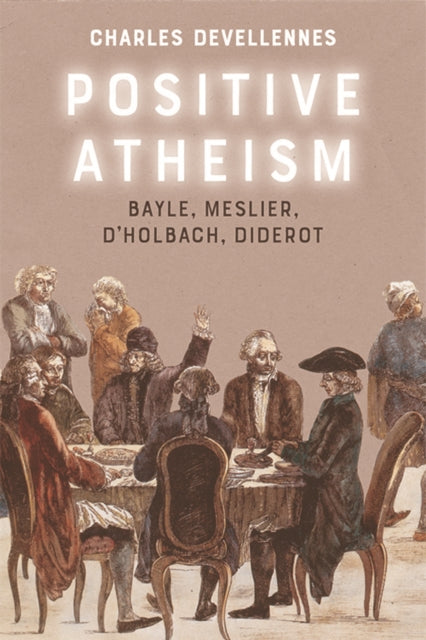
Charles Devellennes
Positive Atheism: Bayle, Meslier, d'Holbach, Diderot
Positive Atheism: Bayle, Meslier, d'Holbach, Diderot
💎 Earn 88 Points (£0.88) on this item.
YOU SAVE £5.36
- Condition: Brand new
- UK Delivery times: Usually arrives within 2 - 3 working days
- UK Shipping: Fee starts at £3.89. Subject to product weight & dimension
Bulk ordering. Want 15 or more copies? Get a personalised quote and bigger discounts. Learn more about bulk orders.
Couldn't load pickup availability
- More about Positive Atheism: Bayle, Meslier, d'Holbach, Diderot
Charles Devellennes' book explores the evolution of atheism as a political philosophy in French Enlightenment thinkers, from negative atheism to positive atheism and eventually metatheism. It examines the works of Pierre Bayle, Jean Meslier, Paul-Henri Thiry d Holbach, and Denis Diderot and shows how their arguments for atheism had profound consequences for political thought and the rise of republicanism.
Format: Paperback / softback
Length: 240 pages
Publication date: 30 November 2022
Publisher: Edinburgh University Press
The evolution of atheism as a political philosophy during the French Enlightenment is a fascinating and complex topic that requires careful examination. This essay will explore the development of positive atheism among French thinkers, as well as the broader context of the history of atheism.
Written from the perspective of atheists or those sympathetic to atheism, as opposed to the perspective of theologians, this essay will explore the larger context of the history of atheism, from the negative atheism of the ancient Greeks to the positive atheism of the modern era. It will also examine the profound consequences of atheism for political thought, as atheists defended republicanism and other political ideologies.
One of the most important figures in the development of positive atheism was Pierre Bayle. In his work, "Essais sur la nature et les causes de la richesse des nations," Bayle argued that atheism was not only compatible with morality but also necessary for the progress of society. He believed that religion was a source of superstition and that science was the only way to understand the world.
Jean Meslier, another key figure in the development of positive atheism, was a French philosopher who was known for his advocacy of reason and skepticism. Meslier believed that religion was a product of human imagination and that it had no basis in reality. He argued that the only way to establish a just society was through the use of reason and that religion was a hindrance to progress.
Paul-Henri Thiry d'Holbach, a French philosopher and chemist, was another important figure in the development of positive atheism. Like Meslier, d'Holbach believed that religion was a product of human imagination and that it had no basis in reality. He argued that the only way to establish a just society was through the use of reason and that religion was a hindrance to progress.
Denis Diderot, perhaps the most famous French philosopher of the Enlightenment, was a strong advocate of atheism. In his work, "Encyclopédie," Diderot argued that religion was a source of superstition and that science was the only way to understand the world. He also argued that the only way to establish a just society was through the use of reason and that religion was a hindrance to progress.
The evolution of atheism from negative atheism to positive atheism had profound consequences for political thought. Atheists were able to defend republicanism and other political ideologies without relying on religious beliefs. This allowed for a more secular and rational approach to politics, which was a hallmark of the French Enlightenment.
However, the development of positive atheism also had its challenges. Atheists were often accused of being immoral or anti-social, and they faced opposition from religious conservatives who saw atheism as a threat to their beliefs. This led to a sense of isolation and marginalization for atheists, who were often excluded from social and political life.
Despite these challenges, the development of positive atheism had a lasting impact on the history of ideas. Atheism became a self-aware philosophy, and atheists were able to develop their own ethical system without relying on religious beliefs. This allowed for a more secular and rational approach to politics, which was a hallmark of the French Enlightenment.
In conclusion, the evolution of atheism as a political philosophy during the French Enlightenment was a fascinating and complex topic that required careful examination. Atheism evolved from negative atheism to positive atheism, with profound consequences for political thought and the development of a more secular and rational approach to politics. While atheists faced challenges and opposition, their contributions to the history of ideas were invaluable, and their legacy continues to be felt today.
Dimension: 216 x 138 (mm)
ISBN-13: 9781474478441
UK and International shipping information
UK and International shipping information
We deliver throughout the United Kingdom and to 128 countries and territories worldwide, including the United States, Australia, Canada, Germany, Spain and France.