Alessandro Ludovico
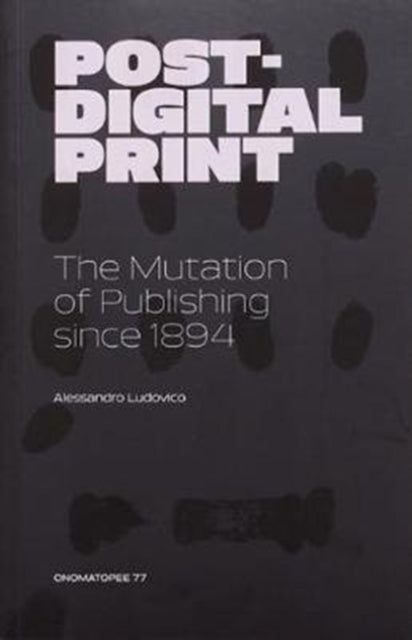
Post-Digital Print, The Mutation of Publishing since 1894
Post-Digital Print, The Mutation of Publishing since 1894
💎 Earn 83 Points (£0.83) on this item.
YOU SAVE £3.34
- Condition: Brand new
- UK Delivery times: Usually arrives within 2 - 3 working days
- UK Shipping: Fee starts at £2.39. Subject to product weight & dimension
Bulk ordering. Want 15 or more copies? Get a personalised quote and bigger discounts. Learn more about bulk orders.
Couldn't load pickup availability
- More about Post-Digital Print, The Mutation of Publishing since 1894
Digital technology has transformed music, film, and books, but book and magazine publishing is still in the early stages of this transformation. Alessandro Ludovico's book explores the history of avant-garde arts as a prehistory of cutting through the dichotomy between paper and electronics in the post-digital age.
Format: Paperback / softback
Length: 192 pages
Publication date: 30 September 2018
Publisher: Onomatopee
Digital technology has become an integral part of our daily lives, transforming music, film, and books into digital formats. However, the publishing industry has only recently begun to embrace this transformation. Avant-garde artists, activists, and technologists have long envisioned a world where publishing is networked and electronic, and electronic publishing has now become a reality. Alessandro Ludovico, the editor and publisher of Neural, a magazine for critical digital culture and media arts, reexamines the history of the avant-garde arts as a prehistory of breaking down the divide between paper and electronics. With over 20 years of experience in print publishing and politically engaged digital art, Ludovico is at the forefront of both print publishing and digitally engaged art.
In the post-digital age of publishing, the question of how the analog and digital will coexist is crucial. Will they remain separate entities, or will they merge and cross over? This book explores the possibilities of this transition and the challenges it presents.
One of the key challenges of digital publishing is the preservation of digital content. With the constant evolution of technology, digital files can become obsolete or inaccessible over time. This has led to the development of various preservation strategies, such as digital archiving, digital preservation, and digital rights management. Digital archiving involves the long-term storage of digital files in a secure and accessible location, while digital preservation involves the maintenance of the integrity and authenticity of digital files over time. Digital rights management involves the control and management of the rights associated with digital content, such as the right to access, use, and distribute.
Another challenge of digital publishing is the impact on the publishing industry. Traditional publishing models are based on the sale of physical books and magazines, and the transition to digital publishing has disrupted this model. Publishers have had to adapt to new business models, such as subscription-based models, e-book sales, and digital advertising. This has led to a shift in the way that books and magazines are produced, distributed, and consumed.
Despite these challenges, digital publishing has also brought many benefits to the publishing industry. It has made books and magazines more accessible to a wider audience, and it has enabled authors to reach a global audience more easily. It has also allowed publishers to experiment with new formats and styles, and to reach new markets.
However, digital publishing has also raised some concerns about the impact on the environment. The production of digital content requires a significant amount of energy, and the disposal of electronic devices can have negative environmental consequences. This has led to the development of sustainable publishing practices, such as the use of recycled paper and the reduction of paper waste.
In conclusion, digital technology has transformed the publishing industry, and the transition to digital publishing is still ongoing. While there are many challenges to be faced, there are also many benefits to be gained. By reexamining the history of the avant-garde arts as a prehistory of breaking down the divide between paper and electronics, Alessandro Ludovico provides a valuable insight into the possibilities of this transition and the challenges it presents.
Weight: 356g
Dimension: 142 x 215 x 16 (mm)
ISBN-13: 9789491677946
Edition number: 3 ed
This item can be found in:
UK and International shipping information
UK and International shipping information
UK Delivery and returns information:
- Delivery within 2 - 3 days when ordering in the UK.
- Shipping fee for UK customers from £2.39. Fully tracked shipping service available.
- Returns policy: Return within 30 days of receipt for full refund.
International deliveries:
Shulph Ink now ships to Australia, Belgium, Canada, France, Germany, Ireland, Italy, India, Luxembourg Saudi Arabia, Singapore, Spain, Netherlands, New Zealand, United Arab Emirates, United States of America.
- Delivery times: within 5 - 10 days for international orders.
- Shipping fee: charges vary for overseas orders. Only tracked services are available for most international orders. Some countries have untracked shipping options.
- Customs charges: If ordering to addresses outside the United Kingdom, you may or may not incur additional customs and duties fees during local delivery.