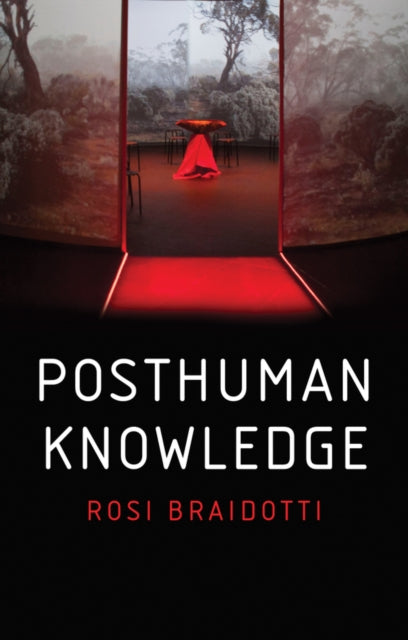
Rosi Braidotti
Posthuman Knowledge
Posthuman Knowledge
YOU SAVE £2.17
- Condition: Brand new
- UK Delivery times: Usually arrives within 2 - 3 working days
- UK Shipping: Fee starts at £3.89. Subject to product weight & dimension
Bulk ordering. Want 15 or more copies? Get a personalised quote and bigger discounts. Learn more about bulk orders.
Couldn't load pickup availability
- More about Posthuman Knowledge
The displacement of anthropomorphism and the radical critiques of humanism have challenged the definition of the human and the humanities. Posthuman Knowledge, by Rosi Braidotti, argues that the human was never neutral but always linked to power and privilege. It calls for a multi-layered and multi-directional project to displaces anthropocentrism while analyzing the discriminatory and violent aspects of human activity and interaction. The posthuman convergence encourages us to think hard and creatively about what we are in the process of becoming.
Format: Paperback / softback
Length: 210 pages
Publication date: 28 June 2019
Publisher: Polity Press
The question of what defines the human, and of what is human about the humanities, has been profoundly shaken up by the radical critiques of humanism and the displacement of anthropomorphism that have gained currency in recent years. This shift has been propelled in part by rapid advances in our knowledge of living systems and their genetic and algorithmic codes, coupled with the global expansion of a knowledge-intensive capitalism. In her book, Posthuman Knowledge, Rosi Braidotti takes a closer look at the impact of these developments on three major areas: the constitution of our subjectivity, the general production of knowledge, and the practice of the academic humanities. Drawing on feminist, postcolonial, and anti-racist theory, Braidotti argues that the human was never a neutral category but one always linked to power and privilege. Hence, we must move beyond the old dualities in which Man defined himself, beyond the sexualized and racialized others that were excluded from humanity.
Posthuman knowledge, as Braidotti understands it, is not so much an alternative form of knowledge as a critical call. It is a call to build a multi-layered and multi-directional project that displaces anthropocentrism while pursuing the analysis of the discriminatory and violent aspects of human activity and interaction wherever they occur. Situated between the exhilaration of scientific and technological advances on the one hand and the threat of climate change devastation on the other, the posthuman convergence encourages us to think hard and creatively about what we are in the process of becoming.
One of the key insights of Posthuman Knowledge is that the human is not a fixed entity but a fluid and dynamic construct. Braidotti argues that we are in the process of becoming posthuman, a species that is shaped by our interactions with technology, biology, and other living systems. This shift is not linear but rather a complex and multifaceted process that involves the blurring of boundaries between the human and non-human, the natural and artificial, and the material and immaterial.
In terms of the constitution of our subjectivity, Braidotti suggests that we must move beyond the traditional notion of the individual subject as a coherent and autonomous entity. Instead, we should recognize that our subjectivity is shaped by a range of factors, including our genetic makeup, our social and cultural experiences, and the technologies that we use. Braidotti argues that we are not passive recipients of knowledge but active agents who shape and transform it through our interactions with the world.
Another important aspect of Posthuman Knowledge is the general production of knowledge. Braidotti argues that the traditional model of knowledge production, which is based on the notion of the individual subject as a knower, is no longer sufficient. Instead, we should recognize that knowledge is produced through a network of actors and institutions, including scientists, researchers, artists, and activists. This shift requires us to think about the ways in which knowledge is distributed, shared, and contested, and to develop new strategies for promoting access to knowledge and promoting the democratization of knowledge production.
In terms of the practice of the academic humanities, Braidotti suggests that we must move beyond the traditional focus on the study of human culture and history. Instead, we should recognize that the humanities are embedded in a broader social and political context and that they are shaped by a range of factors, including economic, political, and social structures. Braidotti argues that the academic humanities have a critical role to play in promoting social justice, challenging power structures, and promoting a more inclusive and equitable society.
Overall, Posthuman Knowledge is a thought-provoking and challenging book that provides a new perspective on the human and the humanities. It challenges us to think beyond the traditional boundaries of our discipline and to consider the ways in which our knowledge, our subjectivity, and our practices are shaped by the rapidly changing world around us. By doing so, we can develop new strategies for promoting social justice, challenging power structures, and promoting a more inclusive and equitable society.
Weight: 310g
Dimension: 215 x 168 x 18 (mm)
ISBN-13: 9781509535262
UK and International shipping information
UK and International shipping information
We deliver throughout the United Kingdom and to 128 countries and territories worldwide, including the United States, Australia, Canada, Germany, Spain and France.